 German / Deutsch
  English
  French / Français
  Spanish / Español
  Dutch / Nederlands
  Italian / Italiano
  Polish / Polski
  Norwegian / Norsk
  Danish / Dansk
  Finnish / Suomi
  Swedish / Svenska
  Czech / Česky
  Greek / Ελληνικά
  Slovak / Slovenčina
  Slovenian / Slovenščina
  Estonian / Eesti
  Latvian / Latviešu
  Lithuanian / Lietuvių
  Hungarian / Magyar
  Romanian / Română
  Bulgarian / Български
  Portuguese / Português
 -
You do not have any products in your shopping cart yet.
Technical cable knowledge from A to Z
Cable Encyclopaedia – Cables, Plugs, Connectors & Standards
MAG’s Cable Glossary brings together technical knowledge on power cables, IEC 60320 appliance connectors, country-specific plugs, cable designations, conductor cross-sections, AWG, USB-C, USB4, certification marks and specialised cable applications. This makes it easy to quickly identify and locate technical differences, connector systems and relevant specialist information.
Key topics: Power cables & IEC 60320 · international mains plugs · cable construction & cross-sections · USB-C & data cables · test marks · specialised cable applications
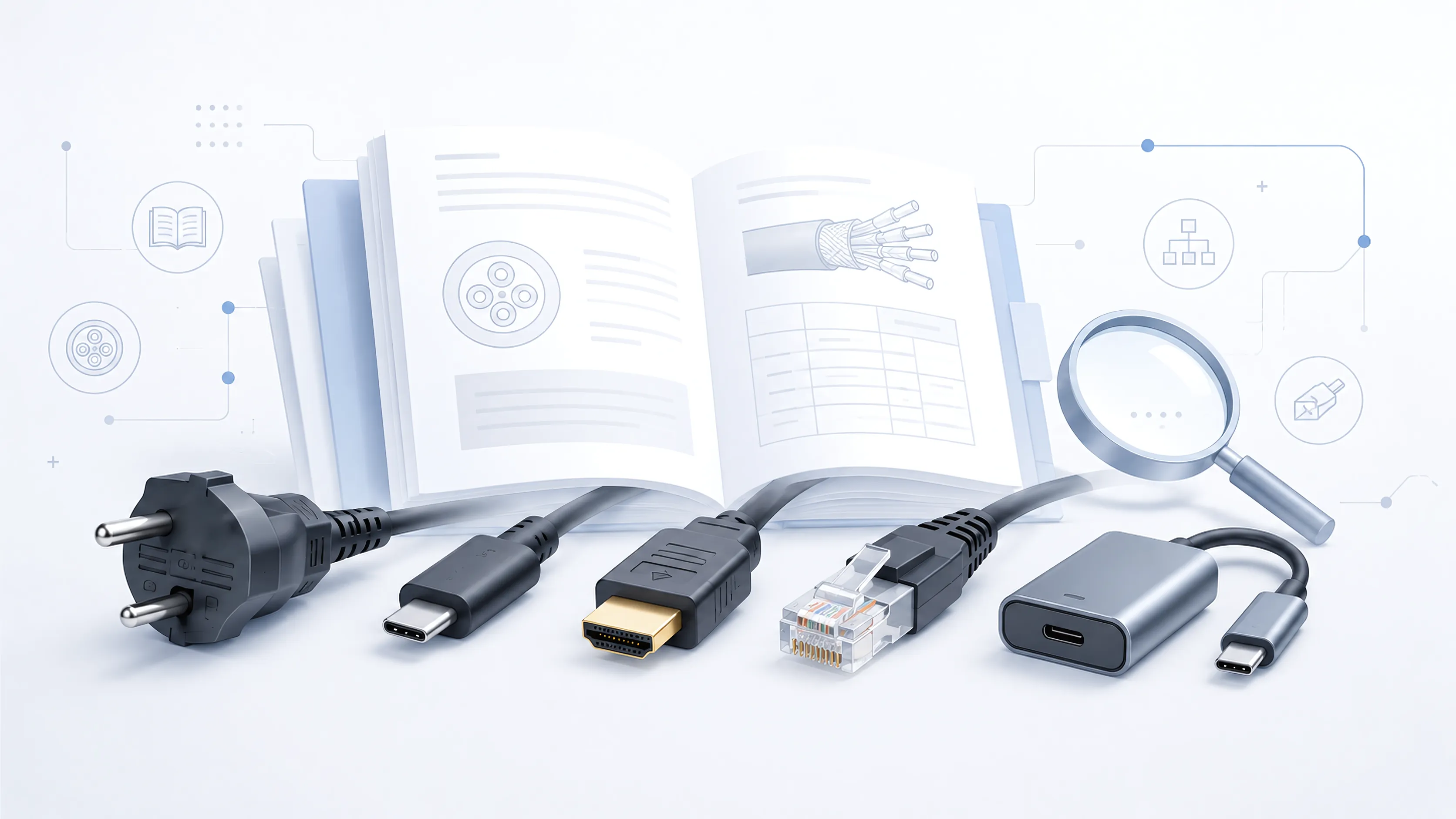
Cable Encyclopaedia: Cable Knowledge from A to Z
Practical selection guide
 Finding a power cable or IT extension cable
Looking for a power cable or an extension lead for low-voltage equipment?
If you’re not yet sure exactly which cable type you need, the MAG Cable Finder can help you narrow down your options. First, you need to decide whether you require a power cable from the socket to the device or an extension lead for low-voltage equipment between IEC connectors.
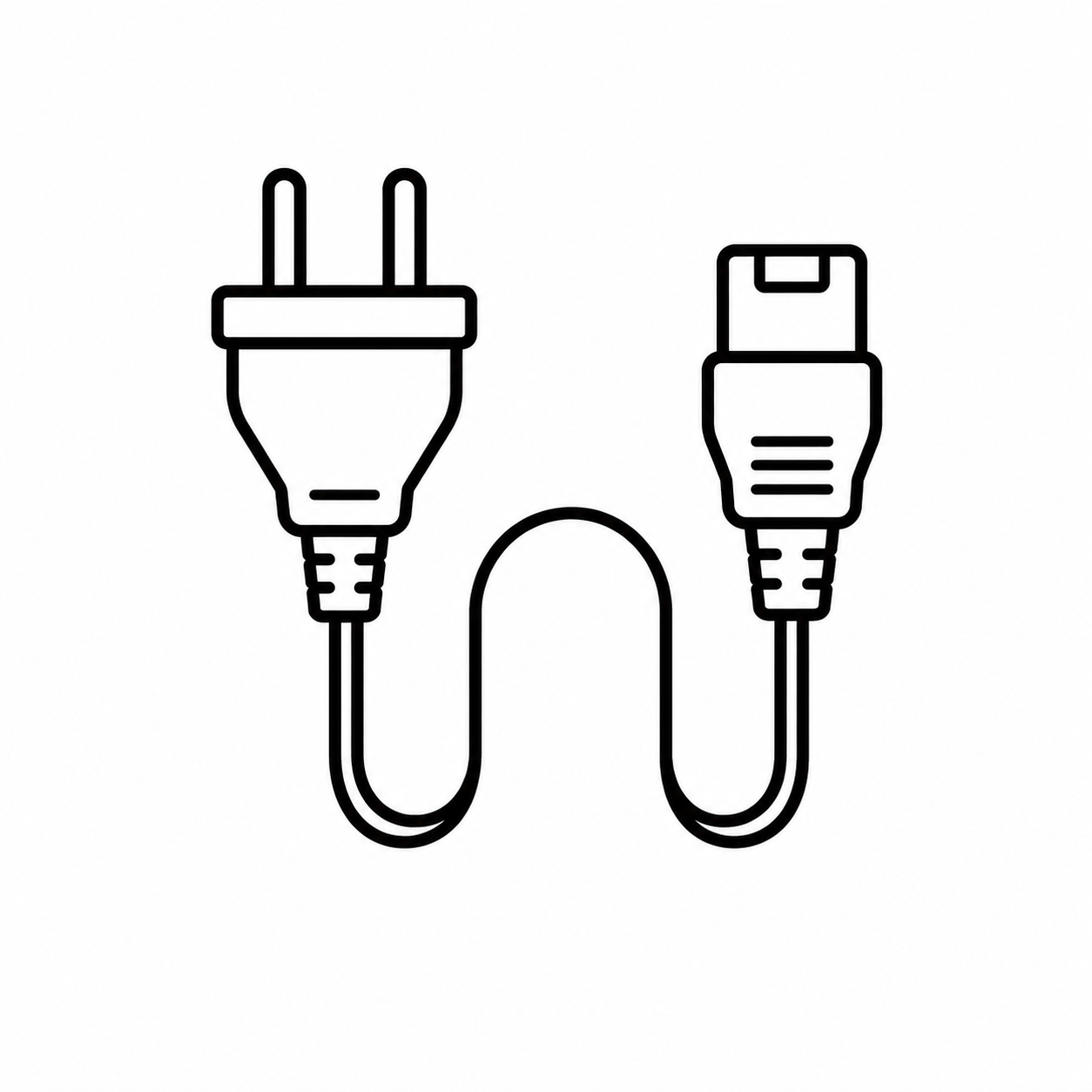
Mains cable: Country-specific plug to device connection – for example, Germany, USA, UK, Switzerland or India to IEC C13.
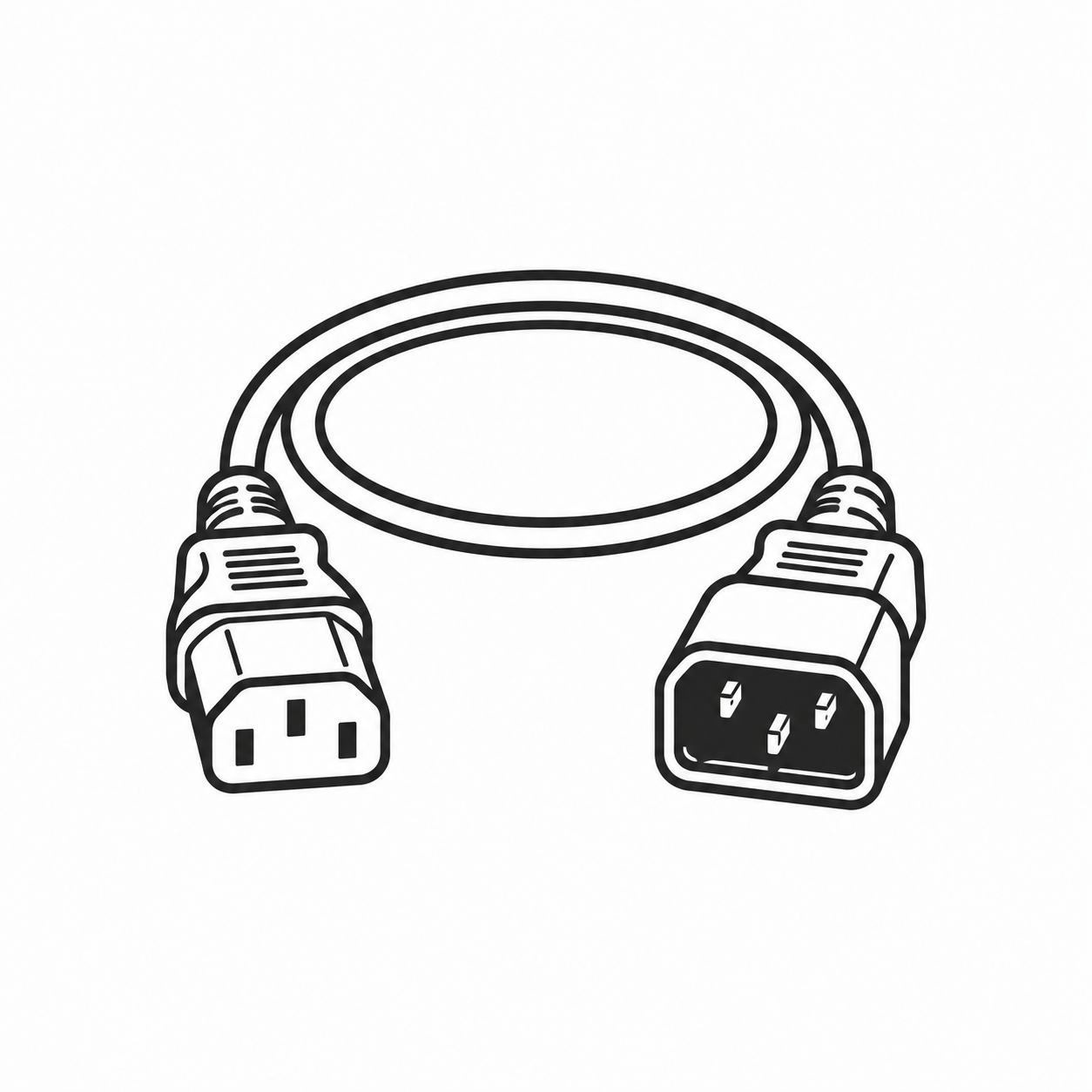
Equipment extension cable: IEC connection between devices, PDUs, UPSs or IT components – for example, C13/C14 or C19/C20.
Mains cables, appliance plugs & IEC 60320
When considering power cables and appliance leads, the mains side, the appliance connection and the cable itself must be assessed together. IEC 60320 covers commonly used plug types such as C7/C8, C5/C6, C13/C14, C15/C16, C17/C18, C19/C20 and other variants.
IEC 60320 appliance plugs in accordance with IEC 60320: C7/C8, C5/C6, C13/C14, C15/C16, C17/C18, C19/C20 and other IEC connectors at a glance. Compatibility of C13, C15 & C17 Differences, protective earth and compatibility of similar-looking IEC appliance couplings. Choosing between C13, C15 or C19? Correctly classifying IEC connections for low-voltage equipment, high-voltage equipment and higher-power applications. International C13/C14 with multiple approvals International approvals and the advantages of multi-approved C13/C14 extension leads for low-voltage equipment. Conductor cross-sectional area 0.75 / 1.0 / 1.5 mm² Conductor cross-sectional areas for mains cables and the significance of load, cable length and cable type. AWG and mm² Classifying AWG 18, AWG 16 and AWG 14 and comparing them with metric conductor sizes. Cable types: Understanding cable designations H05VV-F, H07RN-F, 3G1.5, Correctly identify the number of cores, protective earth and sheath materials. LSZH Halogen-free mains cables Classify LSZH cables, smoke emission, fire gases and typical areas of application. Cable security: Securing power cables against being pulled out Options for securing C13, C19 and other IEC connections. Practical question: Power cable or adapter? When a country-specific power cable is more appropriate than an adapter solution.
International power cables, country-specific plugs & target markets
International power cables are not selected solely on the basis of the shape of the mains plug. In addition, mains voltage, the protective earth conductor, cable type, current-carrying capacity, IEC appliance connections and market-specific approvals can be decisive factors in the selection process.
Power plugs & plug types A–O worldwide Country-specific plugs, target markets, mains conditions and key international plug systems. USA US power cables & NEMA Type A, Type B, NEMA 1-15P, NEMA 5-15P, AWG and North American specifics. USA / Canada NEMA 6-20P – 20 A / 250 V NEMA 6-20P, IEC C13 and C19, AWG14/AWG12, and the current-carrying capacity of North American 250 V power cables. Japan Japanese power cables Type A and Type B, 100 V, 50/60 Hz, and differences compared to US power cables. India Type C, Type D & Type M Indian power plugs, current-carrying capacity and important information for projects in India. Switzerland Swiss power cables Type J, Type 12/13, Type 23, and the distinction between 10 A and 16 A applications. Philippines: Power cables for the Philippines Type A, B and, in some cases, C; mains conditions; and the selection of suitable connection cables.
Important note regarding international power cables: A power plug that fits mechanically does not automatically mean that the entire power cable is suitable for the relevant target market. The technical specifications, markings and approvals of the specific product are decisive.
USB-C, USB4, Thunderbolt & data cables
With modern data cables, the connector type alone is not sufficient for selection. With USB-C in particular, the data rate, charging power, Power Delivery, video transmission, E-marker and supported standard may vary.
Certification marks & specialised cable applications
In addition to connector type, cable construction and cross-section, certifications and specific operating environments can be decisive factors in the technical selection of a cable.
ENEC / VDE ENEC certification for mains cables Clearly explain ENEC, VDE compliance and how this differs from CE marking. USA / Canada Hospital-grade power cables Requirements, Green Dot, NEMA 5-15P Hospital Grade, IEC C13, and UL and CSA aspects for North American applications. Data Centre OCP AC Power Cables Power cables for Open Rack V3 and modern data centre infrastructure. Multi-Approval International C13/C14 Cable Series Multiple international approvals within a single cable series.
Key cable terms explained briefly
These brief definitions enable a quick initial understanding of technical terms. Detailed technical pages are available for many topics, providing further technical information, selection guides and examples.
- Mains cable
- Connection cable between the mains supply and an electrical appliance. Selection criteria include mains plug, appliance connection, cable type, cross-section, length, current-carrying capacity and, where applicable, approvals. Find the right power cable →
- IEC extension lead
- A connection cable with IEC plugs on both ends, for example C13 to C14 or C19 to C20. It connects appliances or power distribution units to one another. Select a cold appliance extension cable →
- IEC 60320
- An internationally used system for appliance connectors. Common combinations include C7/C8, C5/C6, C13/C14, C15/C16 and C19/C20. IEC 60320 explained in detail →
- IEC C13
- A widely used low-voltage connector with a protective earth conductor. Its standard counterpart is IEC C14. Compare C13, C15 and C17 →
- IEC C15
- Plug for high-temperature applications with a protective earth conductor. The standard counterpart is IEC C16. Differences between C13, C15 and C17 →
- IEC C19
- Larger IEC appliance plug for correspondingly higher-power applications. The standard counterpart is IEC C20. Compare C13, C15 or C19 →
- AWG
- American Wire Gauge is a system for specifying conductor sizes, used in particular for North American cables. AWG and mm² explained in detail →
- H05VV-F
- Harmonised cable designation. The individual characters provide information on, amongst other things, the rated voltage, insulation and sheathing materials, and conductor construction. Understanding cable designations →
- 3G1.5
- Three conductors, including a protective conductor, each with a nominal cross-sectional area of 1.5 mm². The conductor cross-sectional areas are not added together to give a total cable cross-sectional area. 3G1.5 and other designations →
- Conductor cross-sectional area
- The conductor cross-section is specified in mm² for many mains cables. Typical values include, for example, 0.75 mm², 1.0 mm² or 1.5 mm². Compare mains cable cross-sections →
- LSZH
- Term used for halogen-free cables or low-smoke cables. The specific material and fire properties must be checked for each individual product. More on LSZH and halogen-free cables →
- USB-C
- USB-C primarily refers to the shape of the connector. Data transfer rates, charging capacity, video and Power Delivery depend on the cable and the connected devices. Choosing the right USB-C cable →
- USB4
- USB4 is a modern transmission standard for data, video and other signals via USB-C. Not every USB-C cable automatically supports all USB4 functions. Compare USB4 and Thunderbolt →
- Country-specific plugs
- Mains plugs vary internationally in terms of design, rated values and standards. When selecting a plug, the target market and the complete connection cable must be checked. Mains plugs worldwide A–O →
Cable knowledge A–Z – an overview of all specialist pages
This alphabetical directory brings together the cable-related knowledge and content pages on mag-kabel.de. It allows you to quickly find existing specialist information on cables, connectors, standards, country-specific plugs and data interfaces.
C
K
N
Frequently asked questions about cables and connectors
How do I find the right power cable?
First, the target market and mains plug type are determined. This is followed by the device connection, earth conductor, power requirements, cable length, cross-section, cable type and required approvals. The MAG Cable Finder is available to assist with this initial selection.
What is the difference between a mains cable and an IEC extension lead?
A mains cable usually connects a mains socket to the device’s mains connection. An extension lead for low-voltage equipment, on the other hand, has IEC connectors at both ends, for example C13 to C14.
What is IEC 60320?
IEC 60320 refers to an internationally used system of appliance connectors. These include, amongst others, C7/C8, C5/C6, C13/C14, C15/C16, C17/C18 and C19/C20.
What do 0.75 mm², 1.0 mm² and 1.5 mm² mean in relation to power cables?
This specification describes the nominal cross-sectional area of a single conductor. The appropriate cross-sectional area for a cable depends, amongst other things, on the load, length, conductor type and specific cable design.
What does H05VV-F 3G1.5 mean?
H05VV-F is a harmonised cable designation. 3G1.5 refers to three conductors, including the protective conductor, each with a nominal cross-sectional area of 1.5 mm².
Are all USB-C cables the same?
No. USB-C primarily refers to the shape of the connector. USB-C cables can differ significantly in terms of data rate, charging power, Power Delivery, video support and other technical characteristics.
Is the correct plug type sufficient for international mains cables?
No. Additional factors to be taken into account include the target market, protective earth conductor, mains parameters, current-carrying capacity, cable type, device connection and any required product-specific approvals.
Determining the appropriate cable type
If the mains side or IEC device connection has not yet been clearly defined, the MAG Cable Finder can narrow down the selection to suitable mains cables or extension leads for audio/video equipment.