 German / Deutsch
 English
 French / Français
 Spanish / Español
 Dutch / Nederlands
 Italian / Italiano
 Polish / Polski
 Norwegian / Norsk
 Danish / Dansk
 Finnish / Suomi
 Swedish / Svenska
 Czech / Česky
 Greek / Ελληνικά
 Slovak / Slovenčina
 Slovenian / Slovenščina
 Estonian / Eesti
 Latvian / Latviešu
 Lithuanian / Lietuvių
 Hungarian / Magyar
 Romanian / Română
 Bulgarian / Български
 Portuguese / Português
Power cable – Rest of the world
In this category, MAG GmbH’s B2B customers will find a selection of mains connection cables for specific countries, international equipment and less common plug systems. The cables are suitable for, amongst other things, export projects, OEM equipment, roll-outs, service calls and spare parts stock.
Depending on the target market, pre-assembled versions with country-specific mains plugs and standard equipment connectors such as IEC 60320 C13, C5 or C7 are available. In addition to mechanical compatibility, the mains voltage, frequency, conductor cross-section, protection class, current-carrying capacity and the certification required in the target country must always be taken into account.
A suitable country-specific power lead simplifies the standardised fitting of equipment and avoids the need for unnecessary adaptor solutions at the point of use.
MAG stocks technically suitable connection cables for both countries. However, local market approval must be considered separately from existing product approval.
In Chile, the three-pin Type L plug is frequently used for earthed applications. Consequently, an Italian Type L mains lead may provide a suitable mechanical and electrical basis for equipment intended for use in Chile.
In Colombia, Type A and Type B plugs are common. For Class I appliances, the earthed Type B or NEMA 5-15P version is generally required. MAG stocks suitable North American connection cables for this purpose.
The following information is intended as a general guide. For export and mass-production projects, the specific device and approval status should always be assessed on a project-by-project basis.
In Libya, different plug systems are used and mains conditions vary depending on the region or installation. Italian Type L versions may be relevant, but must not be planned as a universal solution without prior verification.
Relevant categories: Power cables Italy / Type L | International power adaptors
In these markets, Type G plugs in accordance with BS 1363 are used. A characteristic feature is the fuse integrated into the mains plug, the rated value of which must match the cable and the connected appliance.
Relevant categories: Power cables for England / Type G | International power cables
In Syria and Turkey, European plug systems are frequently used in practice. For earthed appliances, the CEE 7/7 Type E+F plug is often relevant, as it combines both types of earthed plug.
Relevant categories: National power cables / CEE 7/7 | International power adaptors
In the Philippines, Type A and Type B plugs are most commonly found in practice, and Type C is also occasionally used. Despite similar plug shapes, US or Japanese power cables are not automatically an officially approved solution for the Philippine market.
Further reading: Information on Philippine power cables | Power adaptors for the USA and Japan
Taiwanese power cables may resemble North American Type B cables in appearance. However, for regular use, the Taiwanese BSMI approval must be observed. The conductor cross-section, cable marking and device design may also differ from a standard US version.
Related links: US power cables | Taiwanese Type B to C13 power cables with BSMI
To ensure a reliable product selection, you should be aware of at least the following points:
Further categories: International power cables | International power adaptors | Project enquiry to MAG
Mains cables – Rest of the world for export, projects and international procurement
Advantages and typical applications of international power cables
Your benefits at a glance
Typical applications
Specific country notes: Chile and Colombia
 Chile – Type L, 220 V / 50 Hz
 Colombia – Type A/B, 120 V / 60 Hz
Other countries and suitable alternative categories
 Libya


 Ireland, Singapore and Malaysia

 Syria and Turkey
 Philippines: Do not equate A/B plugs with US approval
 Taiwan: Type B design with its own BSMI approval
How to select the right export power cable

Which plug for which country?
In international projects, the question often arises as to which mains plug must be used in the respective country. In some countries – for example, Austria, Belgium, the Netherlands and, in many cases, France as well – sockets are generally used that correspond to or are compatible with the CEE 7/7 system used in Germany.
In Italy (IT) and Switzerland (CH), the following applies: depending on the application, 2-pin power cables may in some cases be comparable to those commonly used in Germany; however, 3-pin variants generally feature different plug systems. Furthermore, many countries worldwide have their own standards, such as Denmark (DK), England (UK), the USA, Japan (JPN), China (CHN), Australia (AUS), Israel (ISR), South Africa (RSA) and India (IND).
In many cases comparable to Germany
- CEE 7/7 is common in several European markets.
- Typical examples: Austria, Belgium, the Netherlands.
- In France, too, compatible solutions are relevant depending on the device and application.
Take note of country-specific features
- Italy and Switzerland differ in particular with regard to 3-pin mains cables.
- Many international markets require their own plug systems and, in some cases, their own approvals.
- The destination country, appliance plug, standard and cable design are decisive factors in the selection process.
Conclusion
Mains plugs and connection standards are not uniform internationally – not even within Europe. To ensure a smooth installation, it is therefore always advisable to base your selection on the destination country, the appliance plug, the approval and the cable design.
If no standard product is directly suitable, mag-kabel.de can assist with selecting suitable alternatives and with project-specific custom solutions.
Alternative links: International power cables | National power cables (CEE 7/7) | International power adaptors | Power cables for England (UK) | Power cables for the USA | Power cables for Switzerland (CH) | Power cables for Italy (IT)
For export projects, roll-outs or country-specific requirements, the MAG GmbH team will assist you in selecting suitable power cables and alternatives.
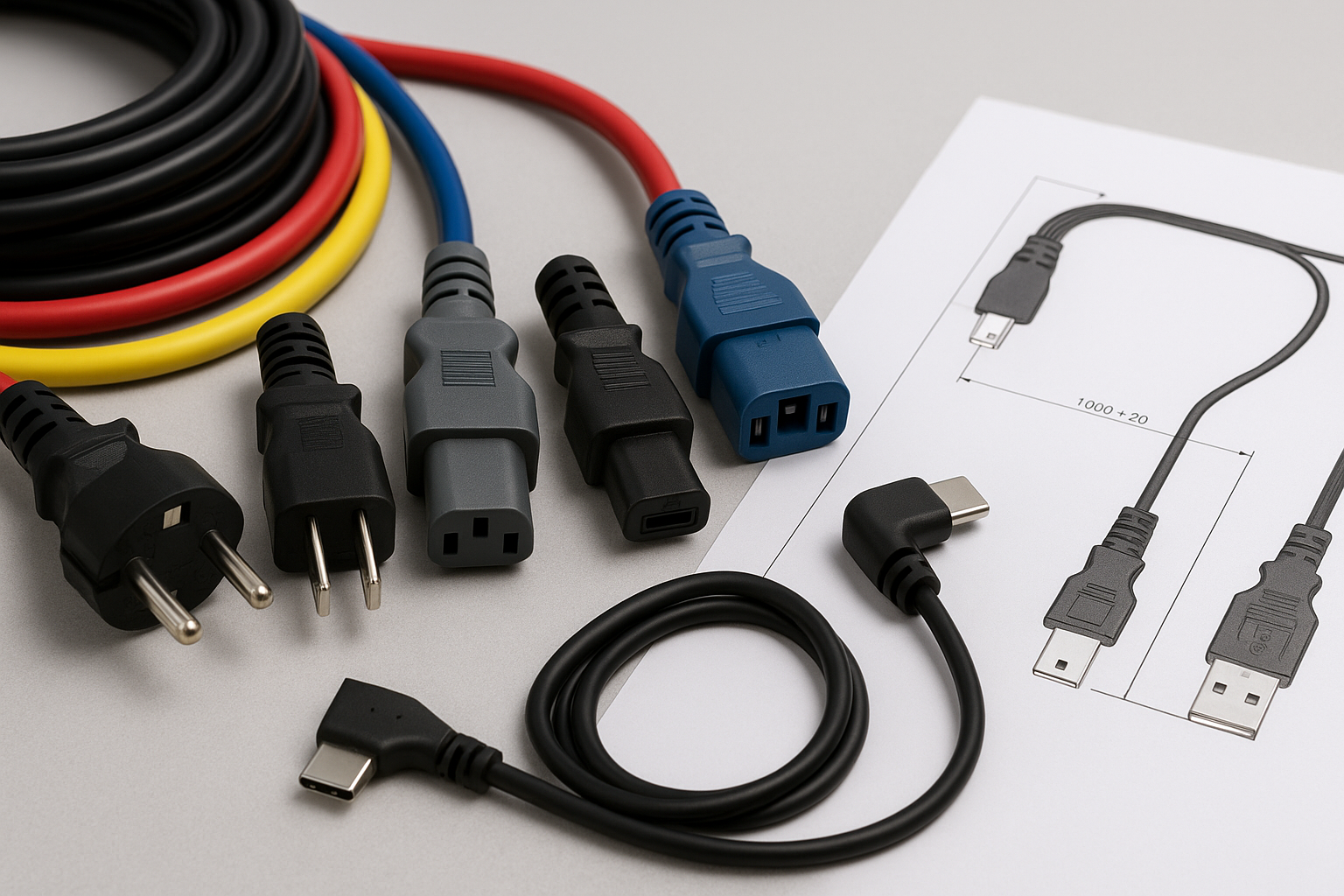
Custom-made products for individual requirements
Do you need a different length, colour or plug configuration? mag-kabel.de also offers suitable solutions for professional use, including bespoke assemblies and project-specific designs.
More about custom-made products