
 German / Deutsch
  English
  French / Français
  Spanish / Español
  Dutch / Nederlands
  Italian / Italiano
  Polish / Polski
  Norwegian / Norsk
  Danish / Dansk
  Finnish / Suomi
  Swedish / Svenska
  Czech / Česky
  Greek / Ελληνικά
  Slovak / Slovenčina
  Slovenian / Slovenščina
  Estonian / Eesti
  Latvian / Latviešu
  Lithuanian / Lietuvių
  Hungarian / Magyar
  Romanian / Română
  Bulgarian / Български
  Portuguese / Português
 Cat.6 flat patch cables – ideal for installation in confined spaces
DINIC Cat 6 flat patch cables combine Gigabit Ethernet with an exceptionally flat cable design. Measuring just approx. 1.5 × 6.1 mm, they are suitable for RJ45 connections behind furniture, along skirting boards, in narrow cable ducts or in other applications where space is limited.
Cat 6 flat patch cables – RJ45 network cables for confined installation spaces

Flat Cat 6 network cables – when there isn’t enough space for a standard patch cable
A standard round network cable cannot always be routed discreetly. Behind furniture, along skirting boards, in narrow cable ducts or within compact built-in units, the height of the cable can be a decisive factor.
DINIC Cat 6 flat patch cables therefore feature a particularly flat profile measuring just around 1.5 × 6.1 mm. Despite their low profile, these are shielded RJ45 patch cables for 10/100/1000BASE-T or Gigabit Ethernet.
If the priority is not maximum transmission performance or PoE, but rather an RJ45 connection for Gigabit Ethernet that takes up as little space as possible, a Cat 6 flat patch cable can be a very practical solution.
Where do flat LAN cables really come into their own?
Behind furniture
There is often very little space available for cable routing between a cupboard, desk or other built-in furniture and the wall.
The low profile of the cable makes it easier to route it discreetly.
Skirting boards & cable ducts
In flat cable ducts or along existing skirting boards, a standard round cable can take up an unnecessary amount of space.
Flat cables require significantly less installation height.
Workstations
To connect a PC, docking station, network socket, router or switch, the cable can be routed over or under furniture to save space.
Particularly useful for neat office installations.
Meeting rooms
Network connections in meeting rooms, presentation units or media technology often require the most discreet cable routing possible.
A white sheath and low profile ensure a visually unobtrusive installation.
Shops & POS
Cash register systems, terminals and other Ethernet devices often have limited space for cabling within retail fittings or shopfitting elements.
Ideal for compact RJ45 connections in shopfitting.
System integration
In devices, furniture and technical installations, the available height may be more important than a particularly large conductor cross-section.
AWG36 enables a particularly slim cable design.
Technical specifications of the DINIC Cat 6 flat patch cables
| Feature | Specification | Meaning |
|---|---|---|
| Category | Cat 6 | Suitable for 10/100/1000BASE-T and therefore Gigabit Ethernet applications |
| Connectors | 2× RJ45 (8P8C) | For switches, routers, patch panels, network sockets, PCs and other RJ45 components |
| Shielding | PiMF/STP | Pairs of metal foil and shielded cable construction to reduce interference |
| Conductor size | AWG36 | Very thin conductors enable a particularly flat and flexible cable design |
| Cable dimensions | approx. 1.5 × 6.1 mm | Particularly low profile for confined installation spaces |
| Contacts | Gold-plated RJ45 contacts | For reliable connection to RJ45 interfaces |
| Colour | white | Discreet installation in office, residential, presentation and retail environments |
| PoE | Not supported | For Power over Ethernet, a network cable approved for this purpose should be selected |
Flat or round network cable – which is better?
| Requirement | Flat Cat 6 patch cable | Round patch cable |
|---|---|---|
| Very limited space | Particularly suitable | Usually requires more vertical space |
| Gigabit Ethernet | Suitable | Suitable |
| Discreet cable routing | Very well suited | Depends on cable diameter |
| 10 Gigabit network | Not the main focus of these Cat 6 flat cables | Check Cat 7 patch cables |
| High-speed up to 25/40 Gbit/s | Not supported | Check Cat 8.1 patch cables |
| PoE / PoE+ | Not applicable | Select an approved Cat 7 or other PoE patch cable |
The products in this category are pre-terminated RJ45 patch cables. For fixed structured building cabling, LAN installation and laying cables intended for this purpose should be used.
Why are these flat cables not intended for PoE?
To achieve the particularly low cable profile, these DINIC flat patch cables use very thin AWG36 conductors. With Power over Ethernet, electrical power is transmitted via the copper conductors in addition to data transmission.
Factors such as conductor cross-section, electrical resistance, cable length, bundling and heat generation play an important role here. Therefore, when using PoE, one should not rely solely on the Ethernet category, but must specifically check the cable’s PoE certification.
The flat patch cables in this category are not intended for PoE. You can find out more about suitable conductor sizes and PoE power levels in the guide PoE, PoE+ and PoE++ – which patch cable and which AWG cross-section?
PiMF/STP – why is the flat cable still shielded?
DINIC flat patch cables use a PiMF/STP construction. PiMF stands for ‘Pair in Metal Foil’ and describes the foil shielding of the twisted pairs.
The shielding serves to reduce electromagnetic interference and crosstalk between the wire pairs. A shielded construction is a particularly useful feature where cables are routed closely together in office, technical or system integration environments.
You can find the basics on the different designations under U/UTP, F/UTP, S/FTP – which LAN shielding is right?
What length should I choose?
For patch cables, it makes sense to choose a length that is as close as possible to what is required. Cables that are too long create unnecessary excess length and make for a cluttered installation. Cables that are too short, on the other hand, can place unnecessary mechanical stress on the connectors and the cable itself.
Which Ethernet category do I need?
Cat 6 flat cables in this category are designed for typical Gigabit applications. If higher data rates, greater performance reserves or specialised server/rack applications are planned, the network category should be reassessed accordingly.
To help you decide: Cat 6A, Cat 7 or Cat 8 – which network cable do I need?
Further network guides
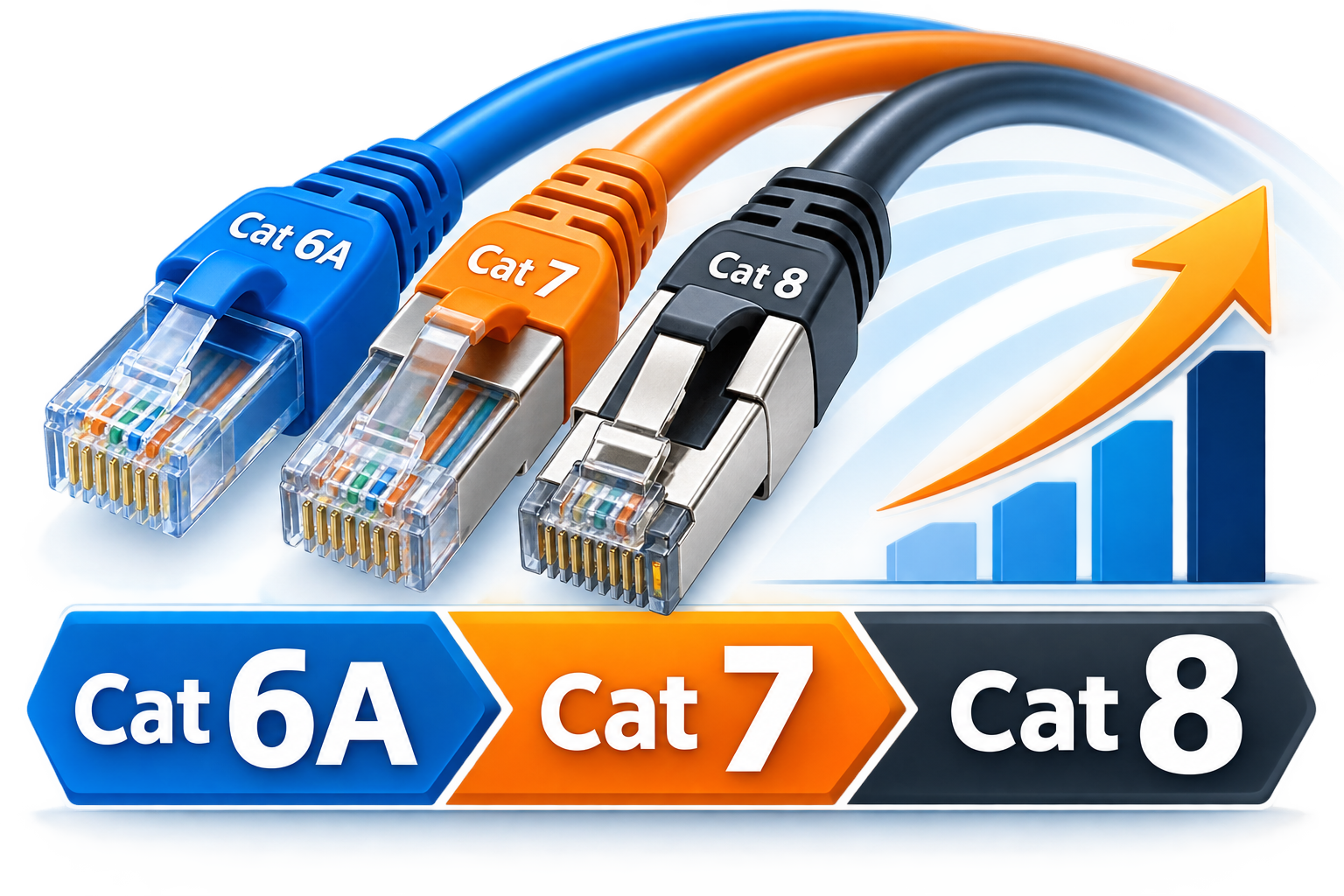
Cat 6A, Cat 7 or Cat 8?
Which category suits the data rate, cable length and planned network application?
Compare categories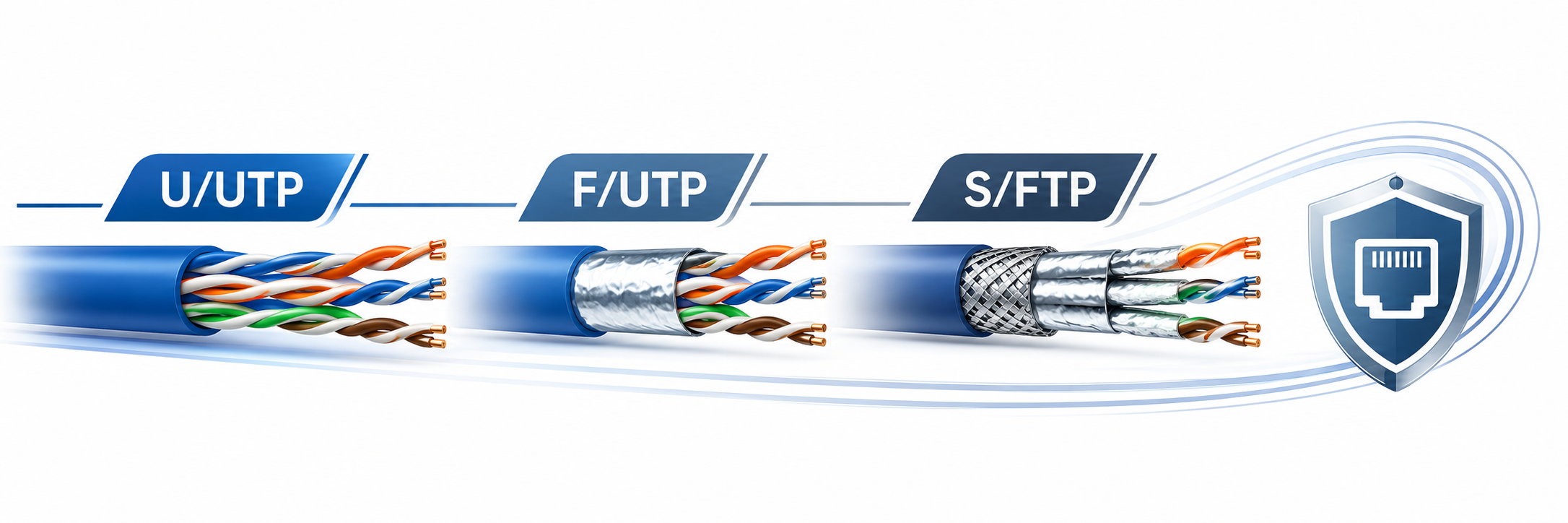
Which type of LAN shielding?
U/UTP, F/UTP and S/FTP, and the importance of shielded network cables.
Compare shielding
PoE and conductor cross-section
Why AWG, solid copper, length and PoE certification are important for power transmission.
Selecting PoE cablesFlat RJ45 patch cables for B2B, retail and system integration
MAG offers DINIC Cat 6 flat patch cables for specialist retailers, system integrators, IT installation firms, shopfitting, office fit-outs and commercial network projects. The range is available in various lengths and packaging options and is particularly suitable for applications with limited space for cable routing.
Frequently Asked Questions about flat Cat 6 patch cables
How flat are the DINIC Cat 6 flat patch cables?
The cable dimensions are approximately 1.5 × 6.1 mm. As a result, the cables require significantly less vertical space than many traditional round network cables.
Do the flat cables support Gigabit Ethernet?
Yes. The DINIC Cat 6 flat patch cables are designed for 10/100/1000BASE-T and are therefore suitable for Gigabit Ethernet applications.
Are the flat patch cables shielded?
Yes. The cables have a PiMF/STP construction. The twisted pairs are shielded with metal foil and the cable is designed as a shielded network connection.
Are the DINIC flat patch cables suitable for PoE?
No. According to the product specifications, the flat patch cables in this category are not intended for Power-over-Ethernet applications. An appropriately certified network cable should be used for PoE.
Can a flat network cable be routed behind a skirting board?
The low profile of the DINIC flat patch cables makes them particularly suitable for confined cable routes, such as behind suitable skirting boards or in shallow cable ducts. However, mechanical stress, bend radii and the specific installation conditions should be taken into account.
Is a flat cable an installation cable?
No. The products in this category are pre-terminated RJ45 patch cables. Separate LAN installation and laying cables are available for fixed structured building cabling.
When should I use a Cat 7 patch cable instead of a Cat 6 one?
If, for example, 10 Gigabit Ethernet, greater transmission reserves or PoE+ are required, Cat 7 patch cables with the appropriate specifications are the more suitable product group. For very short high-speed connections, Cat 8.1 may also be worth considering.