 German / Deutsch
  English
  French / Français
  Spanish / Español
  Dutch / Nederlands
  Italian / Italiano
  Polish / Polski
  Norwegian / Norsk
  Danish / Dansk
  Finnish / Suomi
  Swedish / Svenska
  Czech / Česky
  Greek / Ελληνικά
  Slovak / Slovenčina
  Slovenian / Slovenščina
  Estonian / Eesti
  Latvian / Latviešu
  Lithuanian / Lietuvių
  Hungarian / Magyar
  Romanian / Română
  Bulgarian / Български
  Portuguese / Português
 -
You do not have any products in your shopping cart yet.
Japanese power cables & sockets explained simply
Which solution makes the most sense for Japan? For many enquiries, this can be summarised simply: 2-pin devices are usually Type A, earthed devices are generally Type B, and it is always necessary to check for 100 V as well as the 50/60 Hz situation common in Japan.
Type A for 2-pin devices Type B for earthed devices 100 V / 50 Hz and 60 Hz hybrid Japan/USA possible
An overview of Japanese sockets and power cables
For Japan, Type A and Type B are particularly relevant. However, the plug shape alone is not sufficient to ensure the correct choice. The protective earth conductor, appliance voltage, frequency and the appropriate target market version are also crucial.
Plug types A and B in direct comparison
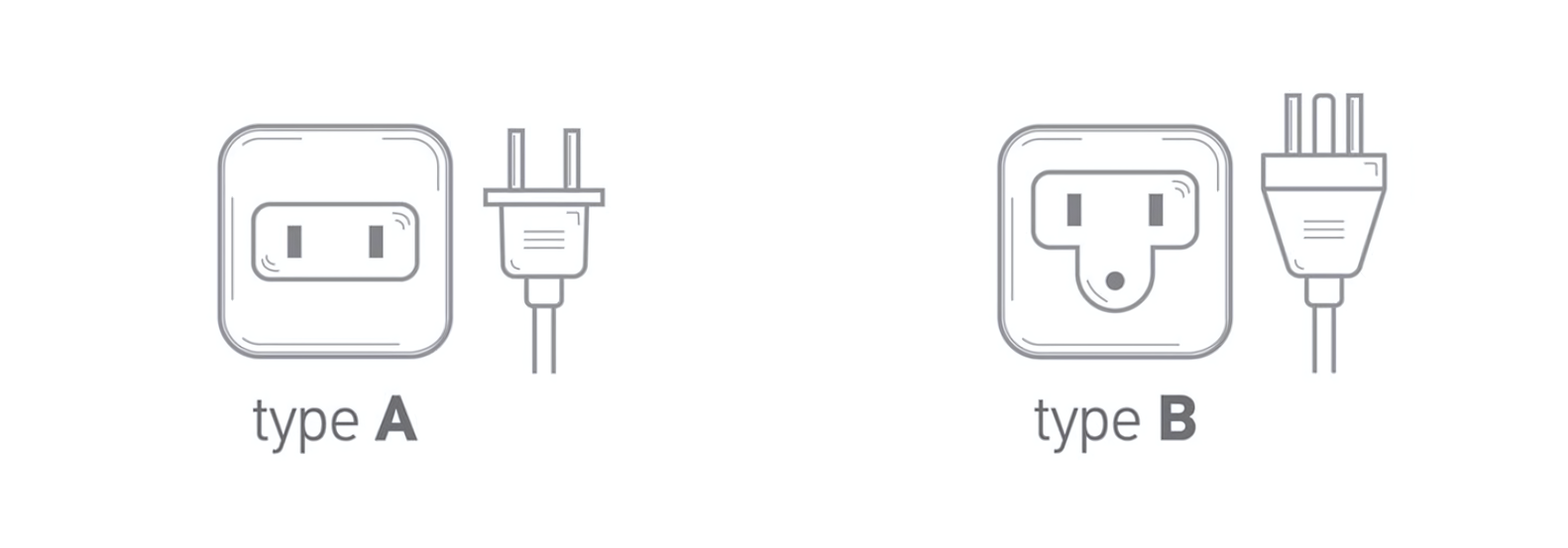
The illustration shows a direct comparison of the plug types relevant in Japan: Type A and Type B.
| Plug type | Number of pins | Typical use | Brief description |
|---|---|---|---|
| Type A | 2-pin | Insulated devices without protective conductor | Usually the right choice for 2-pole applications in Japan |
| Type B | 3-pole | Earthed devices with protective conductor | The standard solution when an earth connection is required |
Important: In Japan, it is not just the plug shape that matters. Particularly in B2B, OEM and project environments, 100 V, 50/60 Hz and the appropriate approvals for the target market should always be taken into account.
Quick decision guide
1. Device is 2-pole
For insulation-protected devices without an earth connection, Type A is usually the clear and appropriate choice for Japan.
2. Device is earthed
As soon as an earth connection is required, Type B is generally the correct option.
3. Device is rated for 230 V only
In this case, a suitable power cable alone is not sufficient. It must be checked whether the device is suitable for 100 V or a wide-range input.
In practice: For many current B2B and export enquiries, three points are particularly important: Type A for 2-pole devices, Type B for earthed applications, and a thorough check of the device’s suitability for 100 V.
Why Type A is usually the best choice for 2-pole devices
Type A is the typical 2-pole solution for Japan. This works well with insulation-protected devices without a protective conductor and with 2-core device supply cables.
Type B, on the other hand, is 3-pole. With a 2-pole appliance, the protective conductor would remain unused in practice. This is precisely why a Type A version is often the clearer and more sensible choice for 2-pole applications.
Rule of thumb: 2-pole appliance without earth = usually Type A. Earthed appliance = usually Type B.
Why Type B is important for earthed appliances
For devices with a protective conductor, the earth connection should not be bypassed using unsuitable adapters or makeshift solutions. Type B is the appropriate choice for such applications, as it takes protective earthing into account.
This point is particularly important in IT technology, industrial applications, OEM projects and export ventures, to ensure that the solution is not only mechanically suitable but also technically sound.
Practical recommendation: For earthed devices with C13, C5 or comparable connectors, Type B is usually the technically sound solution.
Very similar design to US plugs, but different target market requirements
One point in particular often leads to misunderstandings in practice: Japanese Type A and Type B plugs have a very similar design to the corresponding US plugs. This quickly leads to the assumption that a US solution is automatically also a sound solution for Japan.
This is precisely where the difference lies: the plug design alone is not sufficient. Although very similar plug faces are used in Japan and the US, approvals, labelling and target market specifications should nevertheless be considered separately.
- The design appears very similar and, in many cases, makes mechanical sense.
- Nevertheless, the correct design and the appropriate approvals are what count for the target market.
- Particularly for projects, series production and OEM products, mechanical fit alone is therefore not sufficient.
In short: a very similar design does not automatically mean the same suitability for the target market. Anyone wishing to supply exclusively for Japan or simultaneously for Japan and the USA should select the appropriate version specifically.
Hybrid power cable for Japan/USA: a real advantage for OEMs and manufacturers
It is precisely here that MAG has made a particularly interesting breakthrough: there is a hybrid power cable for Japan and the USA that draws on the similar design of both markets and combines key requirements for Japan and the USA in a single solution.
A concrete example is this product:
Hybrid power cable Japan/USA Type B to C13, 1.80 m, AWG18, VCTF/SJT, approvals PSE / JET / UL
This solution is particularly interesting for OEMs, manufacturers, integrators and project customers who wish to design products or device platforms not just for a single market, but for both Japan and the USA in parallel.
Fewer variants
A hybrid solution can help reduce the number of separate country-specific cable variants.
Simpler procurement
This simplifies purchasing processes, product management, approvals and coordination between engineering and logistics.
Better for OEM projects
This can reduce variants, simplify procurement and make OEM projects more cost-effective.
Practical benefit: A suitable hybrid solution can eliminate variants, simplify procurement and make international device platforms significantly easier to plan.
100 V in Japan: the key difference to Europe
Many devices from Germany and Europe are designed for 230 V. Japan, on the other hand, operates on 100 V. Added to this is the regional frequency situation, with 50 Hz in eastern Japan and 60 Hz in western Japan.
This leads to a simple but important practical point: a suitable Japanese power cable does not automatically make a 230 V device suitable for use in Japan.
- With power adapters featuring a wide-range input, use is often possible without any problems.
- For devices with a fixed 230 V input, the voltage must be considered separately.
- For frequency-dependent or sensitive devices, the 50/60 Hz situation should also be checked.
Important: For Japan, the plug type, voltage and, where applicable, frequency should always be considered together.
When MAG can help
MAG currently provides particularly strong support with initial technical assessments, the selection of suitable Japanese versions, and the design of custom power cables for projects, OEM initiatives and recurring requirements.
If a project-specific solution is required for Japan or, in parallel, for Japan and the USA, MAG can assess which version is technically sound, economically viable and suitable for the intended application.
For many current enquiries, this means in practice: Type A for 2-pin devices, Type B for earthed applications and, if required, a hybrid solution when supplies are to be made to both Japan and the USA.
Our commitment: to provide practical advice, carry out thorough technical checks and, where necessary, develop a suitable solution for projects, series production or custom-made products.
Suitable solutions at mag-kabel.de
- Power cables for Japan
Suitable country-specific solutions for B2B, export and project business. - Power adapters for Japan
Useful for testing, servicing or short-term transitional solutions. - Hybrid power cables for Japan / USA
Particularly useful for OEMs and manufacturers with parallel requirements for Japan and North America. - Power plug glossary
Quick overview of international plug types and differences. - Custom-made products
Project-specific cable assembly for special requirements and series production.
FAQ on Japanese power cables and plugs
Which plug types are common in Japan?
In Japan, Type A and Type B are the most common.
When is Type A usually the best choice?
Primarily for 2-pin, insulated devices without an earth connection.
When is Type B suitable?
For earthed devices and applications where protective earthing is required.
Are Japanese and US plugs identical?
They are very similar in design, but this does not automatically mean they are suitable for the same target market.
Why is the hybrid power cable of interest to OEMs?
Because it can help reduce variants, simplify procurement and plan projects for Japan and the US more efficiently.
Is a different plug simply enough for Japan?
No. Additionally, 100 V and, where applicable, the 50/60 Hz situation must also be taken into account.
Can MAG assess a suitable solution for Japan for projects?
Yes, particularly for project requirements, series production prospects, hybrid requirements or custom-made products.
Planning a project for Japan or Japan/USA?
For test quantities, project requirements or series production enquiries, we can assist you in choosing between adapters, international power cables, hybrid versions and custom-made solutions.
Enquire about a
project
View power adapters for Japan View power
cables for Japan View hybrid power cables for Japan / USA