 German / Deutsch
  English
  French / Français
  Spanish / Español
  Dutch / Nederlands
  Italian / Italiano
  Polish / Polski
  Norwegian / Norsk
  Danish / Dansk
  Finnish / Suomi
  Swedish / Svenska
  Czech / Česky
  Greek / Ελληνικά
  Slovak / Slovenčina
  Slovenian / Slovenščina
  Estonian / Eesti
  Latvian / Latviešu
  Lithuanian / Lietuvių
  Hungarian / Magyar
  Romanian / Română
  Bulgarian / Български
  Portuguese / Português
Philippines power cables & sockets explained simply
What types of plugs are used in the Philippines, when is an adapter sufficient, and why aren’t US or Japanese power cables automatically the right solution? Here you’ll find the most important points summarised in an easy-to-understand way.
Philippine sockets and power cables at a glance
In practice, plug types A and B are the most common in the Philippines. In some cases, you may also find sockets that accept type C plugs. However, it is not just the shape of the plug that matters, but also the voltage, frequency, earth conductor and the appropriate market solution.
Plug types A, B and C in direct comparison
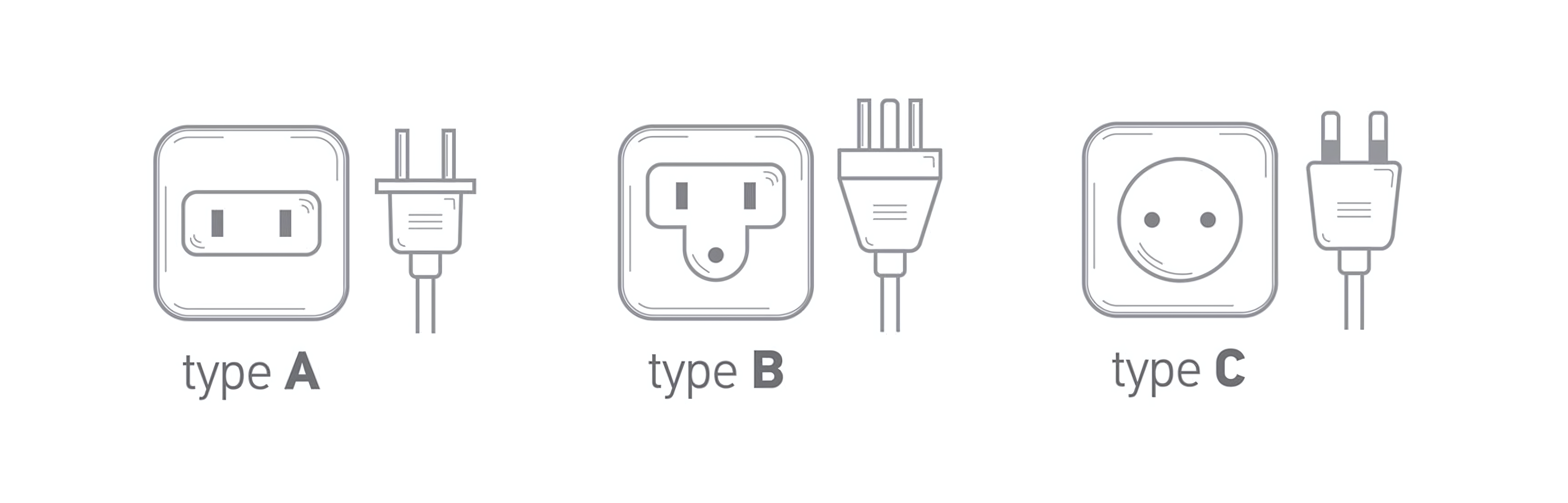
Type A
Two flat contacts. Very common on two-pin devices without a protective earth.
Type B
Two flat contacts plus a protective earth conductor. Suitable for earthed Class I appliances.
Type C
European two-pin plugs work to some extent, but are not a reliable basis for planning or mass production.
| Feature | Germany | Philippines | Important in practice |
|---|---|---|---|
| Mains voltage | 230 V | usually 220–230 V | Many modern power adapters are suitable if they are rated for 100–240 V. |
| Frequency | 50 Hz | 60 Hz | Not critical for many power supplies; please check for motors or special equipment. |
| Connector type | Type C / F | Type A / B / some C | Schuko plugs do not fit directly. Euro plugs may fit in some cases, but are not a clean long-term solution. |
Why US and Japanese power cables are not an official alternative
US and Japanese power cables often appear to fit because of the similar plug shape. However, they are not automatically the right solution for the Philippines.
- USA: Many typical US plugs are rated for 125 V.
- Japan: 100 V is the standard there.
- Philippines: In everyday life, 220–230 V at 60 Hz is usually used.
- Important: The same plug shape does not mean the same technical or market suitability.
A brief note on certification in the Philippines
For power cables, plugs, sockets and similar products, it is not just the technical fit that matters for the Philippine market. Depending on the product group, local labelling or approval may also be relevant.
- Important in the market: In the Philippines, depending on the product, PS Mark or ICC Sticker labelling plays a role.
- In practice: A mechanically compatible plug or adapter does not replace a market approval.
- Useful for projects: Before series production, regular distribution or larger quantities, the certification issue should be checked at an early stage.
When adapters are useful – and when they are not
Appropriate
For test operations, servicing, samples, travel, short-term use or technical evaluation.
Less advisable
For permanent operation, production units, regular distribution, or when a specific country-specific solution is required.
Important to know
An adapter only solves the plug problem. Voltage, frequency and any market requirements remain unaffected.
When MAG can help
MAG currently provides particularly good support with initial technical assessments, selecting a suitable adapter for test or interim solutions, and planning custom power cables for projects, OEM initiatives and recurring requirements.
If a project-specific solution is required for the Philippines, MAG can assess which design is technically sound, economically viable and suitable for the intended application.
Currently not available as standard from stock is a power cable that is already generally available as standard, specifically designed for the Philippines, for immediate regular market distribution. This is precisely why MAG carefully assesses which solution is truly suitable in each specific case – rather than recommending a variant that is merely visually similar.
Suitable solutions at mag-kabel.de
- Power adaptors for the USA / Japan
Ideal for testing, servicing, travel and short-term temporary solutions. - International power cables
Suitable country-specific solutions for export, B2B and project business. - Power plug encyclopaedia
Quick overview of international plug types and differences. - Custom-made products
Project-specific cable assembly for special requirements and series production. - Power category
Power cables, adaptors and accessories in the B2B shop at mag-kabel.de.
FAQ on power cables and adapters for the Philippines
Which plug types are common in the Philippines?
Mainly Type A and Type B, and occasionally Type C.
Is an adapter sufficient for the Philippines?
Often, yes, for short-term use. For long-term or professional applications, a suitable power cable is usually better.
Why aren’t US or Japanese power cables automatically suitable?
Because different voltages are standard there, and a similar plug shape alone does not guarantee a suitable solution.
Is certification important for projects in the Philippines?
Yes, particularly for regular distribution, series projects or larger quantities, the issue of certification should be checked at an early stage.
Can MAG assess a suitable solution for projects?
Yes, particularly for project requirements, series production or custom-made products.
Planning a project for the Philippines?
For test quantities, project requirements or series production enquiries, we can assist you in choosing between adapters, international power cables and custom-made solutions.
Enquire about a
project
View US/Japan power
adapters
View international power cables