
 German / Deutsch
  English
  French / Français
  Spanish / Español
  Dutch / Nederlands
  Italian / Italiano
  Polish / Polski
  Norwegian / Norsk
  Danish / Dansk
  Finnish / Suomi
  Swedish / Svenska
  Czech / Česky
  Greek / Ελληνικά
  Slovak / Slovenčina
  Slovenian / Slovenščina
  Estonian / Eesti
  Latvian / Latviešu
  Lithuanian / Lietuvių
  Hungarian / Magyar
  Romanian / Română
  Bulgarian / Български
  Portuguese / Português
 LC to SC OM4 fibre-optic patch cable
DINIC LC/SC OM4 fibre-optic cables connect different fibre-optic connectors directly to one another: LC on one end and SC on the other. They are particularly suitable for professional multimode connections between active network equipment and existing SC patch panels, distribution frames or couplers.
The cables are designed as OM4 50/125 µm multimode, duplex and LSZH, and are available in lengths from 1 to 100 m.
LC to SC OM4 fibre optic patch cable – Duplex multimode 50/125 µm
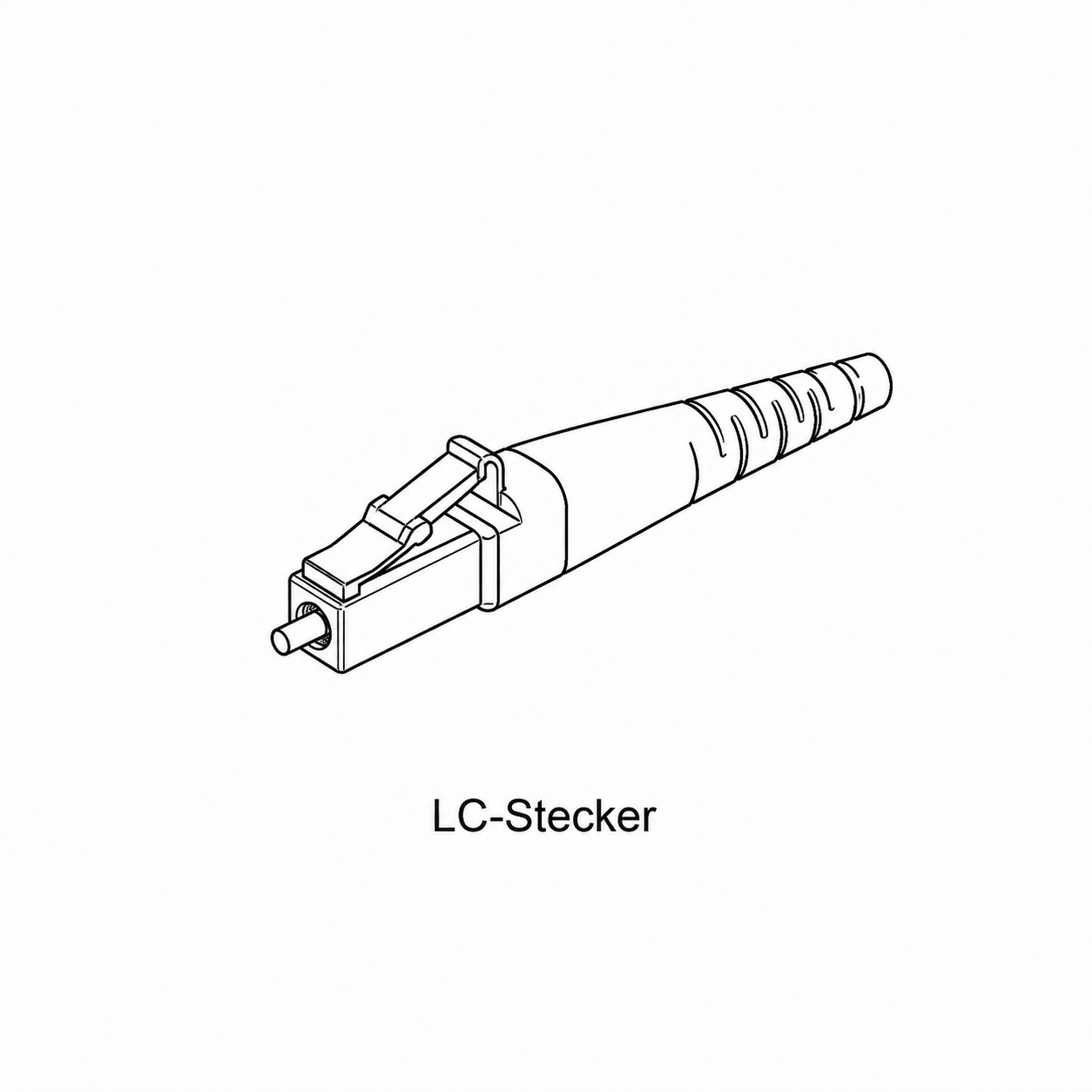 LC compact · 1.25 mm ferrule
.png) SC push-pull · 2.5 mm ferrule
SC push-pull · 2.5 mm ferrule

Choosing the Right LC/SC OM4 Fibre-Optic Cable
An LC to SC OM4 fibre optic patch cable is particularly useful when two components on the same multimode link have different mechanical fibre optic connectors.
A typical example: on one end, there is an LC duplex connector on a suitable optical transceiver; on the other end, there is an SC duplex connector on a patch panel, distribution frame or existing building cabling.
When do I need an LC to SC cable?
Switch to SC patch panel
When a multimode transceiver uses LC on the active side, but the existing passive cabling is terminated with SC.
New technology on existing cabling
LC/SC is a practical solution when modern active network components are to be integrated into an existing SC multimode infrastructure.
Patch panel to patch panel
Even two passive components with different LC and SC connectors can be connected directly using a suitably assembled cable.
Do I need a media converter for LC to SC?
No – not simply because of the different connector types. LC and SC merely describe the mechanical design of the two fibre-optic connectors.
A pre-terminated LC/SC cable can connect both connectors directly. An additional media converter is only required if different transmission technologies or electrical and optical interfaces actually need to be implemented.
LC and SC – what’s the difference?
| Feature | LC | SC |
|---|---|---|
| Ferrule | 1.25 mm | 2.5 mm |
| Design | Compact | larger and easy to grip |
| Locking mechanism | Latching mechanism | Push-pull |
| Port density | High | lower than LC |
| Typical applications | Transceivers, switches, servers, modern patch panels | Patch panels, distribution frames and existing fibre-optic installations |
| Multimode / single-mode | Both possible | Both possible |
What does OM4 50/125 µm mean?
OM4 is a laser-optimised 50/125 µm multimode fibre for high-performance optical network connections. It is frequently used in server rooms, data centres, building cabling and multimode backbones.
However, the maximum possible range does not depend solely on OM4, but always on the specific transmission standard, the transceiver, the connection points and the optical attenuation budget.
What data rates does LC/SC OM4 support?
| Application | Typical OM4 range | What should be borne in mind? |
|---|---|---|
| 1 Gigabit Ethernet | Depending on the optical standard used | Check the transceiver and fibre class. |
| 10GBASE-SR | typically up to 400 m | Use suitable multimode SR transceivers. |
| 25GBASE-SR | typically up to around 100 m | Suitable 25G multimode optics required. |
| 40 / 100 Gigabit | Depends on the transceiver | Not automatically compatible with LC/SC duplex; check the connection of the specific module. |
What does ‘duplex’ mean in the context of LC/SC?
Duplex means that the cable consists of two optical fibres. In many traditional optical Ethernet connections, one fibre is used for one direction of transmission and the second fibre for the opposite direction.
On the LC side, the two LC connectors are often held together by a duplex clip. On the SC side, two SC connectors form the corresponding fibre pair.
Check these four points before ordering
the connectors One end must be LC, the other SC.
the fibre: Both ends and the existing link must be designed for OM4 or compatible 50/125 µm multimode technology.
the transceivers Optical modules must be compatible with the required Ethernet standard, wavelength and multimode link.
duplex and polarity The fibre pair and Tx/Rx assignment must match the technology used.
LC/SC, LC/LC or SC/SC – which variant is suitable?
What does LSZH mean?
LSZH – Low Smoke Zero Halogen – refers to a halogen-free cable sheath design with reduced smoke emission. Such cables are particularly suitable for professional indoor installations in server rooms, data centres, offices and technical areas of buildings.
Why is the sheath erika violet?
Erika violet is frequently used for the visual identification of OM4 multimode connections and makes it easier to identify them in a patch panel or network cabinet.
However, the colour is only a guide. The actual OM4 50/125 µm marking is always decisive for technical selection.
Can I connect OM4 to OM3?
OM3 and OM4 are both 50/125 µm multimode fibres and can, in principle, be connected within a multimode link.
In the case of a mixed link, however, the performance specification should be based on the lower-performance part of the connection. For new installations, end-to-end OM4 cabling is usually more straightforward.
Is LC/SC OM4 suitable for FTTH?
These cables should not be confused with typical FTTH connection cables. FTTH usually employs OS2 single-mode fibre and frequently uses APC connectors such as SC/APC or LC/APC.
An OM4 LC/SC duplex cable of this type, on the other hand, is intended for corresponding multimode network connections.
For router, GF-TA and FTTH connections, you will find separate OS2 fibre-optic cables for routers and fibre-optic connections.
Is this patch cable suitable for outdoor use?
For outdoor, conduit, campus or building-to-building runs, an outdoor cable design specifically intended for this purpose should be used.
You can find suitable solutions under OM4 outdoor fibre-optic cables .
Frequently asked questions about LC/SC OM4 fibre optic cables
What is an LC to SC fibre optic cable?
It is a fibre-optic cable with LC connectors on one end and SC connectors on the other. This allows components with different mechanical fibre-optic connectors to be connected directly.
Do I need an adapter between LC and SC?
Not normally, if you’re using a pre-terminated LC/SC cable. The cable already has the required different connectors at both ends.
Do I need a media converter for LC to SC?
Not simply because of the different connector types. LC and SC are mechanical connection types. Provided the fibre type and optical technology match, the connection can be made directly using the appropriate LC/SC cable.
Is an LC-to-SC connection a multimode connection?
Not necessarily. LC and SC simply describe the connector types. However, cables in this category specifically use OM4 multimode fibres with a 50/125 µm core.
What does ‘duplex’ mean?
Duplex refers to a connection with two optical fibres. In many optical Ethernet connections, two fibres are used for the two transmission directions.
What is the range of OM4 at 10 Gigabit?
For 10GBASE-SR, distances of up to 400 m are typically possible over OM4. The specific transceivers, connection points and the optical loss budget remain the determining factors.
Can I connect LC/SC OM4 to an existing OM3 patch panel?
In principle, OM3 and OM4 can be connected to one another as 50/125 µm multimode fibres. The total distance should then be planned according to the performance limits of the weaker section.
Can I connect a switch to an SC patch panel using LC/SC?
Yes, provided that the optical port on the switch or transceiver uses LC connectors and the fibre class and network standard are compatible with the SC-side multimode infrastructure.
Is this LC/SC cable suitable for a fibre-optic router?
Not normally. FTTH routers typically use OS2 single-mode connections and often APC connectors. Appropriate FTTH connection cables should be used for this purpose.
DINIC OM4 fibre-optic cables for professional networks
LC/SC for different connection ends or, alternatively, LC/LC, SC/SC, as well as outdoor fibre-optic cables and suitable accessories.