
 German / Deutsch
  English
  French / Français
  Spanish / Español
  Dutch / Nederlands
  Italian / Italiano
  Polish / Polski
  Norwegian / Norsk
  Danish / Dansk
  Finnish / Suomi
  Swedish / Svenska
  Czech / Česky
  Greek / Ελληνικά
  Slovak / Slovenčina
  Slovenian / Slovenščina
  Estonian / Eesti
  Latvian / Latviešu
  Lithuanian / Lietuvių
  Hungarian / Magyar
  Romanian / Română
  Bulgarian / Български
  Portuguese / Português
 USA
USA
 Canada
Hospital-grade power cables – requirements, marking and use in the USA and Canada
Hospital-grade power cables are specially designed and marked power cables for North American applications with heightened requirements regarding the quality and reliability of the plug connection. A particularly well-known identifying feature of such hospital-grade plugs is the green dot – the so-called ‘Green Dot’.
Here you can find out what ‘hospital grade’ means, how a hospital-grade power cable differs from a standard US power cable, what role NEMA 5-15P, IEC C13, UL and CSA play, and what equipment manufacturers, industry and B2B users should look out for when making their selection.
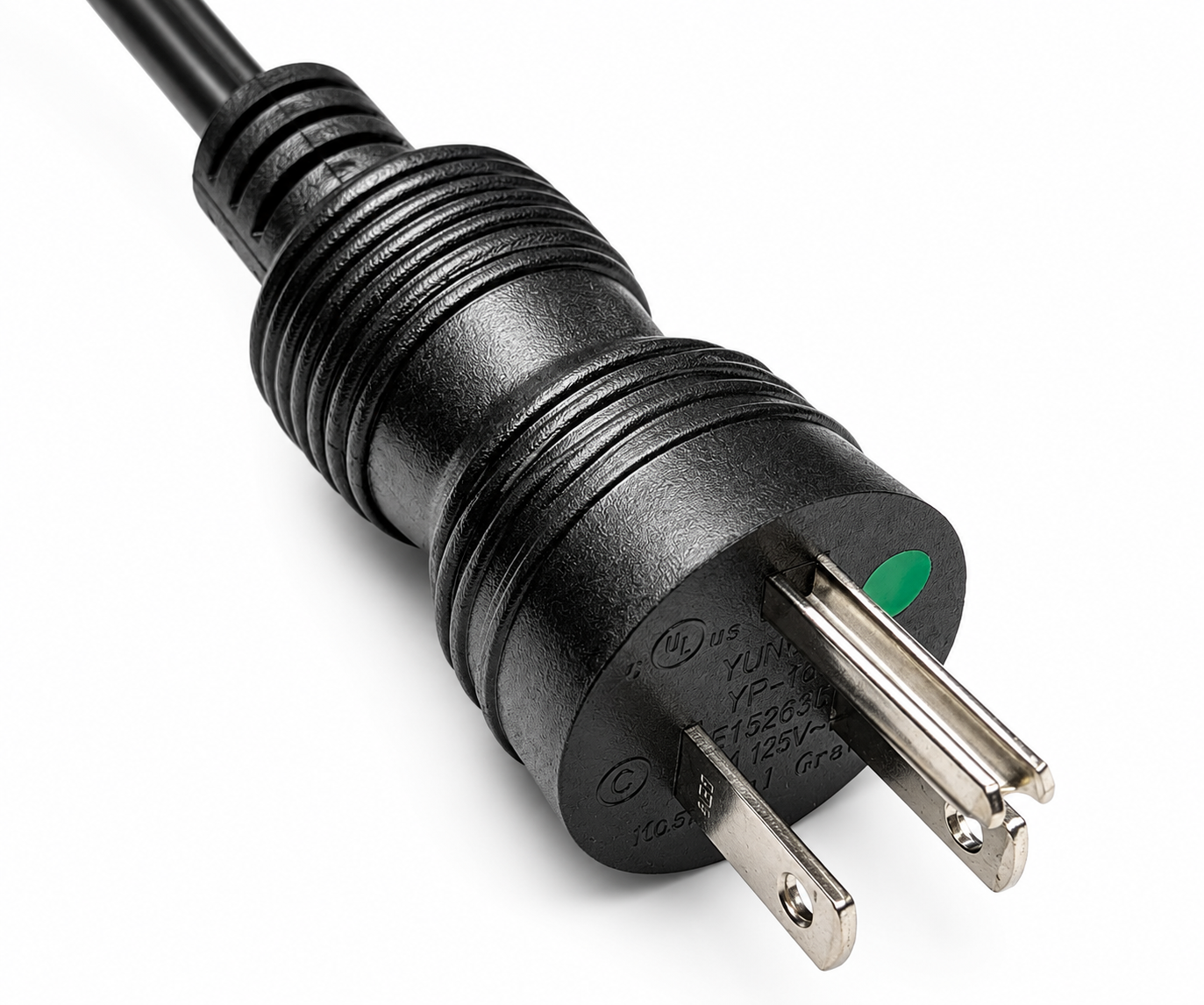
Mains plug for North American applications
USA
Canada
What does ‘Hospital Grade’ mean in relation to a power cable?
In the North American context, ‘hospital grade’ refers to a specific type of mains plug, connector and cable. Such designs must meet additional requirements, particularly regarding mechanical reliability, contact integrity and the safety of the connection.
‘Hospital Grade’ therefore means more than just the external shape of a NEMA plug. A standard NEMA 5-15P and a NEMA 5-15P ‘Hospital Grade’ may look similar mechanically, but the ‘Hospital Grade’ version is designed, tested and marked accordingly.
Green Dot – the green dot on the hospital-grade plug
A particularly distinctive identifying feature of such North American hospital-grade plugs is the green dot.
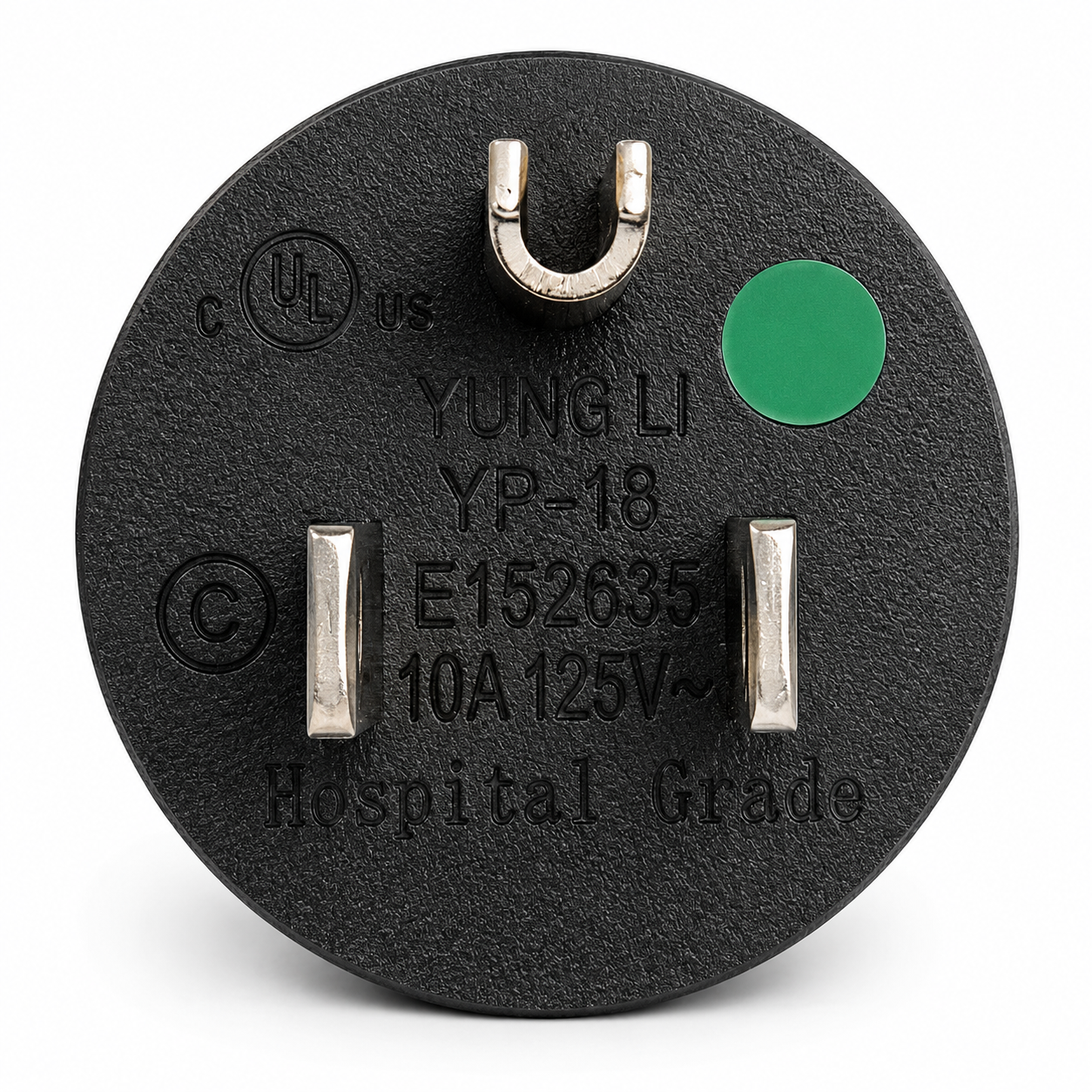
The green dot is clearly visible on the front of the NEMA 5-15P plug shown here. In addition, the plug bears the marking ‘Hospital Grade’.
This allows the hospital-grade version to be clearly distinguished visually from many standard NEMA mains plugs. Nevertheless, the complete approval and product data for the respective cable are always decisive for technical assessment.
Hospital-grade or standard US power cable – what is the difference?
At first glance, a hospital-grade power cable may look very similar to a standard NEMA 5-15P power cable. The key difference lies not only in the shape of the plug, but also in the additional requirements regarding the design and testing of the plug connection.
| Feature | Standard power cable | Hospital Grade |
|---|---|---|
| Plug system | e.g. NEMA 5-15P | NEMA 5-15P hospital grade |
| Protective earth | with the corresponding 3-pole version | with the corresponding 3-pole version |
| Hospital-grade marking | no | yes |
| Green Dot | not usually | Typical labelling feature |
| Requirements | Standard version | Additional requirements for the hospital-grade version |
| Typical applications | IT, office, industry and general-purpose equipment | Medical and professional applications with corresponding requirements |
NEMA 5-15P Hospital Grade – mains plug for the USA and Canada
USA Canada
NEMA 5-15P is a widely used 3-pin North American mains plug. It has two flat live pins and a separate earth pin.
The NEMA 5-15P hospital-grade version meets additional requirements and bears the corresponding hospital-grade marking.
NEMA 5-15P Hospital Grade to IEC 60320 C13
The hospital-grade power cables in the MAG range combine the North American NEMA 5-15P hospital-grade plug with an IEC 60320 C13 appliance socket.
The IEC C13 is connected to a matching IEC 60320 C14 appliance socket. C14 sockets are commonly found on a wide range of professional equipment, for example in the fields of IT, laboratory work, measurement and testing technology, systems engineering, and in medical devices designed for this purpose.
UL, CSA and Hospital Grade – approvals for North America
UL and CSA requirements play an important role in power cables for the North American market. This applies in particular to OEM, industrial, laboratory and medical applications where the power cable used forms part of a defined equipment configuration.
USA · UL
Canada · CSA
Important: ‘Hospital Grade’ does not automatically mean ‘suitable for every medical device’
The term ‘Hospital Grade’ describes the corresponding design and marking of the mains plug connection or the connecting cable.
This does not automatically mean that a cable may be used for any medical application, regardless of the connected device and the installation. The device manufacturer’s specifications, the requirements of the overall system, the specific area of application and the regulations applicable at the place of use are always decisive factors.
Hospital-grade power cables at MAG
The MAG range includes hospital-grade power cables for the USA and Canada, featuring NEMA 5-15P hospital-grade plugs to IEC 60320 C13.
The models on offer use an AWG18 cable with three conductors and an SJT cable type. A range of cable lengths is available to suit different devices and installation scenarios.
| Feature | Model |
|---|---|
| Target market | USA Canada |
| Mains plug | NEMA 5-15P hospital grade |
| Device connector | IEC 60320 C13 |
| Compatible appliance socket | IEC 60320 C14 |
| Conductor configuration | AWG18 × 3 |
| Cable type | SJT |
| Colour | Black |
| Available lengths | 1.80 m · 3.00 m · 5.00 m |
| Approvals | UL / CSA in accordance with the relevant product specifications |
Where are hospital-grade power cables used?
Hospital-grade power cables are particularly relevant where the equipment or installation in use requires a power connection that is appropriately designed and marked.
Which hospital-grade power cable do I need?
When making your selection, you should not focus solely on the term ‘hospital-grade’. The full electrical and mechanical configuration of the connection cable is crucial.
In a nutshell: When do I need a hospital-grade power cable?
You need a hospital-grade power cable if a corresponding hospital-grade power connection is expressly required or specified for your device or your North American installation. To check this, refer to the device specifications, the required NEMA mains plug, the IEC device connection and the necessary approvals.
Frequently asked questions about hospital-grade power cables
What is a hospital-grade power cable?
A hospital-grade power cable is a power connection cable designed and labelled accordingly for North American applications with additional requirements for the mains plug connection.
What does the Green Dot on a hospital-grade plug mean?
The green dot is a typical identifying feature of relevant North American hospital-grade connectors. There is also a corresponding hospital-grade marking.
What does NEMA 5-15P Hospital Grade mean?
NEMA 5-15P refers to a 3-pin North American mains plug with an earth wire. In a hospital-grade version, the connector meets additional requirements and bears the corresponding marking.
Is ‘hospital grade’ relevant for the USA and Canada?
Hospital-grade connection solutions are used in the North American market. For the USA and Canada, the specific requirements and approvals for the particular application must be taken into account.
What does NEMA 5-15P mean in relation to IEC C13?
The NEMA 5-15P is located on the mains side of the cable. The IEC 60320 C13 coupler is connected on the equipment side to a matching IEC 60320 C14 equipment inlet.
What is the difference between a hospital-grade and a standard NEMA 5-15P?
Both essentially use the NEMA 5-15 plug system. However, the hospital-grade version meets additional requirements and bears the corresponding markings, including the distinctive green dot.
Is every hospital-grade power cable automatically suitable for every medical device?
No. Suitability must always be checked against the device specifications, electrical data, intended use, required approvals and the regulations applicable at the place of use.
Which hospital-grade power cables does MAG offer?
MAG stocks hospital-grade power cables with NEMA 5-15P to IEC 60320 C13, AWG18/3 and SJT conductors in various lengths. The technical specifications of the respective product are decisive.
What cable lengths are available from MAG?
The hospital-grade power cables in this product range are currently available in lengths of 1.80 m, 3.00 m and 5.00 m.
Selecting the right power cable for the USA and Canada
In addition to hospital-grade versions, MAG offers further North American power cables with various NEMA plugs, IEC device connectors, AWG conductor sizes and cable types.