
 German / Deutsch
  English
  French / Français
  Spanish / Español
  Dutch / Nederlands
  Italian / Italiano
  Polish / Polski
  Norwegian / Norsk
  Danish / Dansk
  Finnish / Suomi
  Swedish / Svenska
  Czech / Česky
  Greek / Ελληνικά
  Slovak / Slovenčina
  Slovenian / Slovenščina
  Estonian / Eesti
  Latvian / Latviešu
  Lithuanian / Lietuvių
  Hungarian / Magyar
  Romanian / Română
  Bulgarian / Български
  Portuguese / Português
 OM4 outdoor fibre-optic cables – pre-terminated LC/LC breakout cables
DINIC OM4 outdoor fibre-optic cables for professional building, campus and industrial cabling: pre-terminated with four OM4 multimode fibres and individual LC connectors at both ends of the cable.
The robust U-DQ(ZN)BH construction, featuring a halogen-free sheath and E-glass yarn as an additional rodent barrier, is suitable for demanding installation routes, for example between buildings, through suitable conduit, cable protection pipes, shafts and service corridors.
OM4 outdoor fibre-optic cable – 4 fibres, LC/LC, pre-terminated
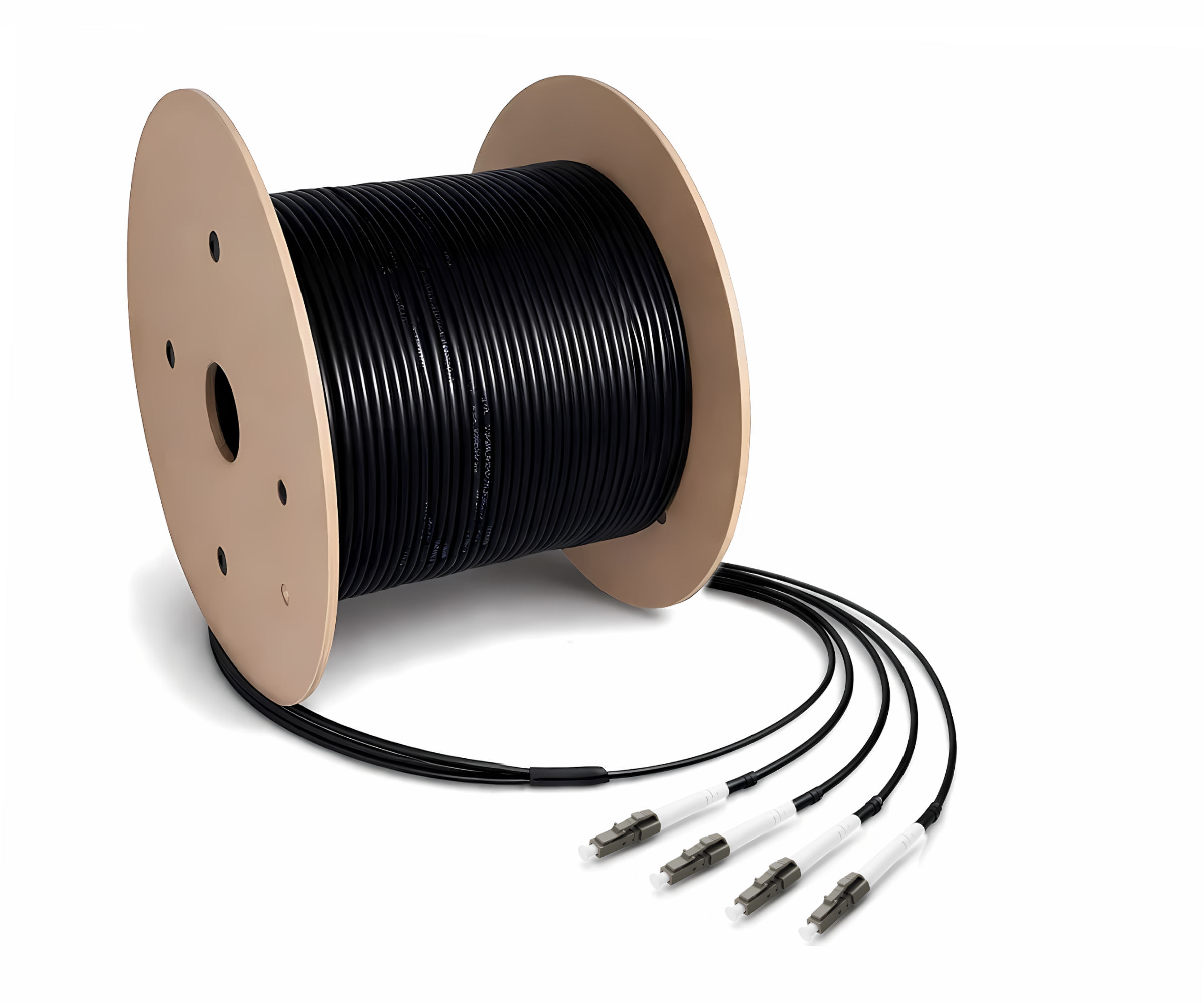

Choosing the Right OM4 Outdoor Fibre Optic Cable – Fibres, Connectors and Installation
When selecting an outdoor fibre-optic cable, it is not enough simply to choose the required length. To ensure a reliable connection, the fibre type, transceiver, connectors, number of fibres, installation route and environmental conditions must all be compatible.
The DINIC Outdoor series in this category combines OM4 multimode 50/125 µm, four fibres, LC/LC termination and a U-DQ(ZN)BH cable construction.
When is OM4 outdoor fibre the right solution?
Connecting buildings
For backbone and uplink routes between offices, halls, warehouses, workshops, plant rooms or ancillary buildings within a suitable multimode infrastructure.
Campus and industry
For optical connections between network distribution frames on factory, logistics and company premises.
Existing OM3/OM4 network
Particularly suitable if suitable multimode transceivers and an OM3/OM4 infrastructure are already in place.
Planning fibre-optic links between two buildings?
The comprehensive MAG guide covers building connections, empty conduits, cable routes, four fibres, pull-through aids and the choice between OM4 and OS2.
Why four fibres?
The outdoor cables in this series have four OM4 fibres. A standard optical duplex connection often uses two fibres. This means that four fibres can be used, for example, as follows:
- 2 fibres for an active duplex connection and 2 spare fibres
- 2 separate duplex connections
- Reserve for future expansion
- Separate optical links for different systems
What does U-DQ(ZN)BH mean?
U-DQ(ZN)BH describes key characteristics of the cable structure and is far more informative for installation planners than the general term ‘outdoor cable’.
| Feature | Significance for the application |
|---|---|
| OM4 50/125 µm | Laser-optimised multimode fibre for suitable optical network and backbone applications. |
| 4 fibres | Four individual optical fibres for spare capacity or multiple duplex connections. |
| LC/LC | Pre-terminated LC connectors at both ends of the cable. |
| U-DQ(ZN)BH | Robust universal cable construction for suitable outdoor, transition and infrastructure installations. |
| E-glass yarn | Additional non-metallic barrier to deter damage caused by rodents. |
| Halogen-free sheath | For professional installation environments where halogen-free cable types are required or preferred. |
Pre-terminated – why is this of interest for B2B installations?
The LC connectors are already factory-fitted. With appropriate planning of the cable route, this allows the time-consuming process of connector assembly or splicing directly at the installation site to be reduced or avoided.
- less assembly work on site
- clearly calculable cable length
- Quick connection to suitable LC patch panels and active components
- Attractive for system integrators, installation companies and industrial projects
- Convenient for use with pre-installed conduit and cable protection pipes
Pulling outdoor fibre-optic cable through conduit
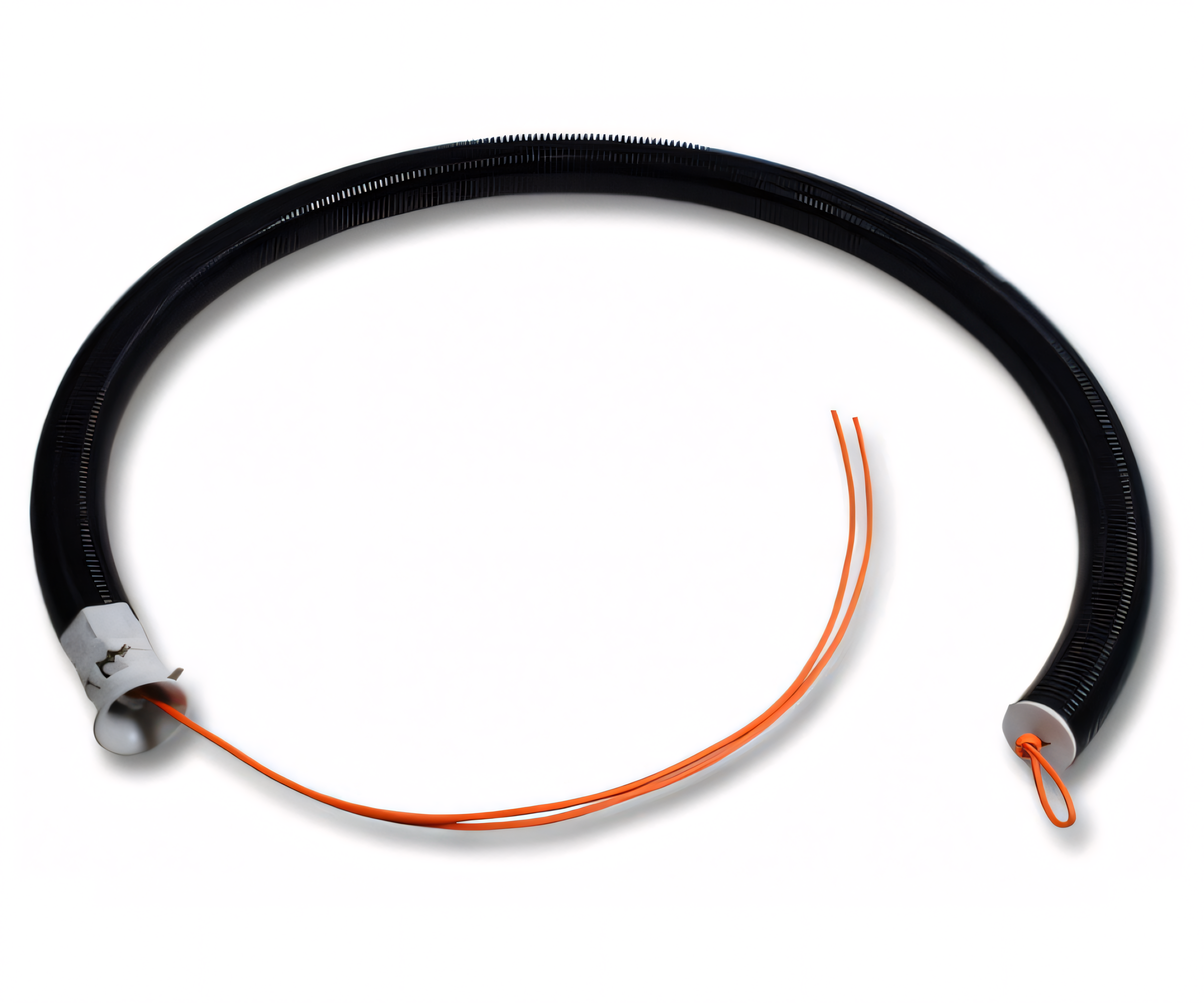
Protect LC connectors during pulling
With pre-terminated fibre-optic cables, the connectors are already fitted. When pulling them through, they should not be fed through the conduit unprotected and, in particular, should not be used as a direct pulling point.
The reusable DINIC pulling aid is designed for cable outer diameters of 6 to 15 mm and facilitates the controlled feeding of pre-terminated cables through empty conduits and cable protection conduits.
View the pulling tool »Observe the bending radius and tensile load
Fibre-optic cables must not be kinked, bent too tightly or pulled through via the pre-terminated LC connectors.
- Observe the minimum bending radius for the respective cable
- Do not apply any excessive tensile forces to the LC connectors
- Check the route and pipe bends in advance
- Protect the connectors mechanically whilst pulling them through
- Take into account the permissible installation and operating temperatures
What data rate is possible with OM4?
The possible data rate and range depend not only on the cable, but also on the specific Ethernet standard and the transceivers used.
An important example is 10GBASE-SR: distances of up to 400 m are typically possible with OM4.
OM4 or OS2 for outdoor installations?
OM4 is particularly suitable if an OM3/OM4 multimode infrastructure and compatible multimode transceivers are already in place.
For very long distances, however, or where the backbone infrastructure is designed for single-mode use in the long term, OS2 should be considered.
Can the outdoor cable be laid directly in the ground?
The term ‘outdoor’ does not automatically constitute general approval for any unprotected, direct burial. Soil conditions, moisture, compressive and tensile loads, as well as mechanical protection, must be taken into account on a project-specific basis when laying cables in the ground.
For building and campus runs using suitable conduit and cable protection conduits, the outdoor installation method offers a practical solution. In the case of direct burial, the specific suitability of the intended cable construction should be explicitly verified.
Frequently asked questions about OM4 outdoor fibre-optic cables
What is an OM4 outdoor fibre-optic cable suitable for?
Typical applications include building-to-building connections, campus and factory networks, industrial and logistics sites, technical containers and backbone links within a suitable multimode infrastructure.
What does ‘4 fibres’ mean?
The cable contains four OM4 multimode fibres. These can be used, for example, for a duplex connection plus two spare fibres, or for two separate duplex connections.
Are four fibres automatically redundant?
No. All four fibres are contained within the same cable. For true route redundancy, separate cables laid along routes that are as different as possible are required.
What is the advantage of LC/LC?
LC is compact and widely used in professional network environments. The pre-terminated LC connectors allow connection to suitable LC patch panels, couplers or optical components.
Is OM4 single-mode or multi-mode?
OM4 is a laser-optimised 50/125 µm multimode fibre. OS2, for example, is used for single-mode connections.
What is the transmission distance of OM4 at 10 Gbit/s?
For 10GBASE-SR, distances of up to 400 m are typically possible using OM4. In addition, transceivers, connectors and the permissible optical loss budget must be taken into account.
Can I pull the pre-terminated cable through a conduit?
Yes, provided the conduit diameter, bends, bend radius and pull path are suitable. The appropriate DINIC pull-in aid can be used to protect and guide the pre-terminated cable.
Is the cable rodent-proof?
The E-glass yarn layer acts as an additional rodent barrier. However, it should not be regarded as a guarantee against all possible rodent damage.
When should I choose OS2 instead of OM4?
OS2 should be considered in particular for very long distances, where single-mode infrastructure is already in place, or where backbone planning is designed for single-mode in the long term.
DINIC OM4 outdoor fibre-optic cable for professional network projects
Pre-terminated 4-fibre LC/LC cables and matching pull-through tools for building, campus and infrastructure installations.