
 German / Deutsch
  English
  French / Français
  Spanish / Español
  Dutch / Nederlands
  Italian / Italiano
  Polish / Polski
  Norwegian / Norsk
  Danish / Dansk
  Finnish / Suomi
  Swedish / Svenska
  Czech / Česky
  Greek / Ελληνικά
  Slovak / Slovenčina
  Slovenian / Slovenščina
  Estonian / Eesti
  Latvian / Latviešu
  Lithuanian / Lietuvių
  Hungarian / Magyar
  Romanian / Română
  Bulgarian / Български
  Portuguese / Português
 Mains connection cable and the cross-section: a crucial detail
Selecting the correct power cable cross-section: 0.75 mm², 1.0 mm² or 1.5 mm²
What conductor cross-section is appropriate for a power cable? 0.75 mm², 1.0 mm² and 1.5 mm² differ primarily in terms of conductor resistance, voltage drop and power loss. A larger cross-section can provide greater electrical headroom for longer cables or more demanding applications – but is not automatically required for every device.
To make the correct choice, the entire connection cable, current draw, cable length, mains plug, IEC appliance connector, cable type, operating conditions and product-specific approvals must always be considered together. The conductor cross-section alone does not determine the permissible current of a mains cable.
Quick answer: Which power cable cross-section should I choose?
1.0 mm²: offers a good balance between flexibility, conductor resistance and additional reserve capacity.
1.5 mm²: further reduces conductor resistance and may be appropriate for longer cables, continuous operation or more demanding applications.
Five factors determine the appropriate conductor cross-section
0.75 mm², 1.0 mm² and 1.5 mm² in direct comparison
The following table serves as a practical guide. It does not constitute a blanket approval of current ratings or cable lengths for every power cable.
| Characteristic | 0.75 mm² | 1.0 mm² | 1.5 mm² |
|---|---|---|---|
| Conductor resistance | higher | medium | lower |
| Voltage drop for the same length / load | higher | lower | the lowest of the three |
| Flexibility / cable volume | often more compact | balanced | often has a sturdier cable construction |
| Typical classification | short standard cables | medium lengths / additional reserve | Longer cables / lower voltage drop |
| Automatically higher permissible current? | No | No | No |
A clear comparison of conductor cross-sections
The diagram shows the area ratio of the three nominal cross-sections schematically. It does not represent the actual outer diameter of a cable or the structure of a fine-stranded conductor.
Why does the cross-sectional area affect voltage drop and heating?
An electrical conductor has a resistance. For the same material and the same length, this resistance decreases as the conductor cross-section increases. At the same current, a lower resistance reduces the voltage drop and the power loss generated in the conductor.
Simplified calculation values for copper conductors at 20 °C
| Cross-sectional area | Calculation value for resistance |
|---|---|
| 0.75 mm² | approx. 24.5 Ω/km |
| 1.0 mm² | approx. 18.1 Ω/km |
| 1.5 mm² | approx. 12.1 Ω/km |
These values are provided solely for the purpose of simplified technical illustration. Actual values may vary depending on conductor class, material, temperature, construction and product requirements. The data for the specific cable applies for approval purposes.
Calculation example: 10 A with a cable length of 5 m
For the sake of simplicity, both the forward and return conductors are taken into account. With a cable length of 5 m, this results in a conductor path of approximately 10 m. The example merely illustrates the order of magnitude of the influence of the cross-sectional area and does not constitute a current rating for a specific product.
| Cross-sectional area | Voltage drop | at 230 V | Power loss | Classification |
|---|---|---|---|---|
| 0.75 mm² | approx. 2.45 V | approx. 1.07% | approx. 24.5 W | Highest losses of the three variants |
| 1.0 mm² | approx. 1.81 V | approx. 0.79% | approx. 18.1 W | balanced average |
| 1.5 mm² | approx. 1.21 V | approx. 0.53% | approx. 12.1 W | lowest losses of the three variants |
Practical selection guide
The following scenarios will help with an initial shortlist. They are not a substitute for checking the specific product.
Check 0.75 mm²
With a shorter, purpose-built connection cable and moderate use, 0.75 mm² can be a compact and technically suitable solution.
Check 1.0 mm²
For medium lengths, or where lower resistance is required compared to 0.75 mm², 1.0 mm² can be a sensible compromise.
Consider 1.5 mm²
For longer cables, longer operating times or where the lowest possible conductor resistance is required, 1.5 mm² may be the more suitable option.
1.5 mm² does not automatically mean 16 A
The permissible current of a connection cable is not determined by the conductor cross-section alone. The mains plug, IEC connector, cable, cable construction, marking and approval must all be suitable for the intended operating current.
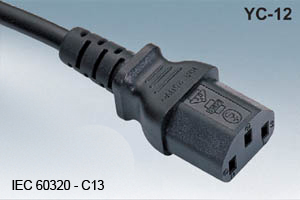
Example: C13 / C14
A larger conductor cross-section does not automatically alter the rated electrical values of the IEC connector used.
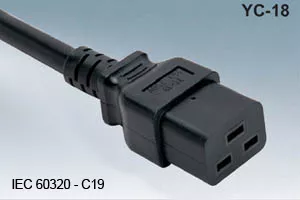
Example: C19 / C20
For 16 A-class IEC applications, dedicated connector systems such as C19/C20 are available.
What do 3G1.5, 3G1.0 or 3G0.75 mean?
In European cable designations, the number following G or X indicates the nominal cross-sectional area of each individual conductor. These values are not added together to give the total cross-sectional area of the cable.
US power cables: AWG instead of mm²
For North American power cables, the conductor size is often specified in AWG – American Wire Gauge. AWG and metric nominal cross-sections are sometimes close to each other, but are not identical.
The same applies to AWG: a general current rating for each power cable cannot be derived from the conductor size alone.
Converting AWG to mm² and correctly classifying US power cablesDetermine cross-sectional area and target market together
For international power cables, it is not sufficient simply to specify a metric cross-sectional area. Depending on the target market, different country-specific plugs, wiring systems, cross-sectional area specifications and approvals are used.
Target country → mains plug → appliance connection → current consumption → cable length → cable / cross-section → required approvals
DINIC mains cables with 1.5 mm² for applications requiring additional cross-sectional area reserve
If, for a particular application, you specifically require lower conductor resistance, a reduced voltage drop or additional cross-sectional area reserve, you will find various power cables and IEC extension leads with a 1.5 mm² conductor cross-sectional area in the DINIC range.
The DINIC marking shown opposite is designed to enable quick identification of our 1.5 mm² cable variants. Whether a 1.5 mm² version is technically necessary or advisable must still be assessed on the basis of the specific product, the connectors and the intended application.
Frequently asked questions about power cable cross-sections
When might 0.75 mm² be sufficient for a power cable?
0.75 mm² can be a suitable solution for shorter standard connection cables designed for this purpose. However, the decisive factors are always the rated values, connectors, cable type, approval and application of the specific product.
When is 1.0 mm² appropriate?
1.0 mm² can be a sensible middle ground if lower conductor resistance is required compared to 0.75 mm², without immediately resorting to a 1.5 mm² version.
When is 1.5 mm² appropriate?
1.5 mm² offers lower conductor resistance compared to 0.75 and 1.0 mm². This can be particularly advantageous for longer cables or when the lowest possible voltage drop is required.
Is 1.5 mm² always better than 0.75 mm²?
No. Whilst a larger cross-section reduces conductor resistance, it is not automatically necessary for every application. The appropriate cable should be selected based on the actual application.
Can a C13 mains cable with a cross-section of 1.5 mm² automatically carry 16 A?
No. The conductor cross-section alone does not determine the permissible current. The entire cable assembly, including the mains plug, IEC connector, cable, marking and approval, is decisive.
Why does cable length matter?
As the cable length increases, the electrical resistance of the connection rises. This can lead to an increase in voltage drop and power loss. A larger conductor cross-section reduces this effect.
What does 3G1.5 mean for a mains cable?
3G1.5 means three conductors, including a green-yellow protective conductor, each with a nominal cross-sectional area of 1.5 mm².
What is the difference between AWG and mm²?
mm² refers to the metric conductor cross-sectional area. AWG is an American sizing system in which a smaller AWG number denotes a larger conductor. AWG values should not be equated across the board with a metric nominal cross-sectional area.
What information is required to select a power cable?
Useful information includes the device connection, current consumption, mains plug or target market, cable length, desired cable type, operating environment, continuous operation and any required approvals.
Specify the power cable in full
Note: This page serves as a practical guide to selecting power cables and connection cables. It is not a substitute for technical product approval or electrical planning. The rated values, markings, approvals and technical data of the specific product, as well as the requirements of the equipment manufacturer and the intended application, are binding.