Power over Ethernet transmits data and electrical power via the same network cable. However, as PoE power output increases, so do the demands placed on copper conductors, conductor cross-sections, connectors, cable length and heat dissipation. Particularly with PoE++ at 60 or 90 watts, you should therefore not use just any RJ45 patch cable.
* The power available at the end device is lower than that supplied by the PSE, as electrical losses occur along the copper cable. PSE = Power Sourcing Equipment, for example a PoE switch or PoE injector. PD = Powered Device, i.e. the end device being powered.
AWG stands for American Wire Gauge and describes the conductor size. A rule applies here that may initially seem unfamiliar to many users:
The cross-sectional area values are rounded nominal values. In the case of flexible, multi-strand conductors, the construction and electrical properties may differ from those of solid conductors. For practical PoE design, the technical data and approval of the specific cable are therefore decisive.
With PoE, network cables transmit not only data but also electrical power. When current flows through a copper conductor, electrical losses occur, generating heat.
A larger copper cross-section has lower resistance for a comparable length. This helps to reduce power losses and heat generation.
Thinner and particularly well-suited to flexible patch connections in the network cabinet or at the workstation.
A practical solution for PoE and PoE+ provided the cable is approved for these applications.
A larger copper conductor with lower resistance. Frequently found in high-performance installation cables for structured building cabling.
Particularly useful for long distances, higher PoE power ratings and future-proof network planning.
A single PoE cable is relatively good at dissipating the heat it generates into its surroundings. However, if many network cables carrying a load at the same time are tightly bundled together in cable ducts, conduits or cable trays, heat can build up inside the bundle.
The higher the PoE power transmitted, the more important the conductor cross-section, cable construction, ambient temperature, bundle size and heat dissipation become.
For professional PoE installations, ensure that the conductors are 100 per cent copper (CU).
CCA stands for Copper Clad Aluminium. In this case, the conductor consists mainly of aluminium and has only a copper coating. Aluminium has a higher electrical resistance than copper.
Particularly when electrical power is being transmitted at the same time, higher conductor resistance can lead to greater losses and additional heat generation.
The Ethernet category and PoE power rating are, in principle, two distinct characteristics. A Cat 8 cable is therefore not automatically better suited for PoE than a Cat 6A cable.
Key factors for power transmission include, in particular, conductor resistance, conductor cross-section, cable length, contact quality, cable bundling and temperature behaviour.
For newly planned high-performance PoE++ networks, high-quality structured cabling at Cat 6A level or higher, with sufficiently large solid copper conductors, is often recommended.
More on choosing the transmission category: Cat 6A, Cat 7 or Cat 8 – which network cable do I need?
U/UTP, F/UTP or S/FTP primarily describe the shielding and not the electrical PoE power class. However, a shielded cable design can offer additional benefits in professional installations and demanding environmental conditions.
The key factor remains that the entire network link must be suitable for the intended data and power transmission.
Further information: U/UTP, F/UTP, S/FTP – which LAN shielding is right?
As the cable length increases, so does the electrical resistance of the copper link. This also leads to increased power losses. For PoE, the general rule is therefore:
Particularly with high-power PoE, the total channel length should be taken into account. This includes not only the patch cables, but also the permanently installed data cable and all transition points.
With PoE, the supply current also flows through the contacts of the RJ45 connectors. At higher power levels, the demands on contact quality and the connection therefore also increase.
Particularly with PoE++, care should be taken to ensure that the plugs, sockets, keystone modules, network sockets and patch panels used are suitable for the intended power level.
This is particularly relevant when connections are disconnected or connected whilst under load. The approval ratings of the system components used should therefore be taken into account.
The latest DINIC Cat 7 and Cat 8.1 patch cables from MAG feature 100 per cent copper conductors in AWG26 and are suitable for PoE+ in accordance with IEEE 802.3at.
This makes them suitable, for example, for many PoE/PoE+ applications involving access points, VoIP telephones, IP cameras and IoT components.
Under the DINIC brand, MAG offers network and Ethernet solutions for specialist retailers, system integration, building cabling, server rooms and professional IT projects. For PoE applications, in addition to category and length, particular attention should be paid to the conductor structure, AWG cross-section and the specified PoE suitability.
For PoE, a standard-compliant network cable with high-quality copper conductors should be used. For professional installations, 100% copper cables are recommended. It is also crucial that the specific cable is PoE-certified.
For PoE+ in accordance with IEEE 802.3at, a high-quality AWG26 solid copper patch cable may be suitable, provided it is expressly approved for PoE+. The DINIC Cat 7 and Cat 8.1 patch cables from MAG meet this requirement.
PoE++ in accordance with IEEE 802.3bt utilises four pairs of wires and, depending on the type, can supply up to 60 or 90 watts at the PSE. For such power ratings, larger copper conductors such as AWG24, AWG23 or AWG22 are particularly suitable. However, it is crucial that the entire cabling run is explicitly approved for the desired PoE++ power rating.
With a comparable cable construction, AWG23 has a larger copper cross-section and lower electrical resistance than AWG26. This can offer advantages, particularly with higher PoE power ratings, long runs and bundled cables. For PoE+, however, a suitably certified AWG26 patch cable may be perfectly adequate.
AWG24 has a larger conductor cross-section and therefore, in principle, lower conductor resistance than AWG26. AWG26, on the other hand, allows for thinner and more flexible patch cables. The choice depends on the PoE power rating, cable length, bundling and the cable manufacturer’s approval.
This cannot be determined solely on the basis of the AWG specification. An AWG26 cable may only be used for PoE++ if the cable and cabling system are designed or approved for the relevant IEEE 802.3bt application. At high power levels and over longer distances, larger conductors provide additional electrical and thermal headroom.
No. PoE++ does not automatically require Cat 8. Ethernet category and PoE power level are different specifications. For high-performance new installations, for example, suitable Cat 6A or higher-grade cabling with sufficiently sized copper conductors is a possible solution.
A Cat 7 cable is not automatically approved for PoE++ simply because of its category. Conductor cross-section, conductor resistance, temperature range, connection technology and the approval status of the specific product must also be taken into account.
Not automatically. Certification for IEEE 802.3at PoE+ does not necessarily mean that the cable is also suitable for IEEE 802.3bt Type 3 or Type 4. For PoE++, the relevant product or system certification must be checked.
The electrical resistance of the copper conductors causes losses during current transmission, which are dissipated as heat. The higher the current and the larger or denser the cable bundle, the more important effective heat dissipation becomes.
For professional PoE installations, MAG recommends cables with 100 per cent copper conductors. CCA conductors have a higher electrical resistance than solid copper, which can be particularly detrimental when transmitting higher electrical power levels.
4PPoE stands for Four-Pair Power over Ethernet. Unlike traditional PoE variants, which supply power via two pairs of wires, the IEEE 802.3bt standard utilises all four pairs of wires in the network cable for high-power levels.
IEEE 802.3bt Type 3 provides up to 60 watts at the PSE. Type 4 enables up to 90 watts at the PSE. Due to losses along the cable run, a maximum of approximately 51 watts is available to the end device for Type 3 and 71 watts for Type 4.
Further information on selecting network cables, categories, types of shielding and connectors can be found in the MAG Cable Encyclopaedia .
PoE, PoE+ and PoE++ – which patch cable and which AWG gauge?
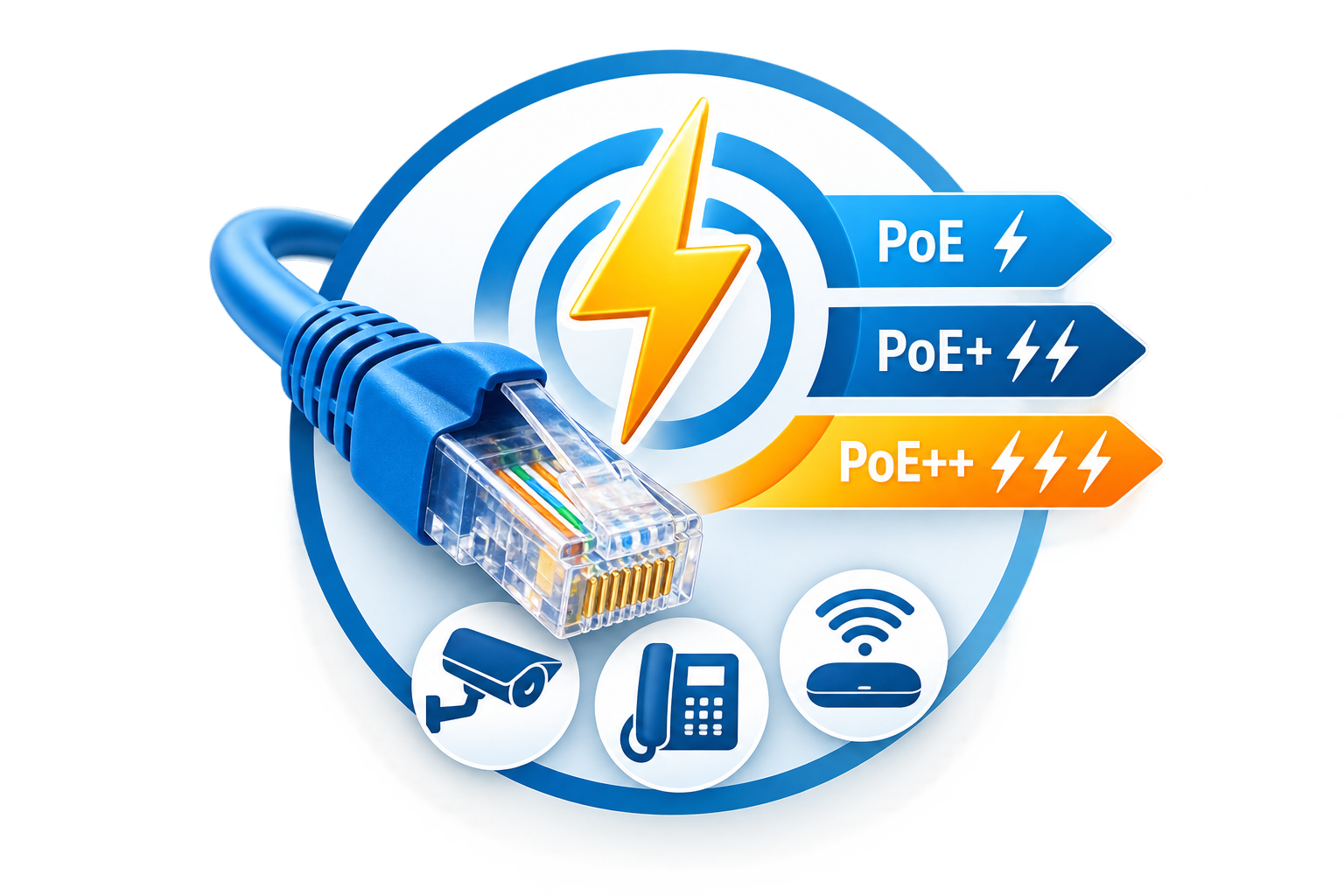
For PoE and PoE+, high-quality AWG26 solid copper patch cables may be suitable, provided they are approved by the manufacturer for the relevant PoE power rating. For PoE++ Type 3 and Type 4, larger copper conductors are becoming increasingly relevant. For newly planned high-power PoE runs, AWG24, AWG23 or AWG22 are advantageous, depending on power, length, bundling and installation.
A comparison of PoE, PoE+ and PoE++
Designation
IEEE standard
Type
Power at the PSE
Power at the terminal device*
Pairs of wires supplied
Typical applications
PoE
IEEE 802.3af
Type 1
up to 15.4 W
up to approx. 12.95 W
2 pairs
VoIP telephones, basic IP cameras, sensor systems
PoE+
IEEE 802.3at
Type 2
up to 30 W
up to approx. 25.5 W
2 pairs
Access points, cameras, IoT, small displays
PoE++
IEEE 802.3bt
Type 3
up to 60 W
up to approx. 51 W
4 pairs
High-performance access points, PTZ cameras, building services
PoE++ / 4PPoE
IEEE 802.3bt
Type 4
up to 90 W
up to approx. 71 W
4 pairs
Displays, lighting, power-hungry network devices and building services
Which AWG wire gauge is suitable for PoE?
An AWG23 conductor is therefore thicker than an AWG26 and, given a comparable design, has lower electrical resistance.
AWG
Nominal conductor cross-section approx.
Property
PoE rating
AWG 28
0.08 mm²
very thin, flexible, higher resistance
Suitable for short, specialised patch cables; for high PoE power ratings and long distances, only with appropriate product approval
AWG26
0.13 mm²
Typical patch cable cross-section
Suitable for PoE/PoE+ subject to appropriate manufacturer approval
AWG24
0.20 mm²
Larger conductor, lower resistance
Good headroom for higher-power PoE applications
AWG23
0.26 mm²
Commonly used in high-quality installation cables
An excellent basis for planning high-performance PoE/PoE++ infrastructures
AWG22
0.33 mm²
Large conductor, low resistance
High electrical headroom for demanding high-power PoE applications
PoE by power rating: Which patch cable should I choose?
Application
Practical cable selection
What should I pay particular attention to?
PoE
up to 15.4 WHigh-quality copper patch cable, e.g. AWG26 or larger
CU conductor, standard-compliant RJ45 connector and product approval
PoE+
up to 30 WAWG26 solid copper may be suitable if it has the appropriate PoE+ approval
Length, bundling, temperature and quality of the connectors
PoE++ Type 3
up to 60 Wpreferably larger copper conductors, e.g. AWG24 or AWG23, with explicit 802.3bt compliance
all four pairs, DC resistance, temperature and cable bundles
PoE++ Type 4
up to 90 WHigh-quality 4-pair PoE cabling with large copper conductors, for example AWG23 or AWG22, depending on the overall system
Explicit Type 4/4P PoE approval, heat generation, connectors and installation conditions
Even a cable with a large conductor cross-section should be technically suitable for the desired PoE application or approved by the manufacturer. Conversely, a high-quality AWG26 patch cable may be perfectly adequate for PoE+.
Why is a larger conductor advantageous for PoE?
AWG26
AWG23
Why are cable bundles important for PoE++?
PoE cables: copper or CCA?
Use network cables with 100% copper conductors and check the specific PoE certification of the product in question.
Cat 6A, Cat 7 or Cat 8 for PoE?
Does LAN shielding play a role in PoE?
What is the recommended patch cable length for PoE?
PoE++: Why are the RJ45 connectors also important?
DINIC patch cables for PoE and PoE+
Which cable is best suited for new PoE installations?
Planning scenario
Recommendation
VoIP, sensors, simple cameras
PoE-approved solid copper patch cable
Access points and PoE+ cameras
PoE+-approved CU patch cable, AWG26 or larger
New building cabling with PoE reserve
High-quality Cat 6A/Cat 7 infrastructure with solid copper conductors, for example AWG 23
PoE++ Type 3 up to 60 W
4-pair PoE-compatible system with larger copper conductors and explicit IEEE 802.3bt compliance
PoE++ Type 4 up to 90 W
Total cable run approved for Type 4; take into account large copper conductors, heat generation and cable bundling at the planning stage
Network cables for PoE and professional LAN installations
Frequently asked questions about PoE, PoE+ and PoE++ patch cables
Which cable do I need for PoE?
Which patch cable do I need for PoE+?
Which cable do I need for PoE++?
Is AWG23 better than AWG26 for PoE?
Which is better for PoE: AWG24 or AWG26?
Is AWG26 sufficient for PoE++?
Do I need Cat 8 for PoE++?
Can Cat 7 transmit PoE++?
Can I use a PoE+ cable for PoE++?
Why do PoE cables get warm?
Are CCA cables suitable for PoE?
What is 4PPoE?
How many watts does PoE++ supply?

B2B shop Retail, Trade & Industry
 German / Deutsch
 English
 French / Français
 Spanish / Español
 Dutch / Nederlands
 Italian / Italiano
 Polish / Polski
 Norwegian / Norsk
 Danish / Dansk
 Finnish / Suomi
 Swedish / Svenska
 Czech / Česky
 Greek / Ελληνικά
 Slovak / Slovenčina
 Slovenian / Slovenščina
 Estonian / Eesti
 Latvian / Latviešu
 Lithuanian / Lietuvių
 Hungarian / Magyar
 Romanian / Română
 Bulgarian / Български
 Portuguese / Português
MAG Network Guide
The short answer:
The smaller the AWG number, the larger the copper conductor.
Important: AWG23 does not automatically mean PoE++.
Particularly with PoE++ at 60 or 90 W: Do not focus solely on the patch cable. Installation cable, keystone jacks, network sockets, patch panels, RJ45 plugs and couplers must all be suitable for the planned power rating.
MAG recommendation for professional PoE networks:
As long as necessary – but not unnecessarily long.
Note regarding PoE++: An existing PoE+ approval must not be automatically extended to IEEE 802.3bt PoE++. For Type 3 or Type 4, the specific suitability of the respective patch cable and the other system components must be verified.