The short answer: For modern network, server and data centre connections, LC is now usually the first choice, as the compact connector enables high port density and is frequently used on optical transceivers. SC is larger, easy to handle and still widely used – particularly in patch panels, telecommunications and FTTH. ST, with its bayonet lock, is, on the other hand, mainly found in older fibre-optic installations as well as in specialised industrial and legacy networks.
However, the connector type alone is not sufficient for selecting a fibre-optic cable. In addition, the fibre type, whether simplex or duplex, the PC/UPC/APC polish, and the connectors at both ends must be suitable for the application.
The LC connector is now one of the most important fibre-optic connectors in professional data networks. Its ferrule has a diameter of just 1.25 mm. As a result, LC takes up significantly less space than SC or ST, which have 2.5-mm ferrules.
This is particularly important where a large number of fibre-optic connections need to be accommodated in a confined space. Typical applications include:
LC connectors are available in both simplex versions for a single fibre and duplex versions for two fibres. In standard Ethernet patch connections, two LC connectors are often combined to form a single duplex unit.
View suitable LC/LC OM4 fibre optic patch cables »
The SC connector has a 2.5 mm ferrule and a square design. It is connected and disconnected using a simple push-pull mechanism, making it easy to handle even in installation and technical areas.
SC connectors are found, amongst other places, in:
In the FTTH sector, SC/APC is particularly widespread. Depending on the router or ONT, an SC/APC-to-LC/APC connection cable may therefore be required, for example.
View SC/SC OM4 fibre optic patch cables »
The ST connector – Straight Tip – also has a 2.5 mm ferrule, but is locked in place using a round bayonet lock.
ST was particularly widespread in older multimode networks. Today, it is mainly still found in:
For new structured network cabling, LC or SC connectors are now generally preferred. However, ST remains relevant when existing installations need to be extended, repaired or connected to new technology.
There is no single ‘better’ fibre-optic connector. The choice depends on the existing interface, fibre type, application and required connection density.
Thanks to its smaller form factor, LC offers advantages in high connection density and is therefore particularly widespread in modern data centres and on active network components.
SC is larger and therefore very easy to grip. The connector remains widely used in professional networks, patch panels and, in particular, in fibre-optic access networks.
If an LC connector is required on one end and an SC connector on the other, a pre-terminated LC/SC fibre optic patch cable can be used. An additional media converter is not required simply because of the different mechanical connector types.
View LC/SC OM4 fibre optic patch cables »
In addition to the mechanical design, the polish or cut of the ferrule must also be taken into account, particularly for single-mode connections.
LC/APC and SC/APC are particularly relevant in single-mode, telecommunications and FTTH applications.
Colours help to identify fibre-optic components. For example, the following are commonly found:
However, colour alone should never replace technical testing. The specifications regarding fibre type, connector and polish are decisive.
Simplex means that a single optical fibre or a single optical transmission path is used. Such patch cables are frequently found in FTTH environments, for example.
Duplex uses two optical fibres. In many traditional optical Ethernet connections, one fibre is used for transmission and the second for reception. This is why LC patch cables for network and data centre applications are often used in a duplex configuration.
The illustrations show a DINIC LC/LC duplex version with two separate LC connectors at each end of the cable. In this design, the two connectors can be mechanically joined together using a duplex clip. The two optical fibres and transmission channels remain separate – the clip facilitates joint handling and ensures the correct pairing of the two connectors.
The fibre type and the connector type must always be considered separately:
An LC connector therefore does not automatically mean multimode, nor does an SC connector automatically mean single-mode. To select the correct cable, the appropriate fibre type must therefore always be determined in addition to the connector.
Yes. If one component has an LC connector and the other an SC connector, a pre-terminated LC/SC fibre-optic cable can be used.
Alternatively, suitable fibre-optic adaptors and couplers are available. However, the fibre type, polish and simplex/duplex configuration must still be compatible.
Many traditional SFP and SFP+ optical transceivers have LC connectors, often in the LC duplex configuration. However, the specific transceiver model and the transmission standard for which it is designed are always the decisive factors.
For higher data rates or other optical standards, connector systems such as MPO/MTP may also be used. The choice of connector should therefore always be based on the optical modules actually in use.
OS2 single-mode fibre is frequently used for FTTH and FTTB connections. The fibre optic connection box or GF-TA often features an SC/APC connector. Routers, ONTs or optical modules, on the other hand, may have a different connector.
For example, if the GF-TA has an SC/APC connector and the end device has an LC/APC connector, a pre-terminated OS2 simplex cable with an LC/APC to SC/APC connection is required.
View fibre optic cables for routers, FTTH and FTTB »
LC has a 1.25 mm ferrule and is significantly more compact. SC has a 2.5 mm ferrule and a larger push-pull design. LC is particularly suitable for high port densities, whilst SC is widely used in patch panels, telecommunications and FTTH, amongst other applications.
Not necessarily. LC takes up less space and is very common in modern network technology. SC is larger, easy to handle and remains an important connector type. The decisive factor is which connectors the existing devices and patch panels have.
With LC duplex, two LC connectors are used together. In traditional optical Ethernet connections, one fibre is often used for transmission and the second for reception. Depending on the cable design, two individual LC connectors can be mechanically coupled together via a duplex clip.
That depends on the cable design. In versions with a detachable duplex clip, the two LC connectors can be separated from one another or re-mounted together in the clip. Other LC duplex versions may have a different design.
Yes. LC refers to the connector type. LC connectors can be used on OM3 and OM4 multimode cables as well as on OS2 single-mode cables.
Yes. SC also primarily describes the mechanical connector design. SC is used for both multimode and single-mode connections.
SC describes the connector design. APC additionally describes the angled polish of the fibre end face. An SC/APC connector is therefore an SC connector with an APC polish and is frequently used on single-mode and FTTH connections.
This should be avoided. APC and UPC connectors have differently finished fibre end-faces. For a reliable optical connection, the types of polish on the components being connected must be compatible.
Yes, particularly in existing networks, industrial facilities and older multimode installations. For new structured IT networks, however, more compact connector systems such as LC or existing SC infrastructure are now predominantly used.
LC is very common in data centres because its compact design allows for high connection density and many optical network modules use LC connectors. However, depending on the data rate, transceiver and transmission standard, MPO/MTP or other connector systems may also be required.
SC/APC is frequently used for FTTH connections. An LC/APC connector may, for example, be present on a router, ONT or optical module. In this case, an OS2 patch cable with an LC/APC to SC/APC connector can be used.
DINIC fibre optic cables and accessories for data centres, server rooms, building cabling, FTTH, and professional network and telecommunications installations.
LC, SC or ST – which fibre-optic connector is best for which application?
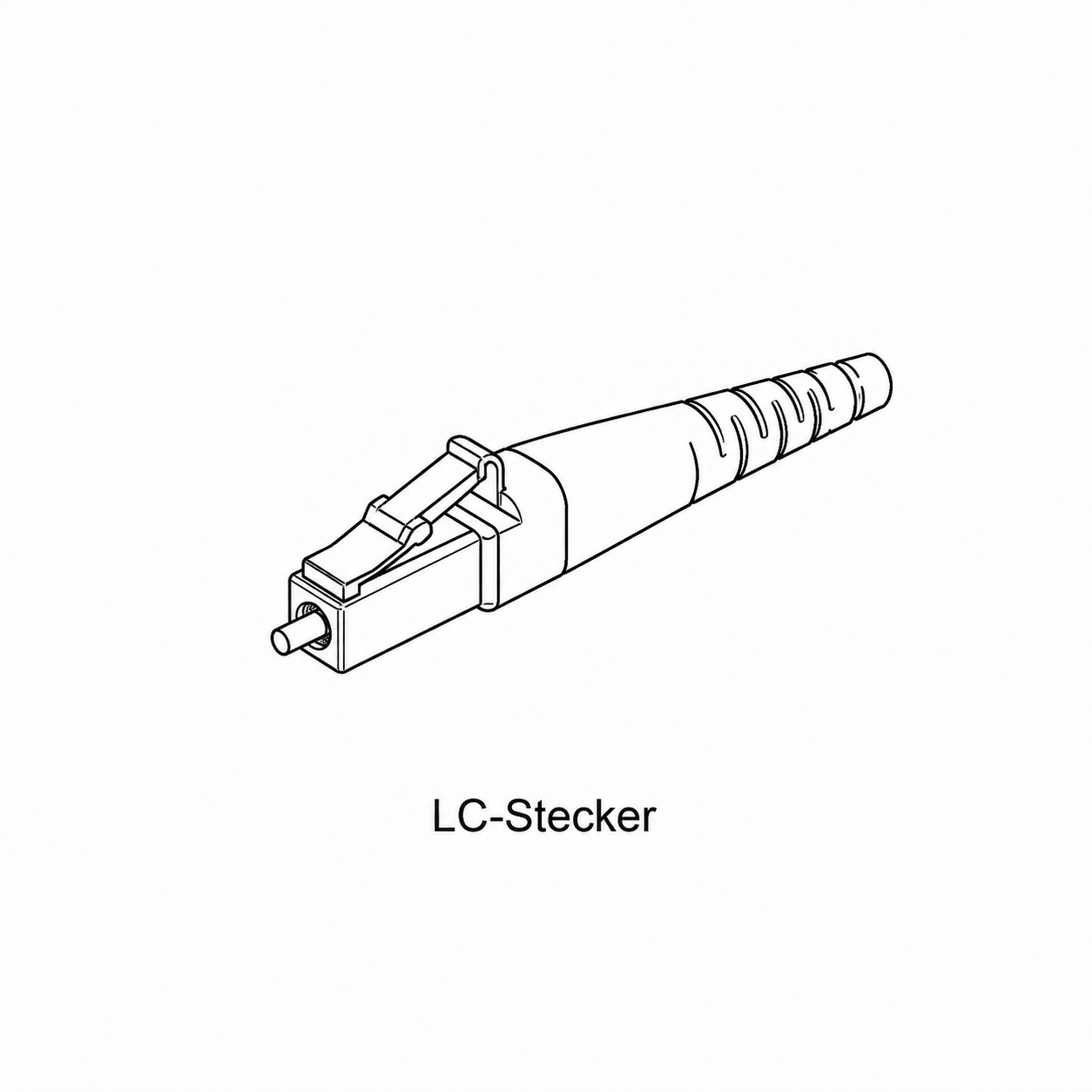
Compact and particularly widespread today
.png)
Tried-and-tested push-pull connector
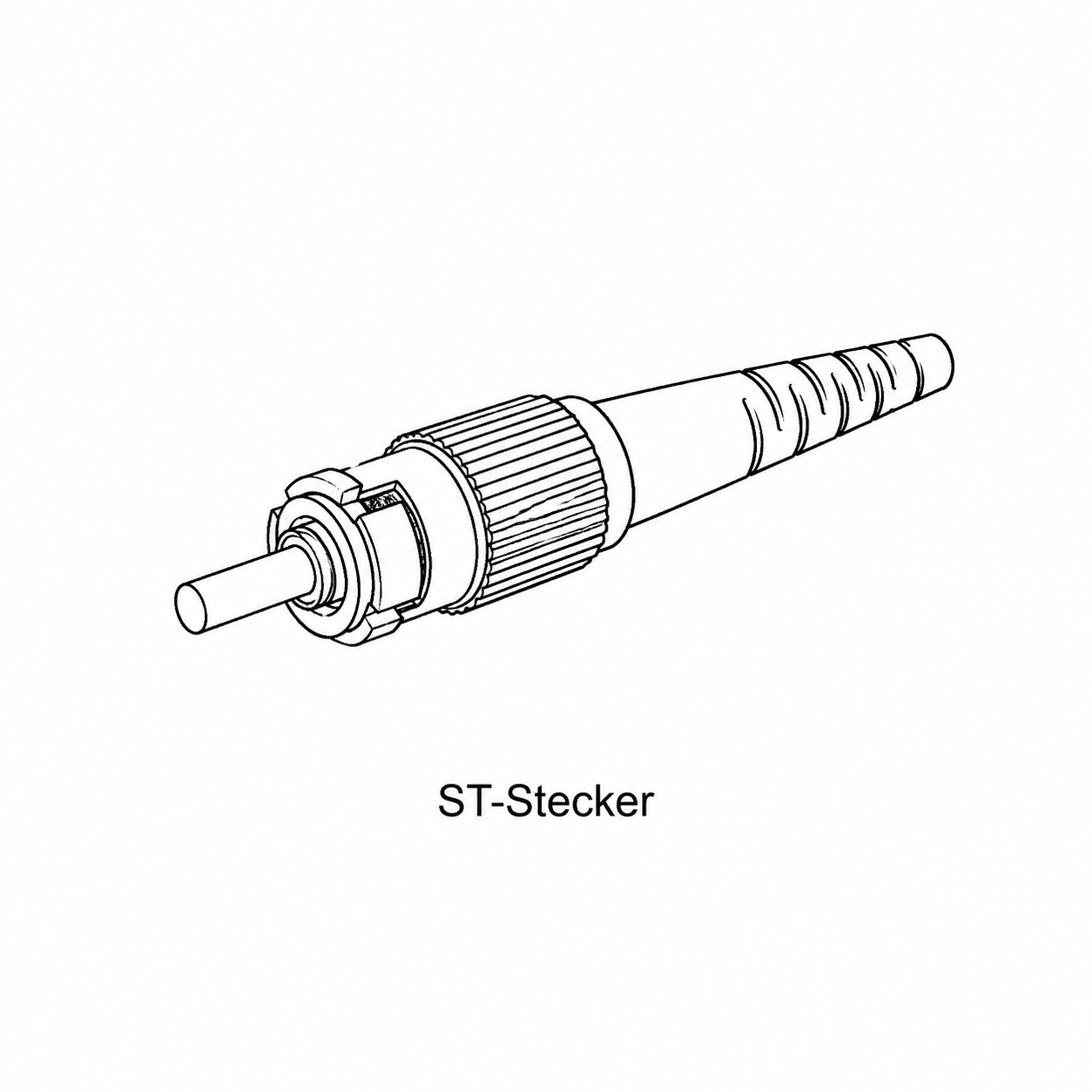
Primarily for existing installations
LC, SC and ST in direct comparison
Characteristic
LC
SC
ST
Design
Compact
square
round
Ferrule
1.25 mm
2.5 mm
2.5 mm
Locking mechanism
Locking mechanism
Push-pull
Bayonet lock
Port density
very high
medium
low
Simplex / Duplex
both possible
Both possible
usually single connectors
Multimode
yes
Yes
Yes, often found in older installations
Single-mode
yes
yes
technically possible, but much less common nowadays
APC versions
yes
yes
Uncommon in today’s network environment
Typical applications
Servers, switches, transceivers, patch panels, data centres
Patch panels, telecommunications, FTTH, building cabling
Older LANs, existing installations, some industrial and measurement technology applications
Recommendation for new installations
often the first choice
still a sensible option – depending on the infrastructure and application
usually only where ST infrastructure is already in place
Quick decision: Which fibre optic connector do I need?
An LC duplex connector is very often required. The key factor is always the socket on the transceiver being used.
Here, LC is often the preferred solution due to its compact design.
In that case, an SC connector is required on this side. Depending on the remote end, an SC/SC or LC/SC patch cable, for example, can be used.
SC/APC is often found here. On the router, ONT or optical module, however, LC/APC may be present, for example.
This is very likely to be an ST connector. When carrying out extensions, you should also check which type of fibre is already installed.
Recabling is not strictly necessary. Cables such as LC-to-SC can connect different mechanical connector systems directly to one another, provided the fibre type and polish are suitable for the application.When is LC the right choice?
When is SC the right choice?
When is an ST connector used?
LC or SC – which connector is better?
What do LC/PC, LC/UPC, LC/APC or SC/APC mean?
Designation
Meaning
Typical application
PC
Physical Contact
Basic polishing of fibre end faces
UPC
Ultra Physical Contact
Optimised straight polish with low back reflection
APC
Angled Physical Contact
Angled end face, typically 8°, for particularly low back reflection
Why are some fibre optic connectors green, blue or purple?
Simplex or duplex – which do I need?
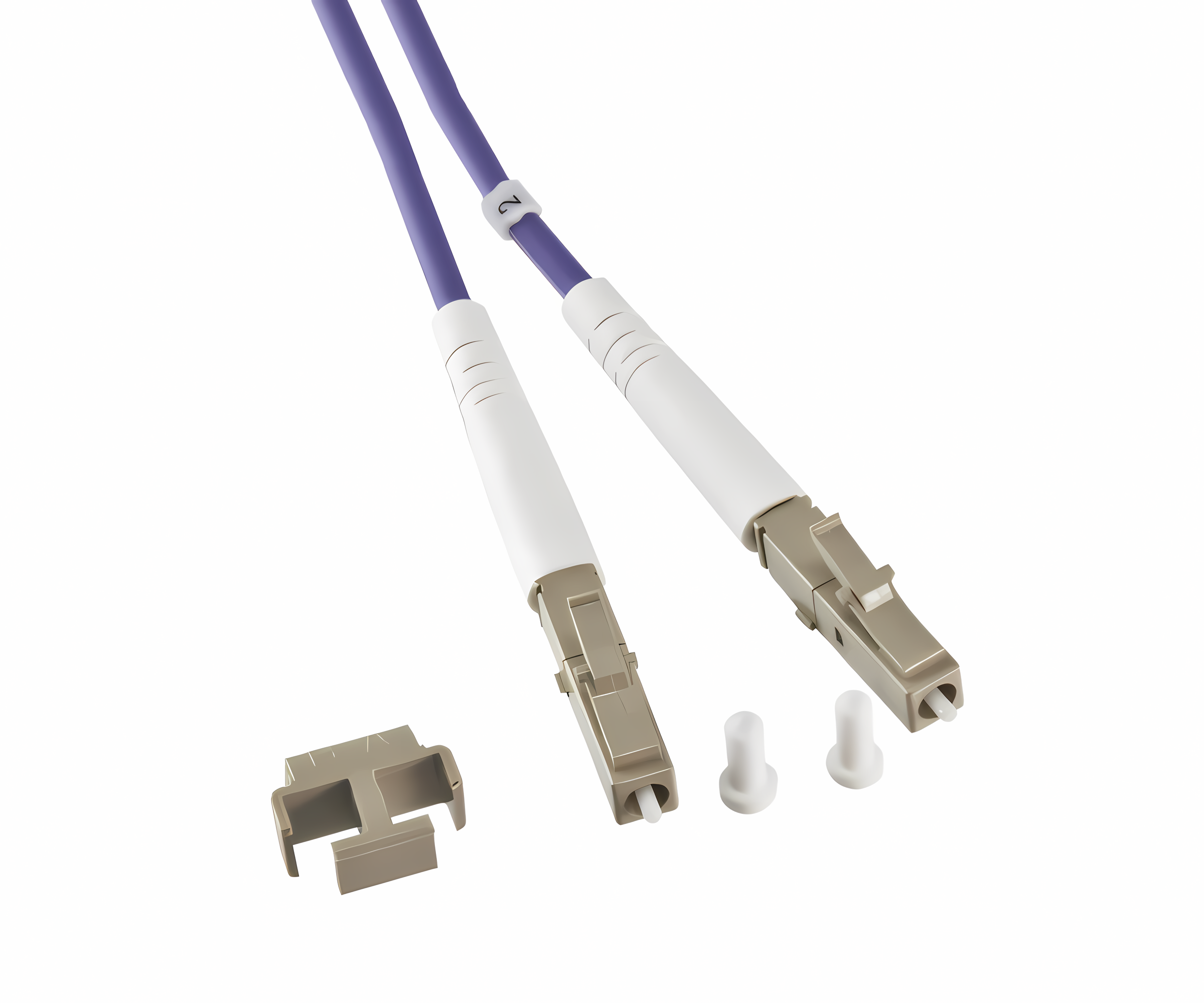
The two LC connectors can still be moved individually. The duplex clip lies separately beside them.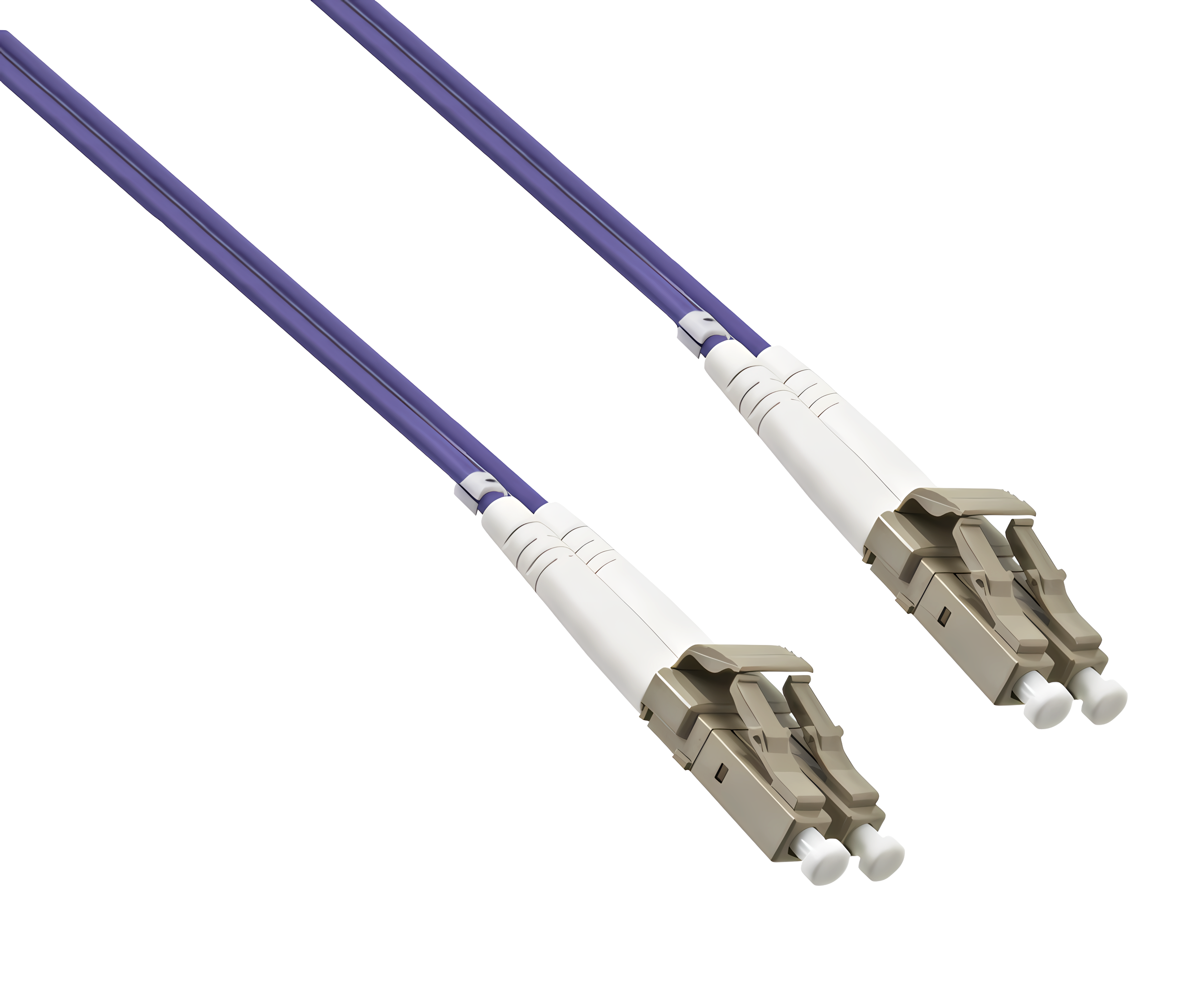
Two LC connectors are coupled together to form a single duplex unit and can be handled as a single unit.Which connector is suitable for OM3, OM4 or OS2?
the connector type
LC, SC, ST or another connector system must be mechanically compatible with the socket.
the fibre type
OM3, OM4 or OS2 must be suitable for the existing link and the transceiver.
the polish
For single-mode applications, take particular care not to confuse UPC and APC.
whether it is simplex or duplex
The number of fibres and the connection type must match the technology being used.
Can I connect LC and SC directly to each other?
Which fibre optic connector should be used for SFP and SFP+ modules?
Which fibre optic connector for FTTH and fibre optic routers?
Frequently asked questions about LC, SC and ST connectors
What is the difference between LC and SC?
Is LC better than SC?
What is an LC duplex connector?
Can an LC duplex connector be separated?
Can LC be both single-mode and multi-mode?
Can SC be used for both single-mode and multi-mode?
What is the difference between SC and SC/APC?
Can I connect SC/APC to SC/UPC?
Is ST still used today?
Which fibre-optic connector is used in data centres?
Which fibre optic connector is used for fibre optic connections?
Suitable fibre-optic patch cables and fibre-optic adaptors

B2B shop Retail, Trade & Industry
 German / Deutsch
  English
  French / Français
  Spanish / Español
  Dutch / Nederlands
  Italian / Italiano
  Polish / Polski
  Norwegian / Norsk
  Danish / Dansk
  Finnish / Suomi
  Swedish / Svenska
  Czech / Česky
  Greek / Ελληνικά
  Slovak / Slovenčina
  Slovenian / Slovenščina
  Estonian / Eesti
  Latvian / Latviešu
  Lithuanian / Lietuvių
  Hungarian / Magyar
  Romanian / Română
  Bulgarian / Български
  Portuguese / Português
Important: LC, SC or ST primarily describe the connector. It is not possible to deduce from this whether the cable is OM3, OM4 or OS2. LC and SC can be used for both multimode and single-mode fibre. The fibre type and connector type must therefore be considered separately.
Please note regarding APC and UPC: An APC connector should not be connected to a PC or UPC counterpart. The different fibre end faces do not align optically correctly and can lead to high attenuation and unwanted reflections. Therefore, do not just check for ‘LC or SC’, but always check the polish of both connectors as well.
Practical tip: Before connecting an LC duplex cable, ensure the correct Tx/Rx assignment or polarity is used. When making a connection without a link, you can therefore check the polarity of the two fibres in addition to the transceiver, fibre type and attenuation.
1. Check
2. Check
3. Check
4. Check