
 German / Deutsch
  English
  French / Français
  Spanish / Español
  Dutch / Nederlands
  Italian / Italiano
  Polish / Polski
  Norwegian / Norsk
  Danish / Dansk
  Finnish / Suomi
  Swedish / Svenska
  Czech / Česky
  Greek / Ελληνικά
  Slovak / Slovenčina
  Slovenian / Slovenščina
  Estonian / Eesti
  Latvian / Latviešu
  Lithuanian / Lietuvių
  Hungarian / Magyar
  Romanian / Română
  Bulgarian / Български
  Portuguese / Português
 -
You do not have any products in your shopping cart yet.
Cable reels / Installation cables
DINIC Cat 7 reel and installation cables are designed for permanent structured network cabling in offices, commercial premises, industrial settings, plant rooms and professional IT infrastructure. S/FTP with PiMF, solid AWG23/1 conductors and up to 1000 MHz provide a high-performance basis for professional data links up to 10 Gigabit.
DINIC Network · Structured building cabling · B2B
Cat 7 installation and run cables – S/FTP, AWG23 and 1000 MHz
For projects: standard and duplex installation cables, as well as a range of reel lengths, enable the planning of floor, riser, plant room and building cabling to suit specific requirements.
Cat 7 installation cable
1000 MHz high bandwidth reserve
S/FTP PiMF + braided screen
AWG23/1 solid conductor
Note: 10 Gbit/s system
100 / 500 m project reels

1 to 3 (from a total of 3)
Cat 7 installation cables for structured network cabling
Installation and laying cables form the permanently installed data link between patch panels, distribution frames and network sockets. Unlike flexible patch cables, DINIC Cat 7 installation cables use solid AWG23/1 conductors and are designed for permanent installation in professional network structures.
Typical applications include office and commercial buildings, floor-to-floor cabling, plant rooms, server rooms, industrial IT infrastructures, as well as the new installation, expansion and modernisation of existing data networks.
For professional new installations:
Cat 7, S/FTP/PiMF, solid AWG23 conductors and carefully matched connection technology form a high-performance foundation for structured 10-gigabit networks and future expansions.
Cat 7, S/FTP/PiMF, solid AWG23 conductors and carefully matched connection technology form a high-performance foundation for structured 10-gigabit networks and future expansions.
Which DINIC installation cables are available?
| Type | Typical use | Special feature |
|---|---|---|
| Cat 7 installation cable, 100 m | Building, floor and project cabling | S/FTP, PiMF, AWG23/1, 1000 MHz, LSZH; certified depending on the item |
| Cat 7 duplex installation cable, 100 m | Two parallel data connections and structured dual runs | Two cables can be laid together – useful for parallel network routes |
| Cat 7 installation cable, 500 m | Larger installations, bulk laying and extensive building projects | Long roll lengths for cost-effective installation of extensive cable runs |
Standard or duplex – which version is best?
Standard installation cable
Single data cable for traditional structured network runs between patch panels and connection sockets.
A flexible solution for individual cable routes and demand-driven port planning.
Duplex installation cable
Two data cables are routed in parallel and can be installed together along a single cable route.
Particularly practical for dual connections and data links that are regularly required in pairs.
500-metre rolls
Long roll lengths minimise the need to change rolls on large-scale projects and enable efficient material planning.
Of interest to installation contractors, larger properties and bulk orders.
Why AWG23 for installation cables?
AWG describes the conductor size. The rule is: the smaller the AWG number, the larger the conductor. AWG23 therefore has a larger copper cross-section than, for example, AWG26, which is frequently used in flexible patch cables.
Solid AWG23/1 conductors are used in installation cables. The larger conductor cross-section offers low electrical resistance and is therefore particularly suitable for longer fixed data links and high-performance network structures.
Cat 7, 1000 MHz and 10 Gigabit – what do these mean?
DINIC installation cables in this category have a Cat 7 cable construction and, depending on the version, are specified up to 1000 MHz. They therefore offer high transmission headroom for professional data installations.
However, the category of the installation cable alone is not sufficient for a complete 10-Gigabit network link. Network sockets, keystones, patch panels, patch cables, connectors and active network devices must also be designed for the required transmission performance.
Always consider Cat 7 as a complete system:
The performance of a structured network cabling system is determined by the entire transmission path. Use connection modules, network sockets, patch panels and patch cables that are compatible with the installation cable.
The performance of a structured network cabling system is determined by the entire transmission path. Use connection modules, network sockets, patch panels and patch cables that are compatible with the installation cable.
S/FTP and PiMF – shielding for professional networks
With S/FTP, the individual twisted pairs are shielded separately by metal foil. This pair-by-pair shielding is known as PiMF – Pair in Metal Foil. In addition, the entire cable has a braided shield.
This design offers high levels of shielding against electromagnetic interference and crosstalk between the wire pairs. This can be particularly advantageous in situations with high cable density, technical rooms or industrial installation environments.
More on the different cable shielding types: U/UTP, F/UTP, S/FTP – which LAN shielding is right for you?
Installation cables and PoE – why AWG23 is of interest
With Power over Ethernet, data and electrical power are transmitted together via the copper conductors. In addition to the Ethernet category, the conductor material, conductor cross-section, cable length, bundling and temperature therefore play a particularly important role.
Solid AWG23 copper conductors generally offer good electrical headroom for high-performance PoE infrastructures due to their larger cross-section. However, this should not automatically be taken to mean approval for every PoE or PoE++ power level.
For PoE and, in particular, PoE++:
Do not focus solely on the cabling. Patch cables, Keystone modules, network sockets, patch panels and connectors must also be suitable for the planned PoE power rating. The technical specifications and approvals of the respective components are decisive.
Do not focus solely on the cabling. Patch cables, Keystone modules, network sockets, patch panels and connectors must also be suitable for the planned PoE power rating. The technical specifications and approvals of the respective components are decisive.
Further information: PoE, PoE+ and PoE++ – which patch cable and which AWG gauge?
Installation cable or patch cable?
| Feature | Installation cable | Patch cable |
|---|---|---|
| Main application | Permanent structured cabling | Flexible device and patch connections |
| Conductor | Solid conductors, in this case AWG23/1 | Often flexible stranded conductors |
| Typical installation | Cable trunking, conduit, riser, underfloor and building installations | Switch, patch panel, workstation, server and end device |
| Connectors | Connected on site using suitable connection modules | Pre-assembled, for example RJ45–RJ45 |
| Corresponding MAG product group | Reel cable / installation cable | Cat 7 patch cables |
LSZH or FRNC-B – select the sheathing appropriate for the installation
Depending on the item, different sheath types are available in this category. When making your selection, you should take into account the location of use, the building’s purpose, the fire safety concept, the installation conditions and the requirements of the specific project.
For example, the 100-metre installation cables are available in an LSZH version, whilst the 500-metre rolls are fitted with an FRNC-B sheath, depending on the item. The technical specifications of the specific product are always decisive.
The three most important guides to network planning
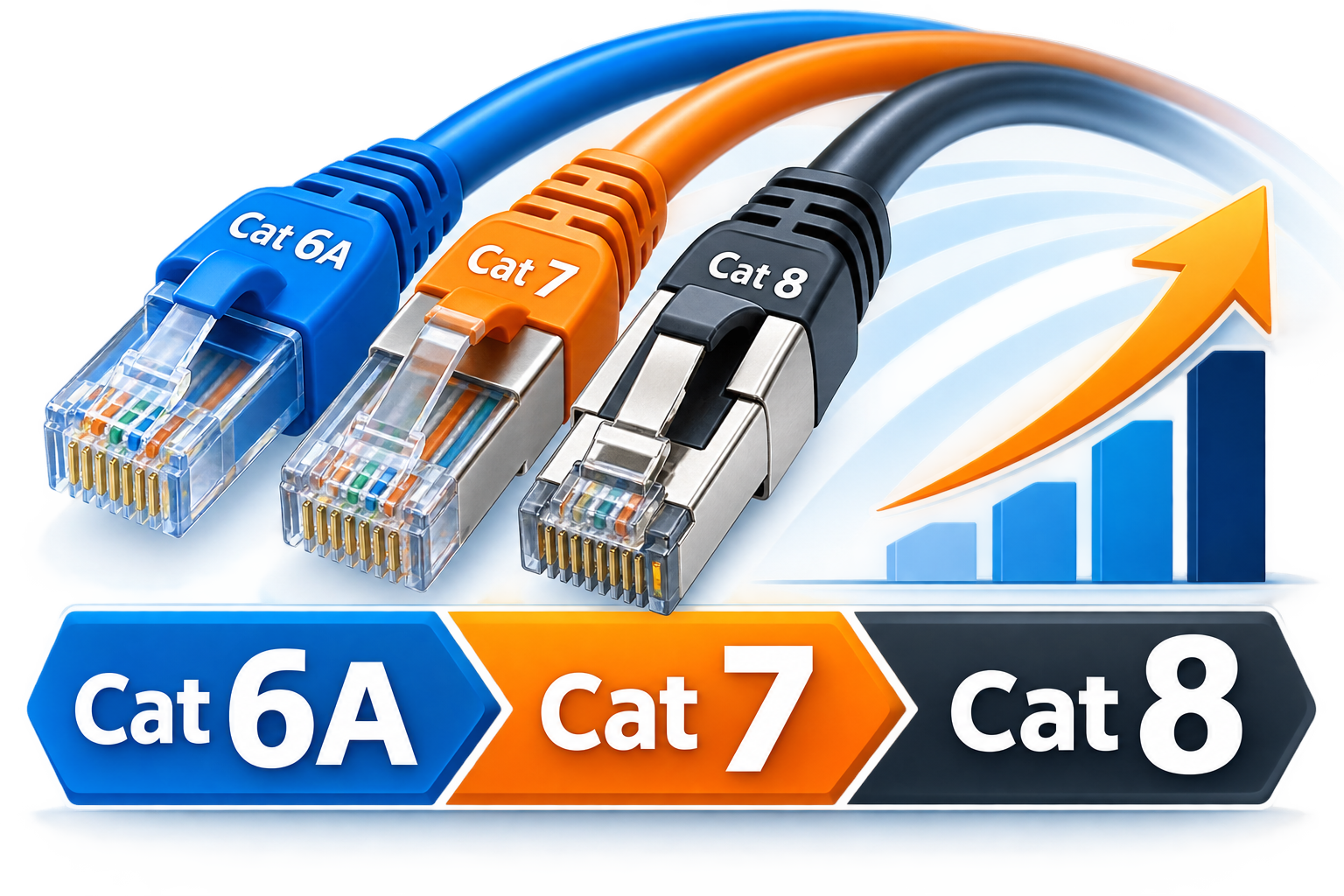
Cat 6A, Cat 7 or Cat 8?
Data rate, frequency, range and areas of application for the various network categories.
Compare categories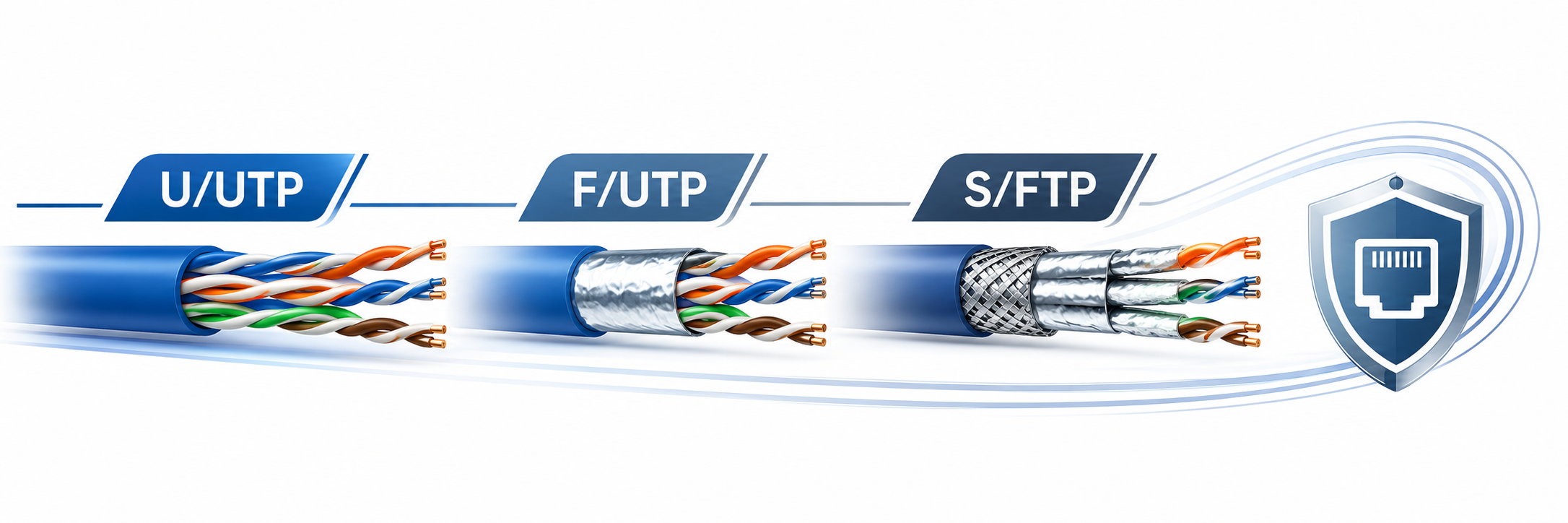
Which LAN shielding?
What U/UTP, F/UTP and S/FTP mean, and when shielded cabling is advisable.
Compare shielding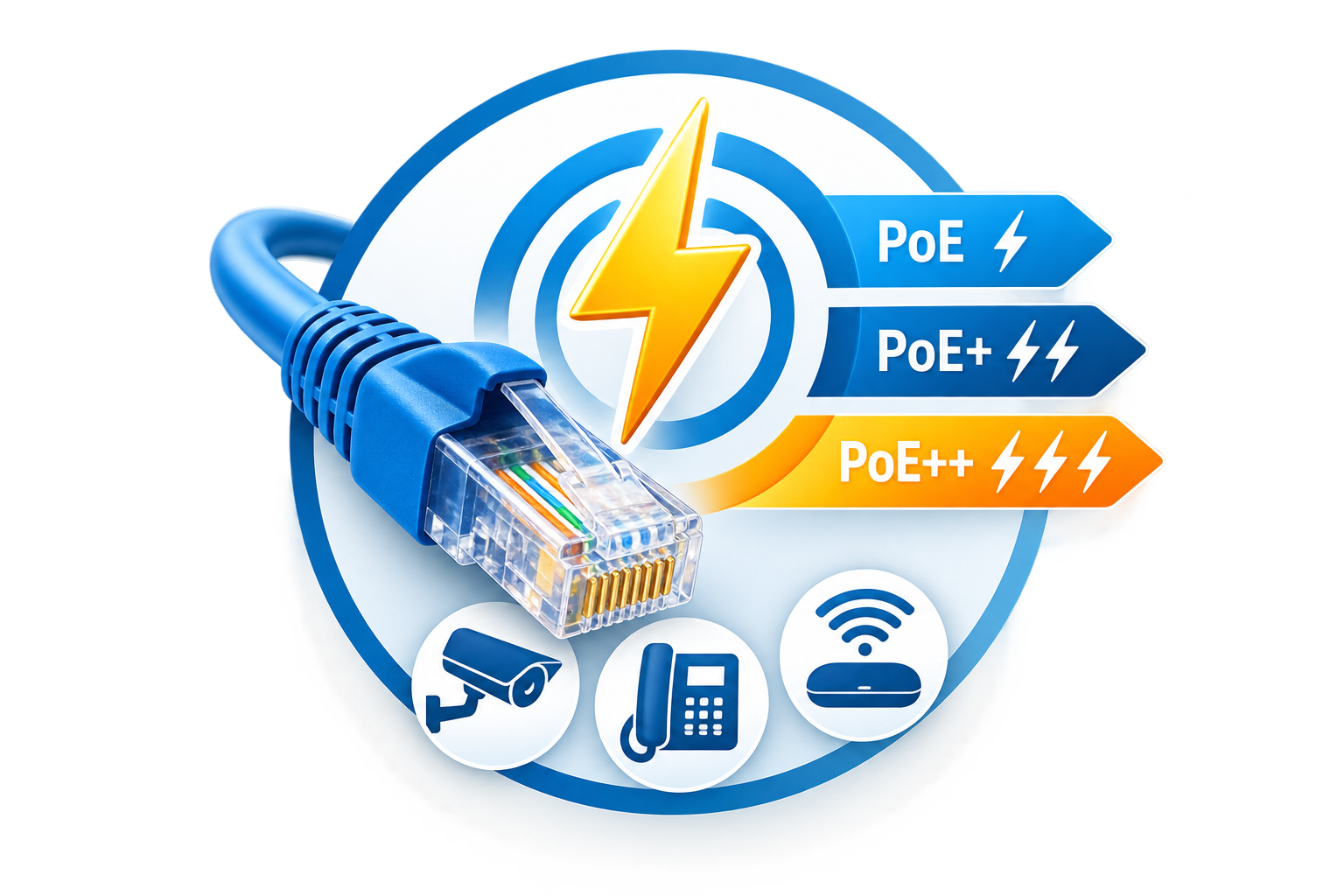
PoE and AWG wire gauge
Conductor size, power, cable length and heat generation with Power over Ethernet.
Planning PoE cablesCat 7 installation cables for B2B and network projects
MAG offers DINIC laying and installation cables for installation contractors, system integrators, specialist retailers, building services, industry and professional network projects. Standard, duplex and long reel lengths enable project-specific material planning, from individual data links right through to extensive structured building cabling.
Frequently asked questions about Cat 7 installation cables
What is the difference between installation cable and patch cable?
Installation cables are designed for permanently installed structured data runs and typically feature solid conductors. Patch cables, on the other hand, are flexible and pre-terminated with connectors to link devices and connection points.
What does AWG23/1 mean?
AWG23 describes the conductor size. The notation ‘/1’ indicates a solid single conductor. This construction is typically used in permanently installed cables.
What do S/FTP and PiMF mean?
In S/FTP, each twisted pair has a foil shield – PiMF, which stands for ‘Pair in Metal Foil’. In addition, a braided shield encloses the entire cable. This provides high levels of shielding for professional network environments.
What is a duplex installation cable?
In a duplex configuration, two separate data cables are routed together. This can simplify installation where two network connections are regularly required along a single cable route.
Is Cat 7 suitable for 10 Gigabit?
Cat 7 installation cables provide a high-performance foundation for 10-Gigabit networks. However, the actual performance achievable always depends on the entire transmission path, including connector modules, patch panels, patch cables and active hardware.
Is AWG23 suitable for PoE?
AWG23 has a comparatively large conductor cross-section and therefore offers good electrical conditions for high-performance PoE cabling. However, the permissible PoE power rating must be checked against the technical approval of the specific cable and the entire cabling run.
What roll length is suitable for a network project?
For smaller projects and individual cable runs, for example, 100-metre rolls are practical. For extensive building cabling, a 500-metre roll can simplify material planning and reduce the number of roll changes.