
 German / Deutsch
  English
  French / Français
  Spanish / Español
  Dutch / Nederlands
  Italian / Italiano
  Polish / Polski
  Norwegian / Norsk
  Danish / Dansk
  Finnish / Suomi
  Swedish / Svenska
  Czech / Česky
  Greek / Ελληνικά
  Slovak / Slovenčina
  Slovenian / Slovenščina
  Estonian / Eesti
  Latvian / Latviešu
  Lithuanian / Lietuvių
  Hungarian / Magyar
  Romanian / Română
  Bulgarian / Български
  Portuguese / Português
 Cat. 8.1 patch cable
DINIC Cat 8.1 patch cables are designed for high-performance RJ45 network connections in racks, server rooms, data centres and professional IT infrastructure. They combine up to 2000 MHz, S/FTP shielding, AWG26 solid copper conductors, an LSZH sheath and RJ45 connectors, and support data rates of up to 40 Gbit/s in appropriately configured network segments.
Cat 8.1 patch cables – 2000 MHz, up to 40 Gbit/s, S/FTP & RJ45

DINIC Cat 8.1 patch cables for high-speed RJ45 networks
Cat 8.1 was developed for particularly high-performance copper Ethernet connections whilst retaining the widely used RJ45 connector. This allows the high transmission performance to be combined with an interface that is also used in numerous existing network devices.
DINIC Cat 8.1 patch cables are tested up to 2000 MHz and are intended for data rates of up to 40 Gbit/s within appropriately configured network links. Cat 8.1 is therefore particularly suitable for rack, server, storage, switch and data centre environments.
Cat 8.1 offers very high frequency and transmission reserves, but is not automatically the best choice for every LAN connection. For standard Gigabit or 10-Gigabit connections, high-quality Cat 7 patch cables are also a practical solution.
Technical specifications of the DINIC Cat 8.1 patch cables
| Feature | Design | Significance for the application |
|---|---|---|
| Category | Cat 8.1 | High-speed copper cabling with RJ45 connectors |
| Frequency | up to 2000 MHz | High transmission margin for demanding short network connections |
| Data rate | up to 40 Gbit/s | For appropriately designed high-speed links and suitable active network hardware |
| Connectors | 2× RJ45 | Direct RJ45 connection to switches, servers, patch panels and other network devices |
| Shielding | S/FTP – PiMF + braided shield | High shielding margin at high frequencies and in dense network cabling |
| Conductor | 100% copper, AWG26 | Defined electrical properties and suitable for the specified PoE applications |
| Sheath | LSZH / halogen-free | Suitable for many professional technical, rack and installation environments |
| PoE | PoE+ in accordance with IEEE 802.3at | Power and data transmission, for example for access points, cameras and VoIP terminals |
The achievable data rate does not depend solely on the patch cable. The cable length, total distance, connectors, patch panel, connection components, switch and network card must also support the desired Ethernet standard.
Where are Cat 8.1 patch cables particularly useful?
Servers & switches
For high-performance RJ45 connections between servers and suitable network switches.
Particularly useful where there are high demands on bandwidth and frequency reserve.
Rack & Patch Panel
For short patch connections within network cabinets and equipment rooms.
S/FTP offers high shielding reserves for dense cable and port configurations.
Storage & NAS
For high-performance storage and network connections, provided the connected systems support the relevant data rate.
Of interest for bandwidth-intensive professional applications.
Data Centre
Cat 8.1 is specifically designed for short, high-speed copper connections in performance-oriented IT infrastructures.
RJ45 remains the standard connector technology.
Industry & IT/OT
In technical or industrial environments, electromagnetic interference and high demands on signal quality may arise.
S/FTP with PiMF and braided shield offers a high-performance shielded cable design.
PoE & PoE+
Compatible network devices can receive both data and electrical power via the same Ethernet connection.
DINIC Cat 8.1 AWG26 cables are certified for PoE+ in accordance with IEEE 802.3at.
Cat 7 or Cat 8.1 – which patch cable should I choose?
| Application | Cat 7 | Cat 8.1 |
|---|---|---|
| 1 Gbit/s | Very well suited | Technically possible, but usually not required |
| 2.5 / 5 Gbit/s | Very well suited | Technically possible |
| 10 Gbit/s via RJ45 | Practical solution | Very high headroom |
| 25/40 Gigabit copper link | Not the intended category | Cat 8.1 with a suitably short total run and appropriate hardware |
| Office / Workstation | Often economically viable | Where there is a specific need for high speed or spare capacity |
| Server / rack / high-speed | Suitable for 10-gigabit connections | Particularly interesting |
You can find a detailed guide in the MAG guide Cat 6A, Cat 7 or Cat 8 – which network cable do I need?
Why does Cat 8.1 use S/FTP?
As transmission frequencies increase, so do the demands on signal transmission and interference suppression. With S/FTP, the individual wire pairs are shielded separately by metal foil. In addition, the entire cable has a braided shield.
This combination offers high levels of shielding and is particularly suitable for densely populated racks, equipment rooms and high-frequency network links.
More on the different types of shielding: U/UTP, F/UTP, S/FTP – which LAN shielding is right for you?
Cat 8.1 and PoE – is AWG26 sufficient?
DINIC Cat 8.1 patch cables feature 100% copper conductors in AWG26 and are certified for PoE+ in accordance with IEEE 802.3at. This is a practical combination for the relevant PoE and PoE+ applications.
However, approval for PoE+ must not automatically be assumed to apply to PoE++ in accordance with IEEE 802.3bt. For higher power ratings, factors such as conductor cross-section, cable length, bundling, temperature and the technical approval of all components must be taken into account.
Detailed information: PoE, PoE+ and PoE++ – which patch cable and which AWG gauge?
The three most important guides to network planning
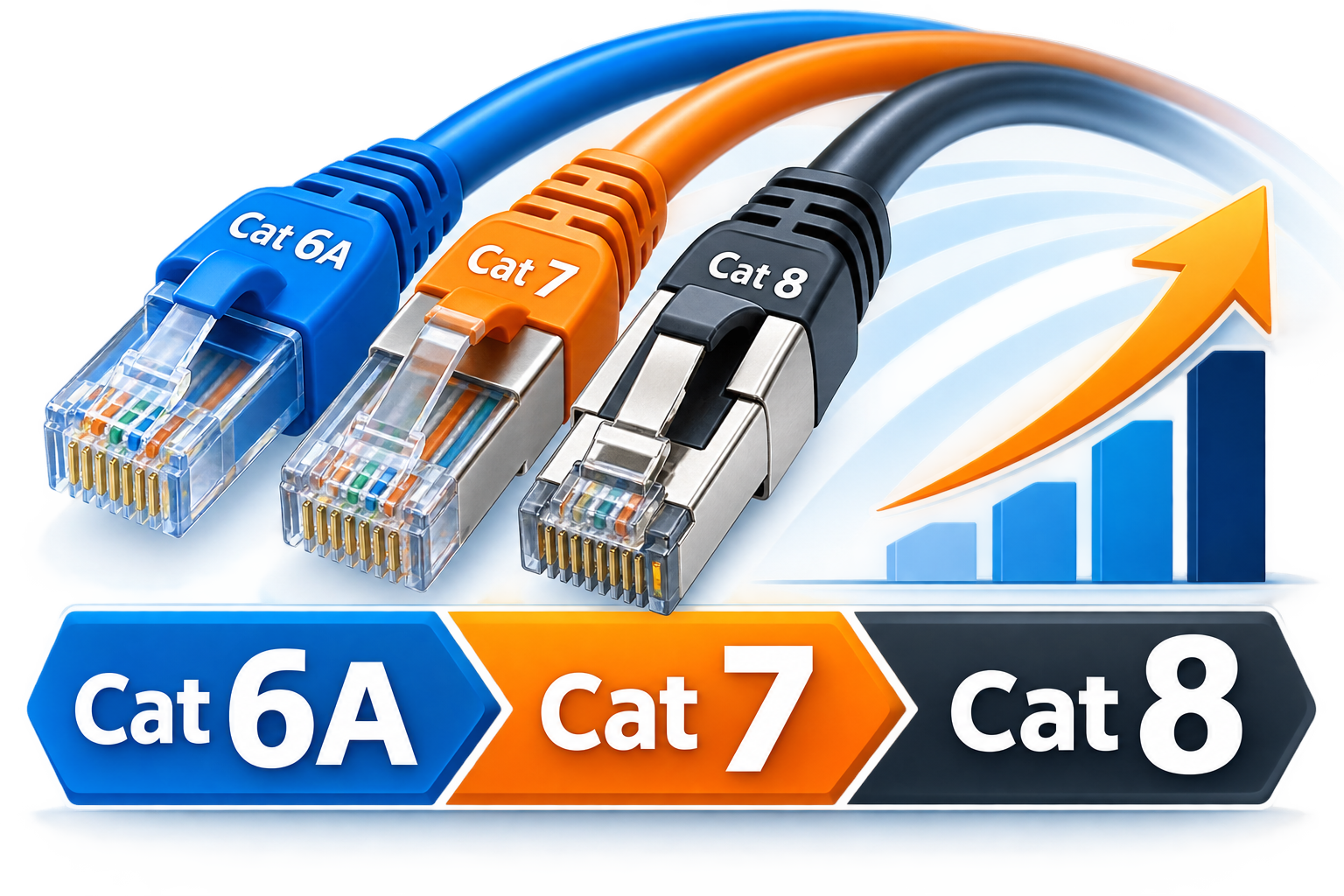
Cat 6A, Cat 7 or Cat 8?
Data rate, frequency, range and typical applications of the categories in a direct comparison.
Compare categories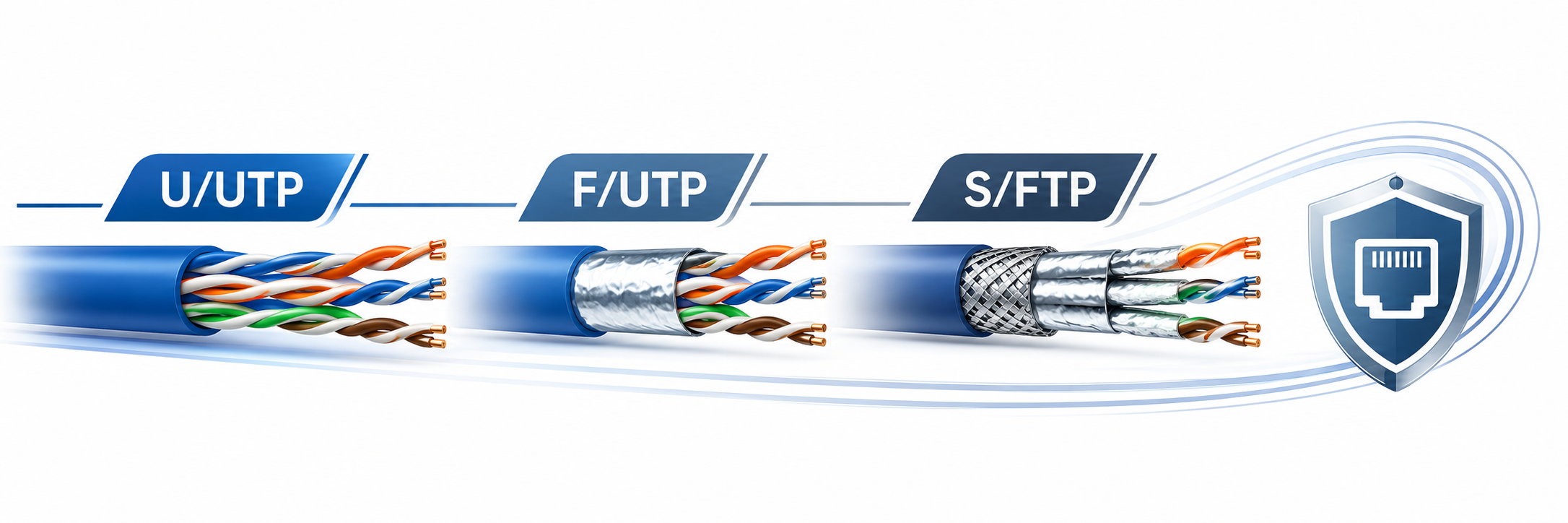
Which LAN shielding?
Differences between U/UTP, F/UTP and S/FTP, as well as typical applications.
Compare shielding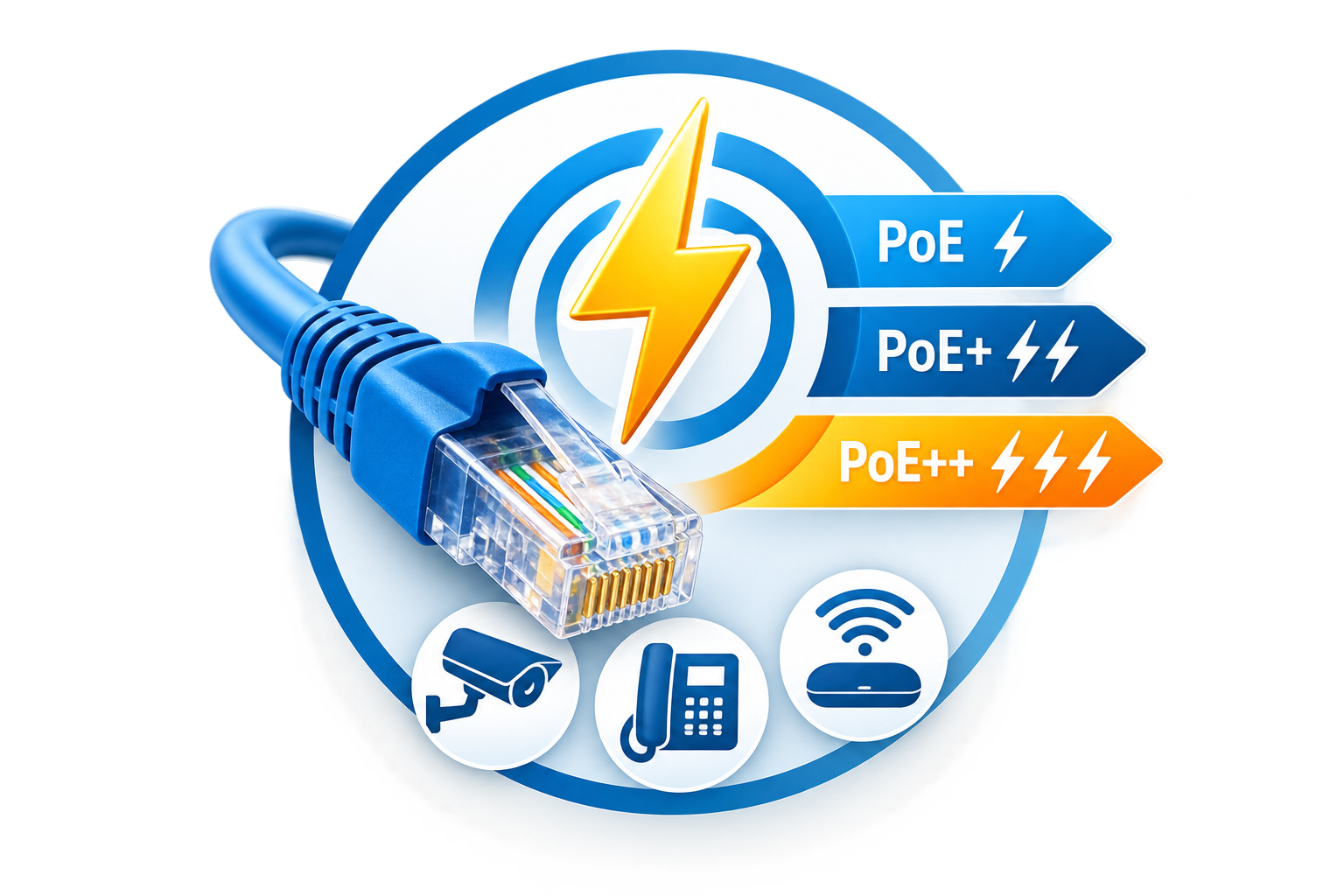
PoE, PoE+ and PoE++
The role of AWG, solid copper, cable length and PoE power in cable selection.
Selecting PoE cablesCat 8.1 patch cables for B2B and professional IT projects
MAG offers DINIC Cat 8.1 patch cables for specialist retailers, system integration, server and network technology, industry and professional IT infrastructures. A range of cable lengths enables the appropriate connection of patch panels, switches, servers, storage devices and other RJ45 components.
Frequently asked questions about Cat 8.1 patch cables
How fast is Cat 8.1?
Cat 8.1 is designed for high-performance short copper runs and supports data rates of up to 40 Gbit/s within appropriately configured network connections. The entire run and the active network hardware must support this data rate.
What frequency does Cat 8.1 support?
DINIC Cat 8.1 patch cables are tested up to 2000 MHz. The high specified frequency provides ample transmission headroom for high-performance Ethernet connections.
Does Cat 8.1 have an RJ45 connector?
Yes. Cat 8.1 uses the familiar RJ45 connector. This means that Cat 8.1 patch cables can also be used with RJ45 devices operating at lower Ethernet speeds. The connection will then operate at the speed supported by all components.
Do I need Cat 8.1 for 10 Gigabit?
No. Cat 8.1 is not technically essential for 10GBASE-T. High-quality Cat 7 patch cables or suitable Cat 6A cabling can also support 10 Gigabit Ethernet.
Which is better – Cat 7 or Cat 8.1?
That depends on the application. For standard Gigabit and 10-Gigabit networks, Cat 7 is often a practical solution. Cat 8.1 offers higher frequency headroom and is particularly suitable for short, high-speed connections, especially where 25- or 40-Gigabit copper connections are planned.
Is Cat 8.1 suitable for PoE?
The current DINIC Cat 8.1 patch cables with AWG26 solid copper conductors are certified for PoE+ in accordance with IEEE 802.3at. For PoE++, however, the specific suitability of the cable in question and the entire cabling run must be verified.
What does S/FTP mean in the context of Cat 8.1?
In S/FTP, each twisted pair is shielded separately with metal foil. In addition, the entire cable has a braided shield. This design offers high shielding reserves under demanding network and installation conditions.
Are DINIC Cat 8.1 patch cables halogen-free?
The current DINIC Cat 8.1 series features an LSZH sheath. LSZH stands for Low Smoke Zero Halogen and refers to halogen-free sheathing material with reduced smoke emission in the event of a fire.