 German / Deutsch
 French / Français
 Spanish / Español
 Dutch / Nederlands
 Italian / Italiano
 Polish / Polski
 Norwegian / Norsk
 Danish / Dansk
 Finnish / Suomi
 Swedish / Svenska
 Czech / Česky
 Greek / Ελληνικά
 Slovak / Slovenčina
 Slovenian / Slovenščina
 Estonian / Eesti
 Latvian / Latviešu
 Lithuanian / Lietuvių
 Hungarian / Magyar
 Romanian / Română
 Bulgarian / Български
 Portuguese / Português
Type G plug (BS 1363): Countries, standards, approvals and fuses
Type G plugs, featuring three rectangular pins, are best known in the UK but are also used in other countries and markets. It is crucial to bear in mind for procurement, equipment manufacturing, OEMs, system integration and export that the same plug design does not automatically mean the same approval for every target market.
To select the correct Type G power cable, the destination country, mains voltage, frequency, fuse rating, conductor cross-section, current-carrying capacity, appliance connection and product-specific approvals must all be taken into account.
Type G describes the characteristic plug design with three rectangular contact pins. BS 1363 is the authoritative UK standards family for the corresponding plug system. A Type G plug may also fit mechanically into sockets in other Type G countries. However, this does not automatically mean that a product tested exclusively for the UK is also approved for Singapore, Hong Kong, Saudi Arabia or any other market.
Identifying Type G plugs: pins, fuse and design
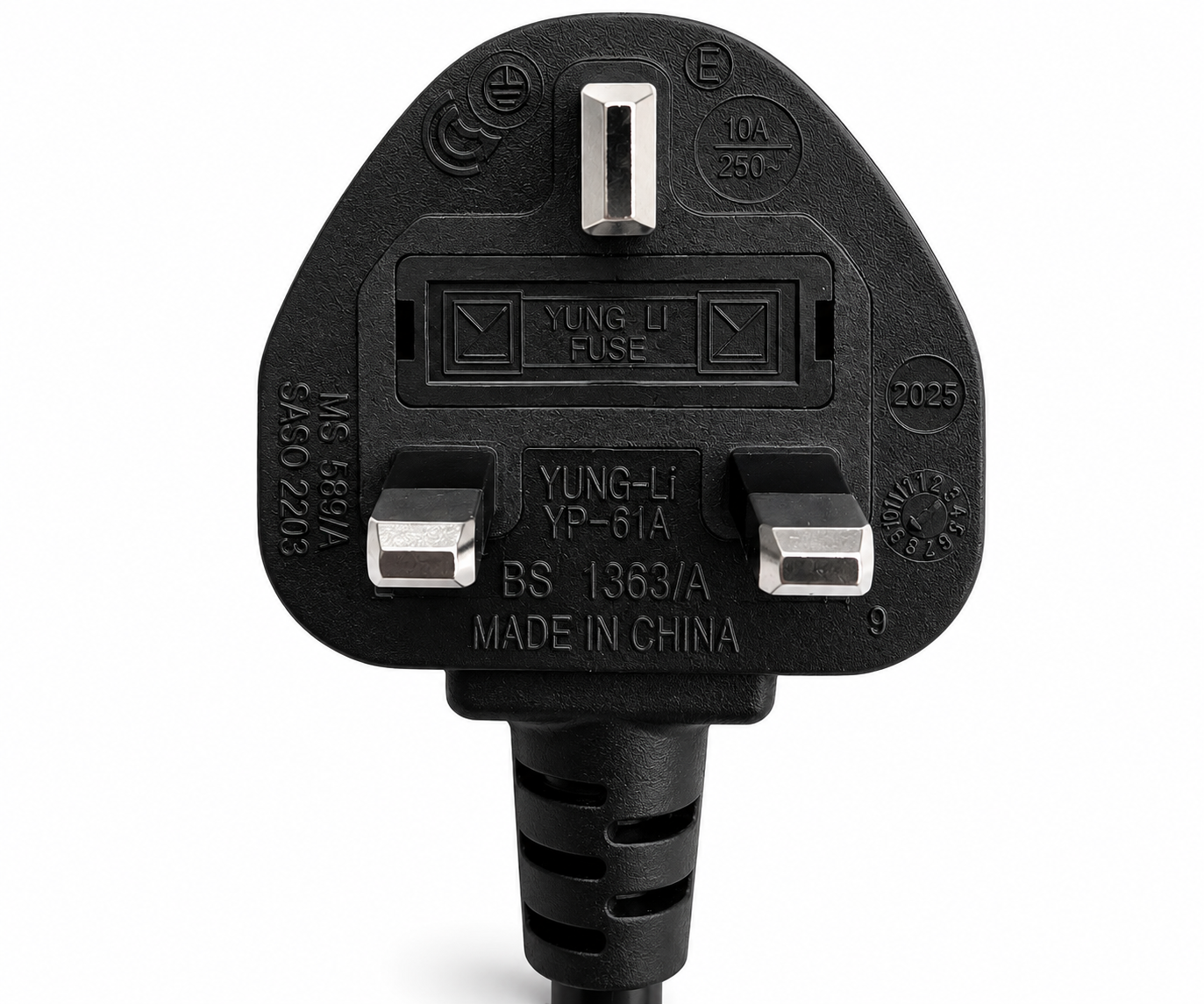
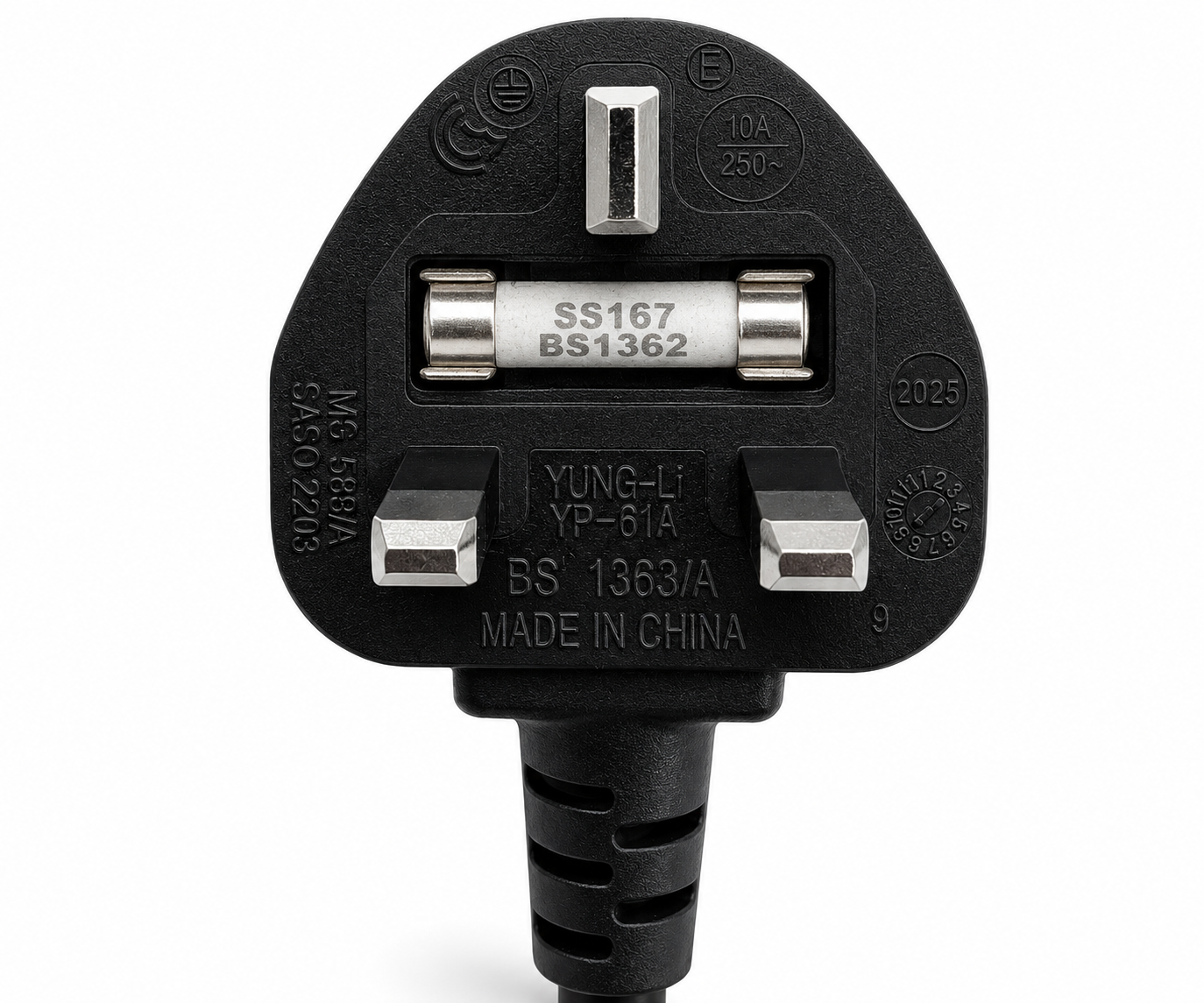
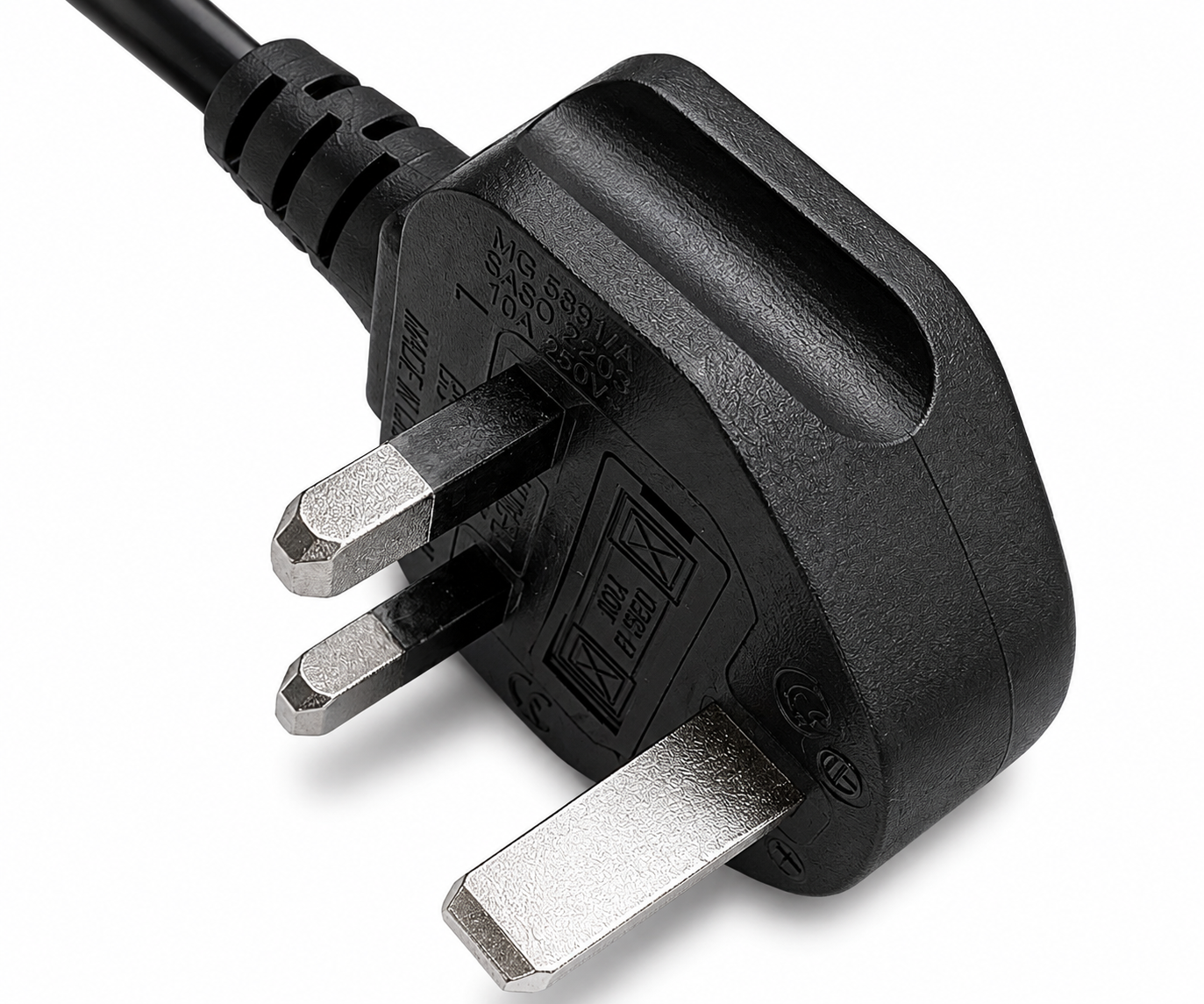
Type G mains plugs are easily recognised by their three rectangular contact pins. When viewed from the front, the earth pin is at the top, the neutral pin on the left and the live pin on the right. The fuse is located in the live pin’s current path.
In the classic BS 1363 system, the earth pin is longer. In compatible sockets, it assists in operating the integrated earth contacts. Another distinctive feature is the fuse integrated into the plug.
Type G and BS 1363 – what is the difference?
Type G plug
‘Type G’ is the internationally recognised designation for the plug system with three rectangular contact pins. It helps with the rapid identification of plugs and sockets.
However, the designation alone does not indicate which national approval a specific product holds.
BS 1363
BS 1363 refers to the British family of standards for the relevant plugs, sockets and other components. For mains plugs, a fuse is part of the system.
For appliances and connecting cables, the current-carrying capacity, cable and fuse must also be suitable for the specific product version.
In which countries is plug type G used?
Type G is used in several European, Asian and Arab markets. The distinction between mechanical compatibility and market approval is particularly important for international series projects.
| Country / Market | Plug system | Typical mains supply | Standard / Approval / Project note |
|---|---|---|---|
 Great Britain / UK |
Type G · BS 1363 | 230 V / 50 Hz | BS 1363; depending on the item, for example ASTA or BSI / Kitemark. Please note the fuse in the plug and the specific cable type. |
 Ireland |
Type G | 230 V / 50 Hz | Type G plug system. For B2B, mass-production and distribution projects, check the requirements of the specific product and target market. |
 Malta |
Type G | 230 V / 50 Hz | Type G plug system. For mass-produced appliances, the current-carrying capacity, appliance connection and product specifications must be compatible. |
 Cyprus |
Type G | 230 V / 50 Hz | Type G is common. When procuring professionally, take specific product and market requirements into account. |
 Hong Kong |
Type G · BS 1363-based | 220 V / 50 Hz | The BS 1363-based system applies to 13 A plugs. Before series production is approved, check that the specific product has Hong Kong approval or safety certificates. |
 Singapore |
Type G · 13 A, 3-pin | 230 V / 50 Hz | SS 145-1:2019 applies to 13-A plugs. For relevant controlled goods, the Singapore SAFETY Mark requirements must be taken into account. |
 Malaysia |
Type G · 13 A | 230 V / 50 Hz | For the relevant 13 A fused plugs, MS 589-1 and BS 1363-1, amongst others, are relevant normative references. Check local approval requirements on a product-by-product basis. |
 Saudi Arabia |
Type G · BS 1363-based | typ. 230 V / 60 Hz | Observe Saudi-specific SASO requirements. The Saudi specification for the 13 A system is based on the British BS 1363 system. |
Mains ratings are typical nominal values. Regional or product-specific variations are possible. The table is intended for technical pre-selection and does not replace verification of the current target market requirements and approvals for the specific product.
Other markets where the Type G plug system is widely used
Type G is also found in other markets. For these countries, too, approval should not be assumed solely on the basis of the mechanical plug shape for export and mass-production projects.
 Brunei
 Bahrain
 Qatar
 United Arab Emirates
 Oman
 Kuwait
A DINIC power cable may have several international approvals or markings. MAG therefore specifies which of these are actually applicable on a product-by-product basis.
For an overview of other international plug systems from Type A to Type O, see Power plugs worldwide – plug types, mains voltage and approvals.
Correctly classifying ASTA, BSI, SASO and SAFETY Mark
Various standards, tests and markings are cited for international Type G power cables. These terms must not be confused with the plug shape alone.
BS 1363
BS 1363 is the authoritative British family of standards for the Type G system. The standard designation must be distinguished from a certification or test mark.
ASTA / BSI Kitemark
Depending on the DINIC item, ASTA or BSI / Kitemark may be indicated, for example. The information provided for the specific product is always decisive.
SASO
Saudi Arabia has its own requirements for plugs and electrical products. Therefore, a Type G cable designed exclusively for the UK is not automatically suitable for use in Saudi Arabia.
Singapore SAFETY Mark
Singapore also uses Type G, but has its own product safety requirements. For the relevant 13 A mains plugs, local requirements and SAFETY Mark compliance are relevant.
Do not start by looking for a test mark and then try to identify the country of use. The better sequence is: target market → electrical requirements → plug → cable → appliance connection → product-specific approval.
Why does a Type G plug have a fuse?
A distinctive feature of the BS 1363 system is the fuse integrated into the mains plug. It forms part of the protection concept and must be compatible with the connecting cable and the intended application.
Depending on the product variant, the DINIC range includes, for example, Type G connection cables with different fuse ratings. The decisive factor is not which fuse could be fitted mechanically, but the current-carrying capacity for which the entire cable has been designed and approved.
For example, a Type G mains cable rated at 5 A must not be converted into a 10 A or 13 A cable simply by replacing the fuse with a higher-rated one. The conductor cross-section, cable, mains plug, IEC appliance plug and the complete product design must be suitable for the required current.
Type G mains cables: What IEC appliance plugs are available?
The mains side alone does not determine the correct cable. On the appliance side, Type G connection cables are frequently combined with IEC 60320 appliance couplers.
Type G to IEC C7
For appliances with a C8 appliance inlet, commonly found in smaller power supplies, AV equipment and Class II protection applications.
Type G to IEC C5
Cloverleaf connector, commonly found on laptop power adapters and compact power supplies.
Type G to IEC C13
Very common for PCs, monitors, printers, networking equipment, servers and AV components with a C14 socket.
Type G to IEC C15 / C19
Depending on the application, for higher temperature requirements or more powerful devices with the corresponding IEC sockets.
Type G adapter or complete power cable?
Not every application requires a new power cable. A Type G mains adapter may be a sensible option for travel, servicing, testing or temporary use. For mass-produced devices, permanent use and export, however, a country-specific power cable is often the clearer solution.
Furthermore, a distinction must be made between a travel adapter, a mountable conversion plug and a complete Type G power lead.
Standard device / OEM? Check for a country-specific power cable.
Device for UK distribution? Check for a UK plug solution or a suitable conversion plug.
Important: An adapter does not alter the mains voltage or mains frequency.
How to choose the right Type G mains cable in 6 steps
Select the right Type G power cable for your project
DINIC Type G power cables are available in various lengths, conductor cross-sections, current ratings, IEC connectors and approval combinations. For international projects, the destination country and required market approvals should be taken into account at the selection stage.
Type G power cables for B2B, OEM, mass-produced devices and export
Under the DINIC brand, MAG GmbH offers international power cables for retail, commerce, industry, system integration, equipment manufacturers and international roll-outs.
For repeat procurement, we recommend a clear specification comprising the target country + mains plug + fuse + cable + conductor cross-section + device connection + length + approval. This helps to avoid the use of connection cables that are mechanically compatible but insufficiently documented for the intended target market.
Frequently asked questions about plug type G and BS 1363
What is plug type G?
Plug type G refers to a three-pin plug system with three rectangular contact pins. It is particularly well known in the UK and is also used in several other countries.
Is Type G the same as BS 1363?
Not entirely. Type G is the internationally recognised designation for the plug design. BS 1363 refers to the British family of standards for corresponding plugs, sockets and other components.
In which countries is Type G used?
Type G is used in the United Kingdom, Ireland, Malta, Cyprus, Hong Kong, Singapore, Malaysia and Saudi Arabia, amongst others, and is also widespread in other markets. National approval requirements may differ despite the plug shape being the same.
Why does a UK plug have a fuse?
The fuse is an integral part of the safety design of the BS 1363 plug system. Its rating must be appropriate for the connecting cable and the intended application.
Can I simply fit a higher-rated fuse into a Type G plug?
No. The current-carrying capacity is not determined by the fuse alone. The conductor cross-section, cable, mains plug, appliance connection and the entire tested product design must all be suitable for the required load.
What does ASTA mean on a UK mains cable?
ASTA is a testing and certification organisation whose mark is used on relevant electrical components and Type G designs. Whether a DINIC product has ASTA approval can be found in the relevant product data.
What does BSI Kitemark mean?
BSI stands for British Standards Institution. The BSI Kitemark is a well-known certification mark. The specific certification must always be checked for the relevant item.
Is a UK mains cable automatically suitable for use in Singapore?
No. Both markets use Type G, but Singapore has its own specific requirements. Among other things, SS 145-1:2019 applies to relevant 13-A plugs; furthermore, SAFETY-Mark requirements may apply.
Is a UK power cable automatically suitable for Hong Kong?
No. Mechanical Type G compatibility alone is not sufficient. For Hong Kong, the specific safety requirements and existing certification documents for the product must be checked.
What requirements apply to Saudi Arabia?
Saudi Arabia uses a BS 1363-based Type G system but has its own SASO requirements. For export projects, the specific Saudi conformity of the product must therefore be verified.
When should I use a Type G adapter instead of a mains cable?
Adapters can be particularly useful for travel, servicing, testing or temporary use. For mass-produced devices, permanently installed equipment and exports, a country-specific mains lead is often the clearer solution. Further information is available in the MAG guide ‘UK & Type G mains adaptors: Which adaptor is the right solution and when?’.
What device connectors are available for Type G mains cables?
Common combinations include Type G to IEC C7, C5, C13, C15 or C19. The connection required depends on the appliance’s inlet, protection class, power requirements and, where applicable, temperature requirements.
How do I find the right Type G power cable?
The MAG Cable Finder helps with pre-selection based on destination country, device connection, power requirements, cable length and other requirements. Suitable DINIC products can then be selected.
Standards, test marks and approvals always relate to the specific product version. The use of the same plug type in several countries does not automatically constitute market authorisation. Before series production approval, export or placing on the market, it should be checked whether the specific item meets the requirements necessary for the target market and application.