U/UTP, F/UTP and S/FTP describe the shielding configuration of a twisted-pair network cable. Which LAN shielding is appropriate depends, amongst other things, on the electromagnetic environment, the cable routing, the desired transmission performance and the overall cabling system. Stronger shielding does not automatically equate to a higher Ethernet speed.
The notation follows a simple principle. The letters before the slash describe the overall shielding of the cable. The letters after the slash indicate how the individual twisted pairs are shielded.
The cable, or the relevant pair of wires, has no additional metallic shield.
A metal foil is used for shielding. It can be used as an overall shield or to shield individual wire pairs.
A metallic braid forms the overall shield of the cable. In S/FTP, this is combined with foil shielding for the individual pairs.
There is no single type of shielding that is automatically the best choice for every installation. The decisive factor is the environment in which the network cable is used.
Unshielded network cables are usually slimmer and more flexible to install. As there is no metallic shield, there is no need to establish a continuous shield connection.
This is a sensible option where interference is manageable and network routes have been planned accordingly.
A common foil shield around the four wire pairs provides additional protection for the data cable against external electromagnetic interference, without the need to shield each pair separately.
This is often a sensible compromise between U/UTP and more complex pair-by-pair shielding.
In addition to an overall metal braided shield, each pair of wires has its own foil shield. This reduces both external interference and crosstalk between the pairs.
Particularly suitable for professional, high-frequency and EMC-critical network environments.
A common misconception is that a more heavily shielded cable will always achieve a higher network speed. However, shielding and transmission category are two distinct characteristics.
Factors determining the possible data rate include, amongst others, the cable category, the specified frequency, the length of the connection, connectors, connection modules, patch panels and the network devices used.
Further information on selecting the correct performance class can be found in the MAG guide Cat 6A, Cat 7 or Cat 8 – which network cable do I need? .
As transmission frequencies increase, so do the demands placed on signal transmission. In S/FTP, each of the four wire pairs is individually shielded by foil. In addition, a braided shield encloses the entire cable.
This design offers a high degree of protection against electromagnetic interference and reduces crosstalk between the individual wire pairs. This is why S/FTP is particularly common in high-performance Cat 7 and Cat 8.1 cabling systems.
DINIC Cat 7 and Cat 8.1 network cables from MAG, for example, use S/FTP with PiMF and an additional braided screen.
A shielded LAN cable can only make optimal use of its intended shielding properties within a cabling run that has been installed correctly. For this reason, the other components in a shielded installation should also be designed accordingly.
Good cable shielding is no substitute for proper cable routing. If data and power cables are routed together or run parallel over long distances, the requirements for separation, spacing and cable routing applicable to the respective installation must be taken into account.
In areas containing motors, frequency converters, control cabinets, high-power power supplies or other potential sources of interference, high-performance shielded network cabling can provide additional EMC reserves.
Whether a network cable is suitable for Power over Ethernet (PoE) cannot be determined solely from the designation U/UTP, F/UTP or S/FTP.
For PoE applications, factors such as conductor material, conductor cross-section, cable length, bundling, temperature conditions, connectors and the specific manufacturer’s approval of the cable must be taken into account. Particularly with higher PoE power ratings, the technical specifications of the relevant product should therefore be checked.
You can find out more about selecting cables for power over Ethernet in the MAG guide ‘PoE, PoE+ and PoE++ – which patch cable and which AWG cross-section?’.
For high-performance professional LAN connections, MAG offers, amongst other things, S/FTP network cables under the DINIC brand. In these cables, the individual wire pairs are shielded by metal foil (PiMF) and are additionally surrounded by an overall braided shield.
This construction is found, for example, in DINIC Cat 7 patch cables, Cat 7 installation cables and Cat 8.1 patch cables.
The MAG range offers specialist retailers, system integrators, installation companies and commercial users network components for workstations, building cabling, racks, server rooms and industrial IT – from pre-terminated RJ45 patch cables to installation cables.
U/UTP refers to an unshielded twisted-pair cable. It has neither an overall metallic shield nor additional shielding for the individual wire pairs. The twisting of the pairs helps to suppress interference.
In F/UTP, there is a common foil shield around the twisted wire pairs. The individual wire pairs themselves do not have separate metallic shielding.
S/FTP refers to a network cable with a braided shield around the entire cable and an additional foil shield around each individual twisted pair. This design provides comprehensive shielding against external and internal cable interference.
That depends on the application. U/UTP is a viable solution for low-interference installation environments. S/FTP offers more comprehensive shielding and is particularly suitable for professional, high-frequency or EMC-critical environments. However, the overall network design is always the decisive factor.
F/UTP has a common foil shield, whereas with S/FTP each wire pair is additionally shielded separately with foil and a braided shield surrounds the entire cable. S/FTP therefore offers more comprehensive shielding, but is not absolutely essential for every installation.
Not necessarily. The type of shielding alone does not determine the maximum Ethernet speed. The category, frequency, transmission standard, cable length and the quality of the entire cabling run are decisive factors.
No. 10GBASE-T, for example, can be implemented using suitable Cat 6A cabling. The specific type of shielding depends on the cabling system, the installation and the environmental conditions. In demanding environments, a shielded solution can offer additional headroom.
A shielded structured cabling system must be professionally installed as a complete system. This includes suitable shielded connection components as well as correct integration into equipotential bonding and earthing in accordance with the specific installation, system specifications and applicable technical regulations.
PiMF stands for ‘Pair in Metal Foil’. This means that each twisted pair of wires is individually shielded with metal foil. In the case of an S/FTP cable, a braided shield is also added around the entire cable.
In the context of network cables, the notation S/FTP is unambiguous: it refers to a braided overall shield and foil shielding applied pair by pair. The notation ‘SFTP’ without a slash is also frequently used on the internet to refer to cables, but in networking terminology it also denotes the Secure File Transfer Protocol or SSH File Transfer Protocol. When referring to cables, the notation S/FTP is therefore preferable.
Shielded systems are frequently used in network cabinets, server rooms and environments with high cable and port density. S/FTP offers high shielding reserves thanks to pair-by-pair foil shielding and additional braided shielding, and is therefore particularly suitable for such applications.
Further basic information on the selection of network cables, connectors and transmission categories can be found in the MAG Cable Encyclopaedia.
U/UTP, F/UTP, S/FTP – which LAN shielding is the right one?
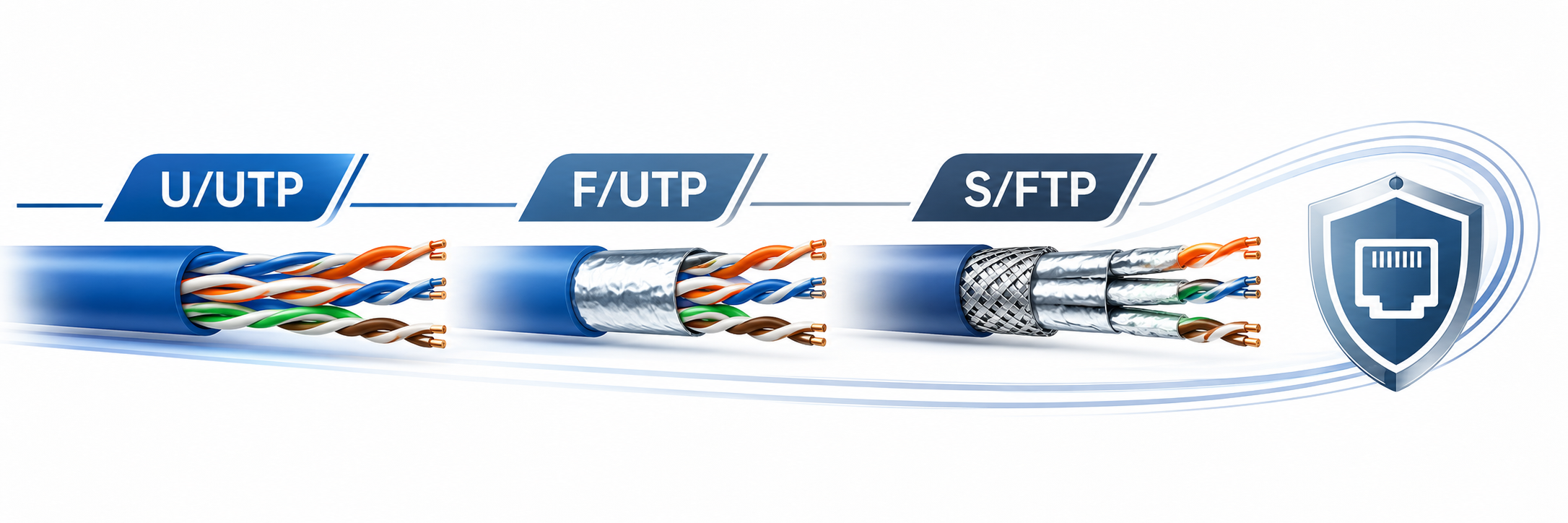
U/UTP is particularly suitable for low-interference environments and offers simple, flexible cabling. F/UTP features a common foil shield around all wire pairs and provides additional protection against external electromagnetic interference. S/FTP combines a braided shield around the entire cable with a separate foil shield for each pair of wires, thus offering particularly comprehensive shielding for demanding network environments.
What do U/UTP, F/UTP and S/FTP mean?
Designation
Overall shielding
Shielding of the wire pairs
Characteristic
Typical application
U/UTP
No shielding
No additional shielding
Unshielded, flexible, simple construction
low-interference office and workplace environments
F/UTP
foil
No additional pair shielding
shared foil shielding
Offices, building cabling, environments with increased EMC requirements
S/FTP
Braid
Each pair of wires separately shielded with foil
Extensive overall and pair-by-pair shielding
Rack, server room, industrial, high density, high-performance networks
The letters used to denote LAN shielding, explained simply
U = Unscreened
F = Foil
S = Screen/Braid
U/UTP or shielded LAN cable – which is better?
U/UTP – for low-interference environments
F/UTP – additional overall shielding
S/FTP – high immunity to interference
What type of LAN shielding do I need?
Application
Suitable selection
Why?
Standard office workstation
U/UTP, F/UTP or S/FTP depending on the existing infrastructure
Generally low electromagnetic interference
Structured building cabling
F/UTP or S/FTP
Additional EMC margin and plannable system cabling
Network cabinet / patch panel
S/FTP
Many data cables and active components in a confined space
Server room / data centre
S/FTP
High port density and demanding transmission conditions
Industrial / machinery environment
S/FTP
Increased electromagnetic interference possible
Cable routes with potential EMC interference
Shielded cabling
Reduction of coupled electromagnetic interference
Cat 7 / professional 10-Gigabit cabling
often S/FTP
High transmission and shielding margins
Cat 8.1 / short high-speed connections
S/FTP
High frequencies and demanding patch/rack applications
S/FTP is not automatically faster than U/UTP
Cat 6A, Cat 7 or Cat 8 primarily describe the transmission characteristics or category. U/UTP, F/UTP or S/FTP, on the other hand, describe the cable’s shielding structure.
Why is S/FTP frequently used with Cat 7 and Cat 8.1?
Shielded network cable: the entire system must be compatible
What is important when laying cables in parallel with power lines?
LAN shielding and PoE – is there a connection?
What type of shielding does MAG use in DINIC network cables?
LAN and Ethernet cables for professional networks
Frequently asked questions about U/UTP, F/UTP and S/FTP
What does U/UTP mean in relation to a network cable?
What does F/UTP mean?
What does S/FTP mean?
Which is better: U/UTP or S/FTP?
Which is better: F/UTP or S/FTP?
Is S/FTP faster than U/UTP?
Do I absolutely need S/FTP for 10 Gigabit?
Does a shielded LAN cable need to be earthed?
What does PiMF mean in relation to a LAN cable?
Is SFTP the same as S/FTP?
What type of LAN shielding is suitable for servers and network cabinets?

B2B shop Retail, Trade & Industry
 German / Deutsch
 English
 French / Français
 Spanish / Español
 Dutch / Nederlands
 Italian / Italiano
 Polish / Polski
 Norwegian / Norsk
 Danish / Dansk
 Finnish / Suomi
 Swedish / Svenska
 Czech / Česky
 Greek / Ελληνικά
 Slovak / Slovenčina
 Slovenian / Slovenščina
 Estonian / Eesti
 Latvian / Latviešu
 Lithuanian / Lietuvių
 Hungarian / Magyar
 Romanian / Română
 Bulgarian / Български
 Portuguese / Português
MAG Network Guide
The short answer:
Example: S/FTP. The ‘S’ before the slash stands for the braided screen around the entire cable. The ‘F’ after the slash indicates that each twisted pair is additionally shielded with foil. This pair-by-pair foil shielding is often referred to as PiMF – Pair in Metal Foil.
Important: The table is intended as a selection guide and does not replace the planning of electrical and data installations. Prescribed clearances, isolation classes, equipotential bonding, cable routing, as well as the requirements of the components used and relevant standards must be complied with regardless of the chosen cable shielding.
Key point:
Simply using a shielded cable is not enough: if the shielding is interrupted at connectors, sockets or patch panels, or is not connected correctly, the intended shielding effect of the entire run may be compromised.