 German / Deutsch
  English
  French / Français
  Spanish / Español
  Dutch / Nederlands
  Italian / Italiano
  Polish / Polski
  Norwegian / Norsk
  Danish / Dansk
  Finnish / Suomi
  Swedish / Svenska
  Czech / Česky
  Greek / Ελληνικά
  Slovak / Slovenčina
  Slovenian / Slovenščina
  Estonian / Eesti
  Latvian / Latviešu
  Lithuanian / Lietuvių
  Hungarian / Magyar
  Romanian / Română
  Bulgarian / Български
  Portuguese / Português
 -
You do not have any products in your shopping cart yet.
Indian power cables – choosing the right Type C, Type D and Type M
Which power cable for India is suitable for your device? When it comes to Indian power sockets, Type C, Type D and Type M are particularly relevant. However, the correct choice does not depend solely on the shape of the mains plug: other crucial factors include the protective earth conductor, power consumption, the socket at the point of use, cable cross-section, the IEC device connection and the design appropriate for the market.
This selection guide is aimed in particular at procurement departments, equipment manufacturers, system integrators, OEMs, industry and international roll-out projects, and explains when a 2-pin Indian version, Type D or Type M, may be appropriate.
230 V / 50 Hz
Mains supply in India
Type C
2-pole Indian version
Type D
3-pin · earthed, 6 A class
Type M
3-pole · 16 A version
BIS
Check the product-specific documentation
Quick answer: Type C, Type D or Type M for India?
Type C (Indian version): for suitable 2-pole, insulated appliances without a protective earth conductor.
Type D: for earthed applications, provided the 6 A rating and the existing socket are suitable for the application.
Type M: for earthed applications where a 16 A mains plug version is required or where a higher current reserve is needed.
Type D: for earthed applications, provided the 6 A rating and the existing socket are suitable for the application.
Type M: for earthed applications where a 16 A mains plug version is required or where a higher current reserve is needed.
Important: The IEC appliance connection alone does not determine the Indian mains plug. An appliance with an IEC C13 plug does not automatically require Type M. The requirements of the entire connection cable and the on-site installation are decisive.
A direct comparison of Indian plug types C, D and M
The following illustration helps with visual differentiation. Type C is 2-pin, whilst Types D and M have a protective earth conductor. Type M is significantly larger than Type D.
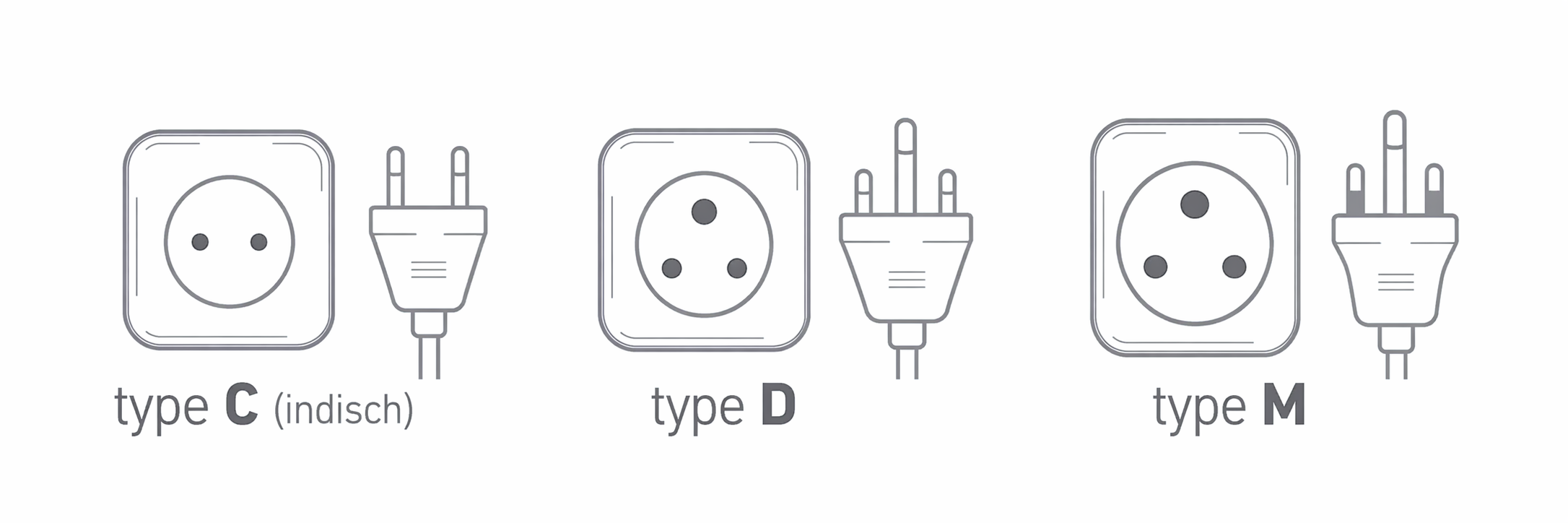
Type C, Type D and Type M – differences at a glance
| Feature | Type C – India | Type D | Type M |
|---|---|---|---|
| Number of poles | 2-pole | 3-pole | 3-pole |
| Protective conductor | no | yes | yes |
| Classification | 2-pole Indian version | 6 A class | 16 A version |
| Typical device group | Insulated 2-pole appliances | Smaller earthed appliances | Earthed devices with higher power requirements / reserve |
| Typical IEC page in the range | e.g. C7 | e.g. C5 | e.g. C13 |
| Important when selecting | Distinguish the Indian version from the European Euro plug | Check the rated current of the entire cable | Ensure that a Type M socket is available |
Note on rated current: The rated current class of the mains plug does not automatically determine the permissible current of the entire connection cable. The plug, appliance coupling, cable, cross-section, approval and appliance requirements must all be considered together.
Which Indian plug is suitable for my application?
2-POLE
Type C – for appliances without a protective earth conductor
A 2-pole Type C version designed for India is particularly suitable for devices with protective insulation that, by design, do not require a protective earth conductor.
- 2-pole without PE
- e.g. in conjunction with IEC C7
- more appropriate than an unnecessary 3-pin mains plug
- Check the India version for each specific item
EARTHED · 6 A CLASS
Type D – for smaller earthed applications
Type D is widely used in India and is suitable for earthed applications provided that the intended load and the entire connection cable are compatible with the specific version.
- 3-pin with earth conductor
- 6 A mains plug class
- e.g. with IEC C5 in the DINIC range
- The appliance side can also limit the total rated current
EARTHED · 16 A VERSION
Type M – for higher loads and greater reserve
Type M is the larger 3-pin version and is used in applications where a 16 A mains plug connection is required. In the DINIC range, Type M is available with IEC C13, amongst others.
- 3-pole with protective conductor
- Mains plug rating up to 16 A
- Often suitable for IEC C13 applications
- Larger than Type D and not compatible with Type D sockets
Type D or Type M – what is the key difference?
Both versions are 3-pin and have a protective earth conductor. However, Type M is larger and designed for a higher current rating. The contact pins and their spacing differ from Type D.
Type D Smaller earthed Indian version. Suitable where the power requirement, the appliance and the existing Type D socket are compatible with the application.
Type M Larger earthed 16 A version. Suitable for higher power requirements or where the installation specifically requires Type M.
Type D and Type M are not interchangeable: Type M is larger in design and does not fit into a Type D socket. It is therefore essential to check which plug system is available at the intended location before use.
Does a device with an IEC C13 plug automatically require a Type M socket?
No. IEC C13 specifies the appliance end of the mains cable; it does not automatically determine the correct mains socket in India. A C13 cable may be designed on the appliance side to fit a C14 socket, whilst the mains-side selection is determined separately based on the installation.
Type M can be particularly useful for C13 applications if a 16 A mains plug version or additional reserve capacity is required. However, for lower current requirements, another technically suitable solution for India may be sufficient.
Key point: The mains plug and the IEC equipment connection are two separate selection decisions. Compare IEC 60320 C7, C5, C13, C15 and C19
Always treat an Indian mains cable as a complete connection
MAINS SIDE
Type C, D or M
compatible with sockets in India
CABLE
Cross-section & length
suitable for the load and application
DEVICE SIDE
e.g. C7, C5, C13
Suitable for the device input
DOCUMENTATION
BIS / IS
Check specific item
CURRENT PUBLISHED STATUS: 23 July 2026
BIS-certified power cables: Manufactured directly in India
MAG has successfully had the first BIS-certified power cables manufactured directly in India. The necessary BIS certifications and test reports are available for selected cable types. Further types are being tested in stages and incorporated into the supply chain.
Important: The certification and documentation status applies to specific products. Therefore, the details and documents for the specific product in question are always decisive.
European Type C and Indian Type C versions – do not treat them as equivalent
A European Type C plug may be mechanically compatible with various sockets available in India. However, this does not automatically mean that a European power cable is the right solution for a professional project in India.
For mass-produced devices, OEMs, exports, roll-outs and permanent installations, a power cable designed specifically for the Indian target market should be selected. In doing so, the mains plug, cable construction, device-side specifications and the required documentation must all be considered together.
Indian power cable or mains adapter?
Fixed Indian power cable
For mass-produced devices, OEMs, roll-outs, repeat orders and permanent installations, a fully specified Indian power cable is generally the clearer solution.
India power adaptor
Adapters can be useful for service calls, commissioning, test set-ups or temporary applications. However, they are no substitute for checking the voltage, current, protective earth and equipment requirements.
DINIC India power cables for B2B, OEM and project business
The DINIC range includes India power cables with various mains and device connectors. Depending on the model, options include Type C to IEC C7, Type D to IEC C5 and Type M to IEC C13, amongst others. Technical specifications, rated current, cross-section and BIS documentation are specified for each item.
View India power cables in the rangeIndia project, OEM or mass production requirements?
For the technical pre-selection of an Indian power cable, the following details are particularly helpful: socket or mains plug type, appliance connection, current consumption, cable length, cable cross-section, quantity and the required market/approval specification.
Frequently asked questions about Indian power cables
Which mains plugs are used in India?
For India, Type C, Type D and Type M are particularly relevant. The type of plug to be used depends on the appliance, the protective earth conductor, the power requirement and the socket available at the point of use.
When is Type C suitable for India?
A Type C version designed for India is particularly suitable for compatible 2-pin, insulated appliances without an earth conductor, for example those with an IEC-C7 appliance connector.
When is Type D suitable for India?
Type D is suitable for earthed applications provided that the 6 A mains plug class, the actual load and the other components of the connection cable are appropriate for the intended application.
When is Type M the better choice?
Type M is a 3-pole 16 A version and is particularly suitable where the installation specifies Type M or a higher current rating is required. It is used, amongst other things, in professional C13 applications.
Does a Type M plug fit into a Type D socket?
No. Type M is larger than Type D and is not mechanically compatible with a Type D socket. The plug system available at the point of use must therefore be checked before making a selection.
Does a device with an IEC C13 plug always require a Type M socket?
No. C13 describes the appliance end of the connection cable. The appropriate Indian mains plug also depends on the power requirement, the socket, the cable construction and the project’s requirements.
Is every MAG mains cable for India automatically BIS-certified?
No. Certification and documentation status are specific to each item. When making a selection, the technical specifications and available documentation for the specific product are therefore always decisive.
What information is helpful when making an enquiry for India?
Ideally, you should provide details of the destination country and location of use, mains plug type, IEC equipment connection, power consumption, cable length, cable cross-section, quantity and the required approval or documentation specifications.
Further information
Mains plugs worldwide Compare country-specific plugs and international plug types A to O. IEC 60320 appliance plugs Identify C7, C5, C13, C15, C17, C19 and their matching counterparts. Power cable cross-sections Compare 0.75 mm², 1.0 mm² and 1.5 mm² in a practical context. BIS certification in India Current status regarding manufacturing, certification and availability.
Note: This page serves as a practical selection guide for power cables for use in India. The technical data, rated values, certificates and documents for the specific product, as well as the requirements of the equipment manufacturer and the intended installation, are binding. A mechanically compatible connector does not automatically mean that the entire connection cable is suitable for the application.