 German / Deutsch
  English
  French / Français
  Spanish / Español
  Dutch / Nederlands
  Italian / Italiano
  Polish / Polski
  Norwegian / Norsk
  Danish / Dansk
  Finnish / Suomi
  Swedish / Svenska
  Czech / Česky
  Greek / Ελληνικά
  Slovak / Slovenčina
  Slovenian / Slovenščina
  Estonian / Eesti
  Latvian / Latviešu
  Lithuanian / Lietuvių
  Hungarian / Magyar
  Romanian / Română
  Bulgarian / Български
  Portuguese / Português
 -
You do not have any products in your shopping cart yet.
Everything you need to know about Swiss power cables with SEV approval
Swiss power connections differ from many EU versions in key details. For businesses, retailers, resellers and projects, it is therefore not just the mechanical fit that matters, but above all the correct specification for Switzerland and Liechtenstein, the appropriate current rating and the correct connection to the appliance.
Practical note: Many terms are used interchangeably in everyday language: ‘Type J’ is often used internationally to describe the Swiss system, but when purchasing, specific details such as Type 12, Type 13, Type 23, current rating, appliance connection and approval are crucial.
At first glance, 2-pin EU plugs and Swiss 2-pin variants appear similar. For simple applications, an EU version may be a practical option. However, as soon as project lists, tenders or customer specifications require ‘Switzerland’, ‘CH’ or ‘SEV’, a suitable CH version should be procured.
Important for B2B: Visual similarity is no substitute for a specification. For resale, mass-produced devices, public institutions or standardised customer requirements, the genuine CH variant is usually the better and lower-risk choice.
The former designation SEV 1011 is still frequently used in the market as a search and reference aid. Today, the Switzerland-specific standardisation system centred on SN 441011 is the authoritative framework. ENEC can be a strong European safety certification, but it does not automatically replace a Swiss/CH specification that is expressly required.
For many commercial devices requiring a protective conductor, a grounded Swiss version is the right choice. Typical applications include IT equipment, monitors, AV equipment, measurement technology, power strips and technical devices, where the target market is Switzerland or Liechtenstein.
Procurement tip: For project or series enquiries, in addition to the Swiss plug type, the appliance plug, cable length, cross-section, sheath material, colour, packaging and required approvals should be clearly specified.
C19 equipment connections are frequently used in high-power IT, server and PDU infrastructure. If an application requires 16 A, the entire connection chain must be compatible: plug, socket, cable, fuse, equipment connection and product marking.
Important: Type 12/13 is the typical 10 A range. For 16 A applications, suitable 16 A versions such as Type 23 and an appropriately designed infrastructure are required. Do not select based on ‘it sort of fits’, but according to the specification.
The most important categories are summarised here to help you select products quickly. For B2B projects, we recommend a clear distinction between the Swiss version, the 2-pin EU variant and, where applicable, bespoke solutions.
For procurement in CH/LI, resale, project requirements and applications with clear Swiss specifications.
For devices without a protective earth conductor and applications without specific Swiss requirements.
For project requirements, bulk orders, custom lengths, packaging, certification or special device plugs.
Note for buyers and resellers: If customers, projects or internal standards require a Swiss version, clear product categorisation helps with stock management, quotation preparation, documentation and avoiding complaints.
Type J is the international designation for the Swiss plug system. In procurement, specific details such as Type 12, Type 13, Type 23, current rating and device connection are particularly important.
No. 2-pin EU and CH variants may look similar and be practically interchangeable, but they are not automatically identical in specification. If CH, Switzerland or SEV is specified, a suitable CH version should be selected.
If the appliance requires a protective earth conductor and is intended for use in Switzerland or Liechtenstein, a grounded CH version is the right choice. The appliance’s input, power rating and specific product labelling remain the decisive factors.
No. For 16 A applications, the entire connection chain must be rated for 16 A. Typical 10 A versions such as Type 12/13 are not suitable for this purpose.
Useful details include the target market, device plug, cable length, current requirement, cross-section, colour, required certification, quantity, and whether the order is for standard stock, resale or a project/series solution.
Conclusion: For Switzerland and Liechtenstein, clear specification is more important than a mere visual match. Those who properly take CH/SEV/SN-441011 requirements into account will reduce queries, incorrect orders and complaints in procurement, project business and resale.
Swiss mains plugs and cables: Type J, Type 12/13, Type 23 and SEV – explained simply
B2B focus: procurement, retail, projects Type J: Swiss system for CH/LI – cleanly separating 10 A and 16 A. Guidance only; not legal advice
Type J / CH
Swiss plug system, relevant for Switzerland and Liechtenstein.
Protective earth
For devices with a protective conductor, the earthed CH version is essential.
10 A ≠ 16 A
Do not confuse Type 12/13 with Type 23.
B2B practice
A clear CH specification reduces queries and incorrect orders.
Quick selection guide for commercial procurement
Type overview: Correctly classifying Swiss plugs and sockets
Type
Number of pins / Application
Typical current
Notes for procurement and project planning
Type 11
2-pole, without earth conductor
10 A
For appliances without a protective earth conductor; check the CH specification if use in Switzerland is expressly required.
Type 12
3-pin plug with earth conductor
10 A
Classic earthed CH plug; often referred to internationally as ‘Type J’.
Type 13
3-pin socket with protective collar
10 A
Socket compatible with Type 12 plugs; very common in the current Swiss system.
Type 23
3-pin 16 A version
16 A
For higher-power single-phase applications; different design to the 10 A variants.
Type 15 / Type 25
Multi-phase versions
10 A / 16 A
For specific multi-phase applications; not to be confused with standard mains cables for IT equipment.
2-pin: EU Type C and Swiss CH version
Understanding SEV, SN 441011 and ENEC correctly
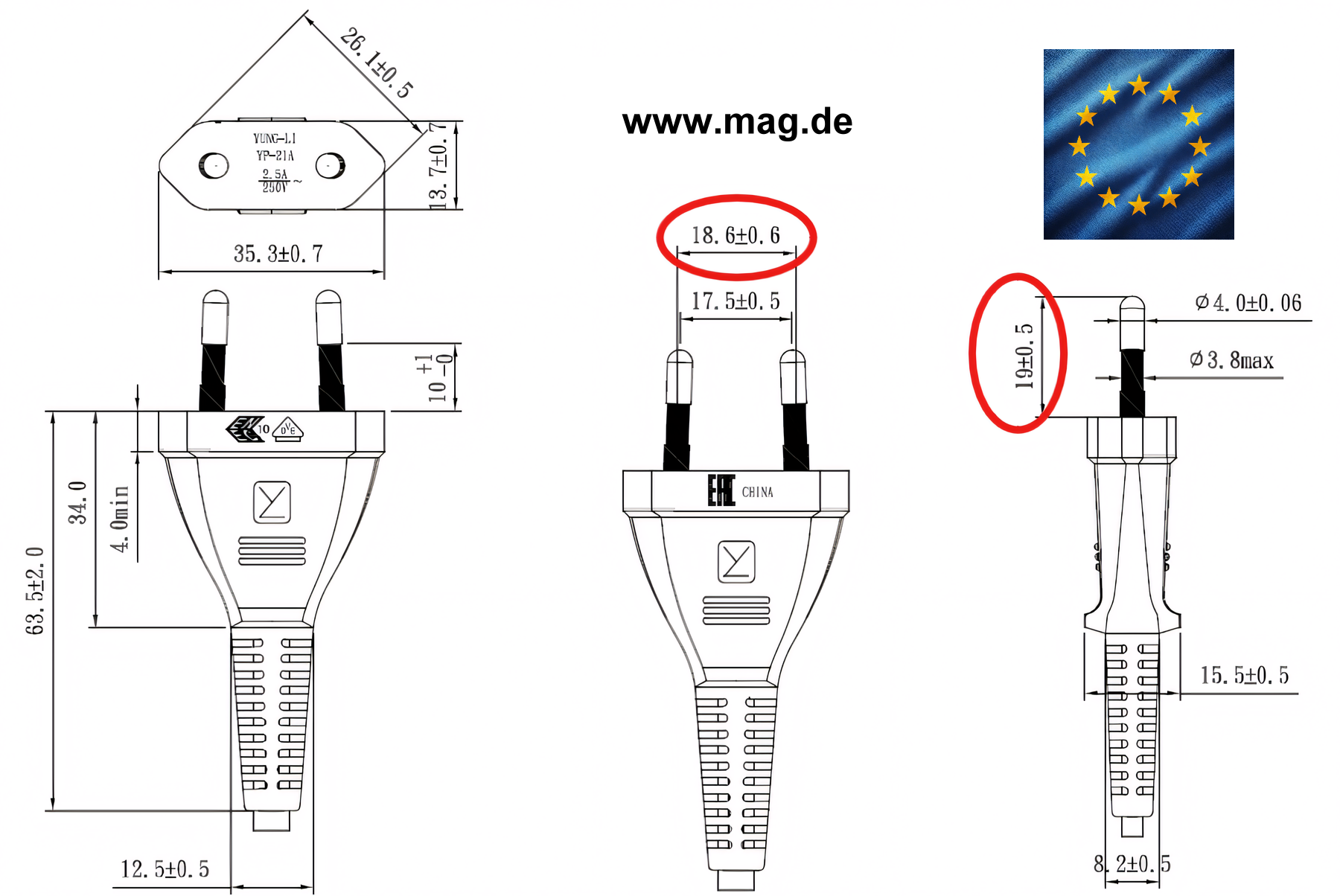
For applications without an explicit CH requirement, depending on the device, country of use and power requirements..png)
For Swiss/Liechtenstein requirements and standardised commercial procurement.
Type J: the earthed Swiss solution for devices requiring a protective conductor
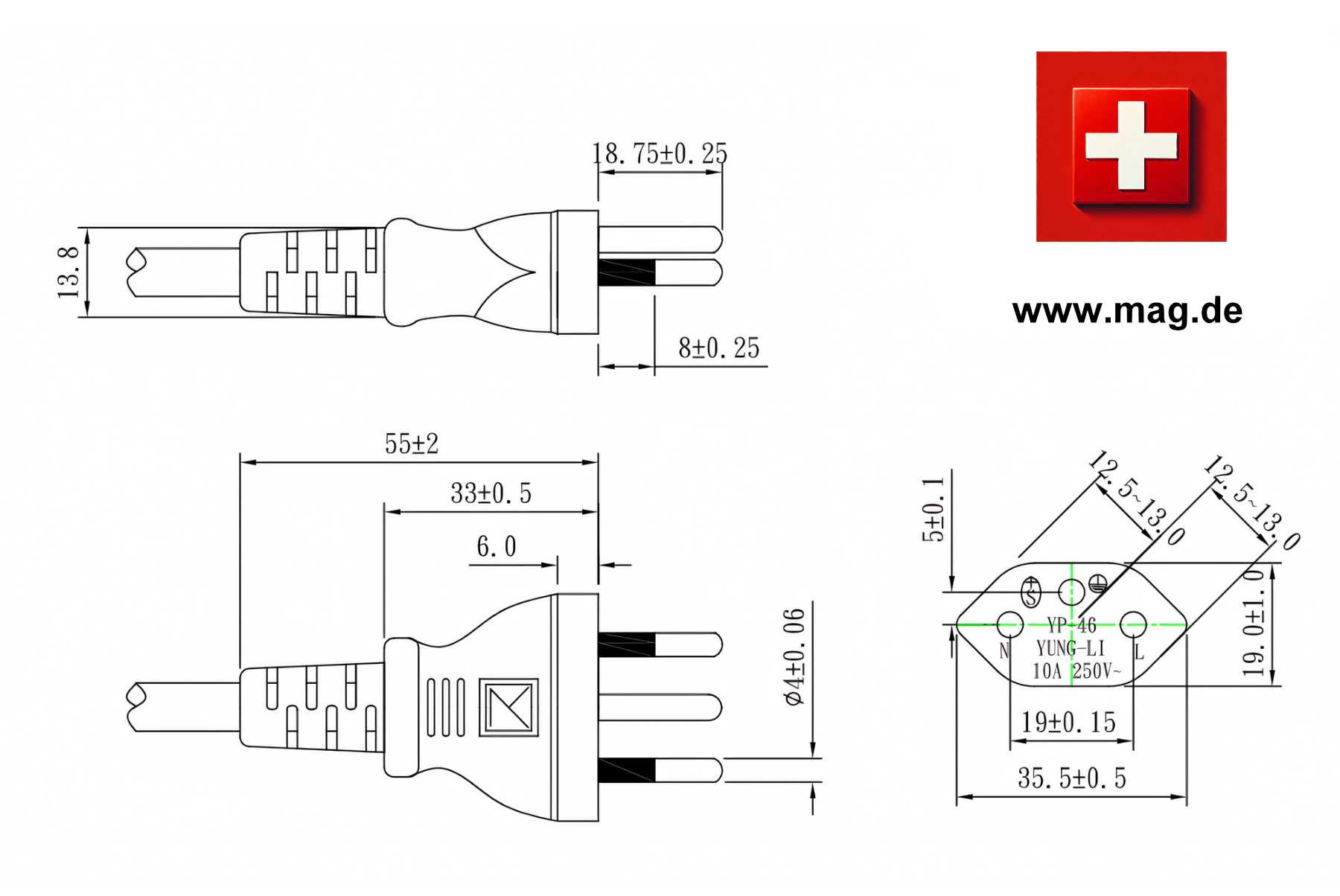
Relevant category: Power cables Switzerland (CH)
C19 and 16 A: do not confuse with 10 A Swiss mains cables
Type 12/13 vs. Type 23: the practical difference
Relevant categories for Swiss power cables and 2-pole variants
Power cables for Switzerland (CH)
2-pin power cables
Selection guide / Enquiry
FAQ: Swiss mains plugs explained briefly
What is Type J?
Is an EU Type C plug automatically a Swiss version?
When do I need Type J with a protective earth conductor?
Can I use a 10 A Swiss mains cable for C19/16 A?
What information helps with a quick product recommendation?