
 German / Deutsch
  English
  French / Français
  Spanish / Español
  Dutch / Nederlands
  Italian / Italiano
  Polish / Polski
  Norwegian / Norsk
  Danish / Dansk
  Finnish / Suomi
  Swedish / Svenska
  Czech / Česky
  Greek / Ελληνικά
  Slovak / Slovenčina
  Slovenian / Slovenščina
  Estonian / Eesti
  Latvian / Latviešu
  Lithuanian / Lietuvių
  Hungarian / Magyar
  Romanian / Română
  Bulgarian / Български
  Portuguese / Português
 LC to LC OM4 cable
DINIC LC/LC OM4 fibre optic cables for professional networks: pre-terminated duplex patch cables with LC connectors at both ends for server rooms, data centres, patch panels, switches, storage systems and structured fibre optic cabling.
The OM4 multimode fibre with 50/125 µm offers high modal bandwidth for high-performance optical connections. The LSZH sheath is halogen-free, low-smoke and flame-retardant, making it particularly suitable for professional building and IT installations.
Select the appropriate length: In this category, you will find LC/LC OM4 patch cables for short rack connections as well as for longer distances – from 1 m to 100 m.
LC/LC OM4 fibre optic patch cable – duplex multimode 50/125 µm
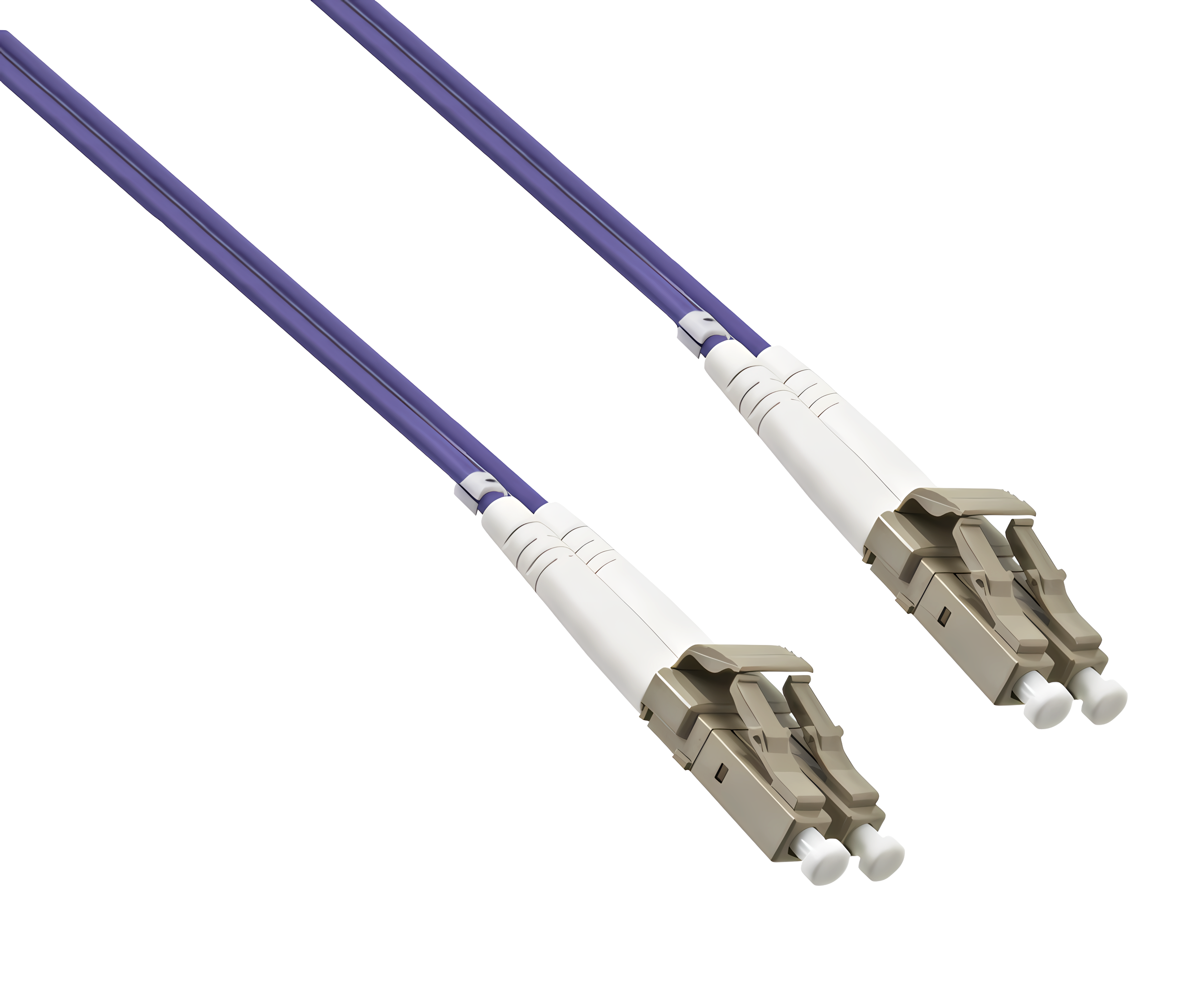

Choosing the right LC/LC OM4 fibre optic cable
An LC/LC OM4 fibre-optic patch cable combines a laser-optimised OM4 multimode fibre with LC connectors at both ends of the cable. In the duplex version, two optical fibres are available for the optical connection.
Before placing an order, four factors should therefore be taken into account: the OM4 fibre type, the LC connectors, the duplex requirement and the optical transceiver being used.
When is LC/LC OM4 the right choice?
Switch and transceiver
When both optical components or transceivers have compatible LC duplex connectors and are designed for OM4 multimode.
Patch panel and distribution frame
For patching between LC patch panels, floor distribution frames, splice boxes and active network equipment.
Data centres and server rooms
For short and medium-length optical patch links between network, server and storage components within an OM4 infrastructure.
What does OM4 50/125 µm mean?
OM4 is a laser-optimised multimode fibre with a fibre core of 50 µm and a cladding diameter of 125 µm. At 850 nm, OM4 has a higher effective modal bandwidth than OM3 and therefore offers additional performance headroom when used with suitable transmission standards.
The effective modal bandwidth for OM4 is typically 4,700 MHz·km, compared with 2,000 MHz·km for OM3.
What speed does LC/LC OM4 support?
The possible data rate is not determined by the cable alone. The specific optical Ethernet standard and the transceiver used are decisive factors.
| Optical applications | Typical OM4 range | LC/LC Duplex? |
|---|---|---|
| 10GBASE-SR | up to approx. 400 m | Yes – the relevant SR SFP+ transceivers typically use duplex LC. |
| 25GBASE-SR | up to approx. 100 m | Yes – with suitable SFP28-SR transceivers featuring duplex LC. |
| 40 Gigabit | Depends on the transceiver | Not automatically. Standard 40GBASE-SR4 typically uses MPO/MTP; specialised BiDi optics may use duplex LC. |
| 100 Gigabit | Depends on the transceiver | Not automatically. There are both multi-fibre MPO/MTP solutions and specialised duplex LC BiDi optics. |
What does LC/LC duplex mean?
LC/LC means that there are LC connectors at both ends of the cable. LC uses a compact 1.25 mm ferrule and enables high connection density in patch panels and active network equipment.
Duplex means that there are two optical fibres. In many traditional Ethernet connections, one fibre is used for transmission and the second for reception.
LC/LC, LC/SC or SC/SC – which variant do I need?
The correct connector combination depends on the connectors at both ends of the link. Having different connectors on either side is not a problem, provided that the fibre type and optical technology are compatible.
What does LSZH mean?
LSZH – Low Smoke Zero Halogen – refers to a halogen-free cable sheath with reduced smoke emission in the event of a fire. The DINIC LC/LC-OM4 versions in this category are halogen-free, flame-retardant and low-smoke.
This is particularly relevant for server rooms, data centres, office buildings, plant rooms and structured building cabling.
Why is the OM4 cable erika violet?
The heather-purple outer sheath makes it easier to visually identify OM4 connections in racks, patch panels and cable routes. The colour aids quick identification – however, the actual OM4 50/125 µm marking always remains the decisive factor for technical selection.
Can I connect OM4 to OM3?
OM3 and OM4 are both 50/125 µm multimode fibres and can, in principle, be connected to one another within a multimode infrastructure.
However, for mixed-mode runs, performance planning must be based on the weakest section of the entire route. For new installations, consistent OM4 cabling is therefore usually more straightforward.
What cable length should I choose?
The length should be chosen so that the actual route, including a reasonable amount of slack, is covered. Excessively long loops, on the other hand, make it difficult to route the cable neatly.
This category offers short patch lengths for racks and patch panels, as well as longer pre-terminated connections of up to 100 m.
Is LC/LC OM4 suitable for FTTH or a fibre-optic router?
Not normally. FTTH and FTTB connections typically use OS2 single-mode fibre and frequently feature APC connectors such as LC/APC or SC/APC.
The OM4 cables in this category, on the other hand, are multimode patch cables for corresponding network and data centre applications.
You can find suitable cables for direct fibre-optic connection under Fibre-optic Router Connection – OS2 LC/APC and SC/APC .
Frequently asked questions about LC/LC OM4 fibre-optic patch cables
What is an LC/LC OM4 cable?
An LC/LC OM4 cable is a multimode fibre-optic cable with OM4 50/125 µm fibres and LC connectors at both ends of the cable.
What does ‘duplex’ mean in relation to a fibre optic cable?
Duplex means that there are two optical fibres. In many optical Ethernet connections, one fibre is used for transmission and a second for reception.
Is OM4 multimode or single-mode?
OM4 is a laser-optimised multimode fibre with a 50/125 µm core. For single-mode connections, for example, OS2 with a 9/125 µm core is used.
What is the range of OM4 at 10 Gigabit?
For 10GBASE-SR, ranges of up to 400 m are typically achievable over OM4. In addition, transceivers, connection points and the available optical attenuation budget must be taken into account.
Is LC/LC OM4 suitable for 25 Gigabit?
With suitable 25GBASE-SR SFP28 transceivers and a duplex LC connector, OM4 can typically be used up to around 100 m. The specification of the transceiver used is crucial.
Can I use LC/LC OM4 for 40 or 100 Gigabit?
That depends on the transceiver. Standard SR4 parallel optics usually use MPO/MTP. Specialised BiDi transceivers, on the other hand, can utilise two OM4 fibres via a duplex LC connector. You should therefore always check the connector type and the specified range for the specific module.
Can I connect OM4 to an OM3 link?
In principle, yes, as both are 50/125 µm multimode fibres. However, when planning the performance of a mixed link, the section with the lower performance should be taken as the basis.
Is this cable suitable for outdoor use?
For outdoor, conduit and building-to-building runs, an outdoor cable design specifically intended for this purpose should be used. MAG offers separate OM4 outdoor fibre-optic cables for this purpose.
Is LC/LC OM4 suitable for an FTTH router?
Generally speaking, no. FTTH typically uses OS2 single-mode fibre and frequently employs APC connectors. Specifically designed fibre-optic router connection cables should be used for this purpose.
Further DINIC fibre-optic solutions
OM4 patch cables with various connector combinations, outdoor fibre-optic cables and accessories for professional fibre-optic installations.