How do you reliably connect two buildings via a network? For office and production buildings, warehouses, workshops, outbuildings or technical facilities, a fibre-optic connection is often an excellent technical solution.
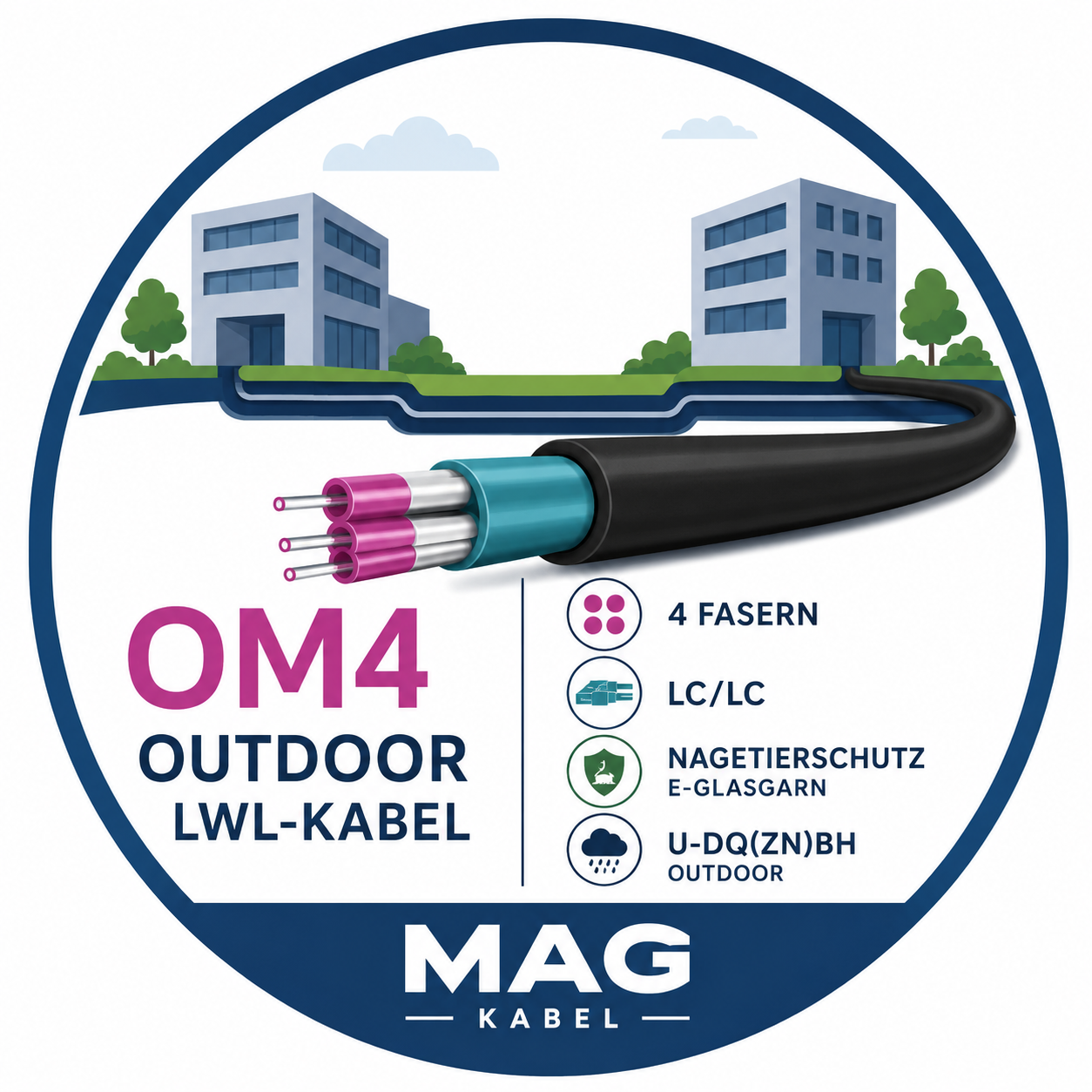
Fibre-optic cables transmit data optically, enable high bandwidths over long distances and do not establish an electrically conductive connection between the buildings via the fibre-optic cables themselves. For professional campus and building connections, MAG offers pre-terminated DINIC outdoor fibre-optic cables with OM4 multimode, four fibres and LC connectors.
Fibre-optic cables transmit data optically. No electrically conductive connection is established via the fibre itself between the active network components.
Fibre-optic cable is well suited to industrial and technical environments because optical transmission is not affected by electromagnetic interference, as is the case with metallic data cables.
OM4 is a high-performance multimode fibre for modern network, backbone and uplink connections when used with suitable optical transceivers.
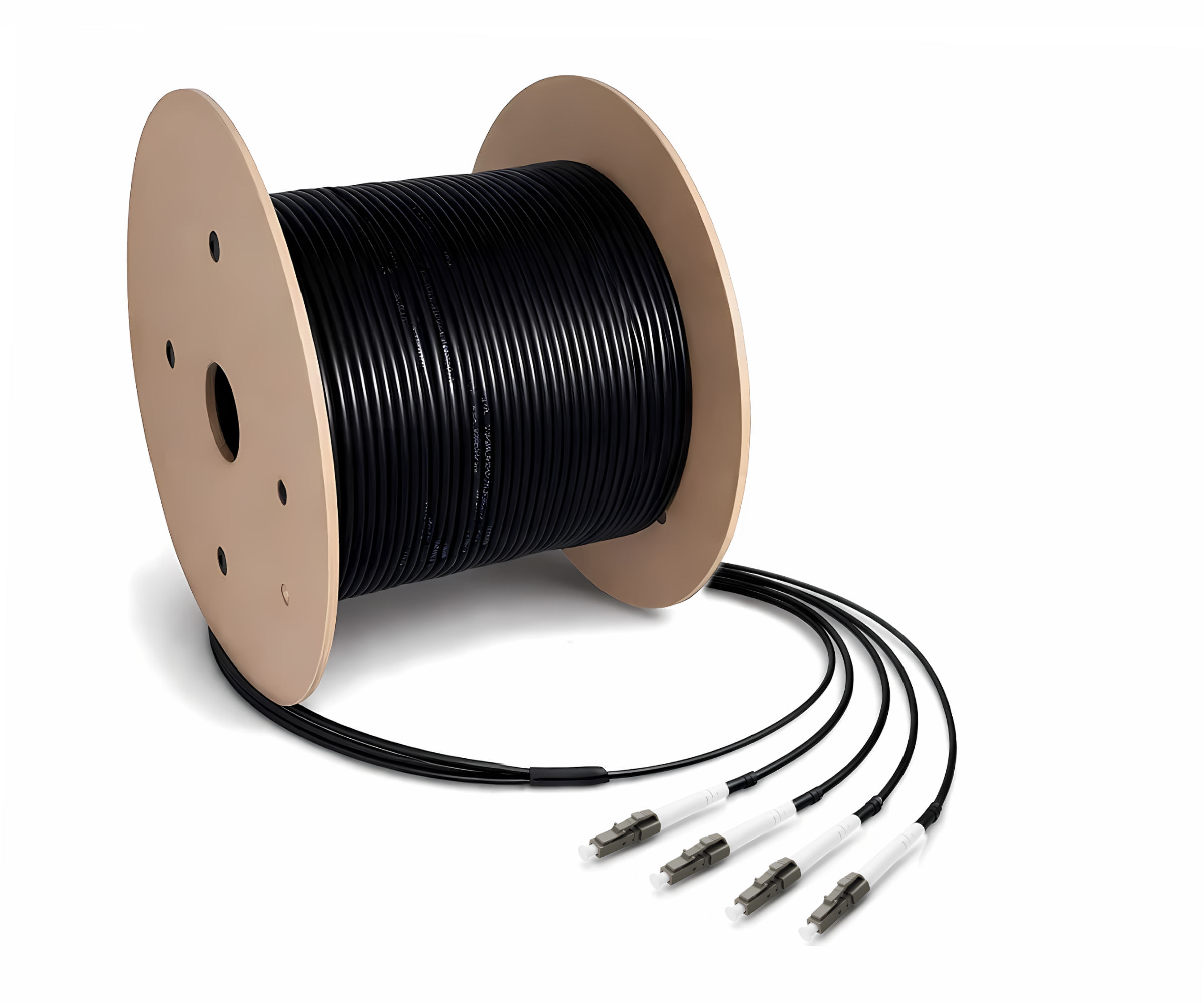
The DINIC outdoor cables in this series contain four OM4 optical fibres. Accordingly, there are four individual LC connectors at the cable end.
Conventional duplex network connections require two fibres – typically one fibre for transmission and one for reception. Four fibres therefore open up various possibilities:
With a pre-terminated fibre-optic cable, the fibre-optic connectors are already fitted at the factory. For many clearly defined building runs, this simplifies installation considerably.
The connectors are already in place. Depending on the installation concept, there may be no need for time-consuming connector assembly on site.
Once the cable has been laid correctly, the individual LC connectors can be routed directly to the designated patch panels or optical components.
Pre-defined cable lengths simplify the preparation of building, campus and industrial projects.
A common planning question is: Should the building connection be established using OM4 multimode or OS2 single-mode? The answer does not depend solely on the distance.
The maximum range is not determined by the OM4 designation alone. The decisive factor is always the combination of fibre, network standard, transceiver, connectors and the optical loss budget.
An important example is 10GBASE-SR: with OM4, distances of up to around 400 m are typically possible.
DINIC OM4 outdoor cables use a U-DQ(ZN)BH construction. This designation describes key design characteristics of the cable.
Outdoors, in ducts, storage areas, industrial plants or technical cable routes, cables may be exposed to an increased risk from rodents. DINIC Outdoor cables therefore feature a layer of E-glass yarn as an additional barrier.
The E-glass yarn construction enhances the cable’s mechanical protection without the need for metallic armouring.
For building-to-building runs, existing or newly laid empty conduits or cable protection conduits are often used. One point is particularly important, especially with pre-terminated cables: the sensitive LC connectors must not be pulled through the conduit unprotected during installation, nor must they be used as a pulling point.
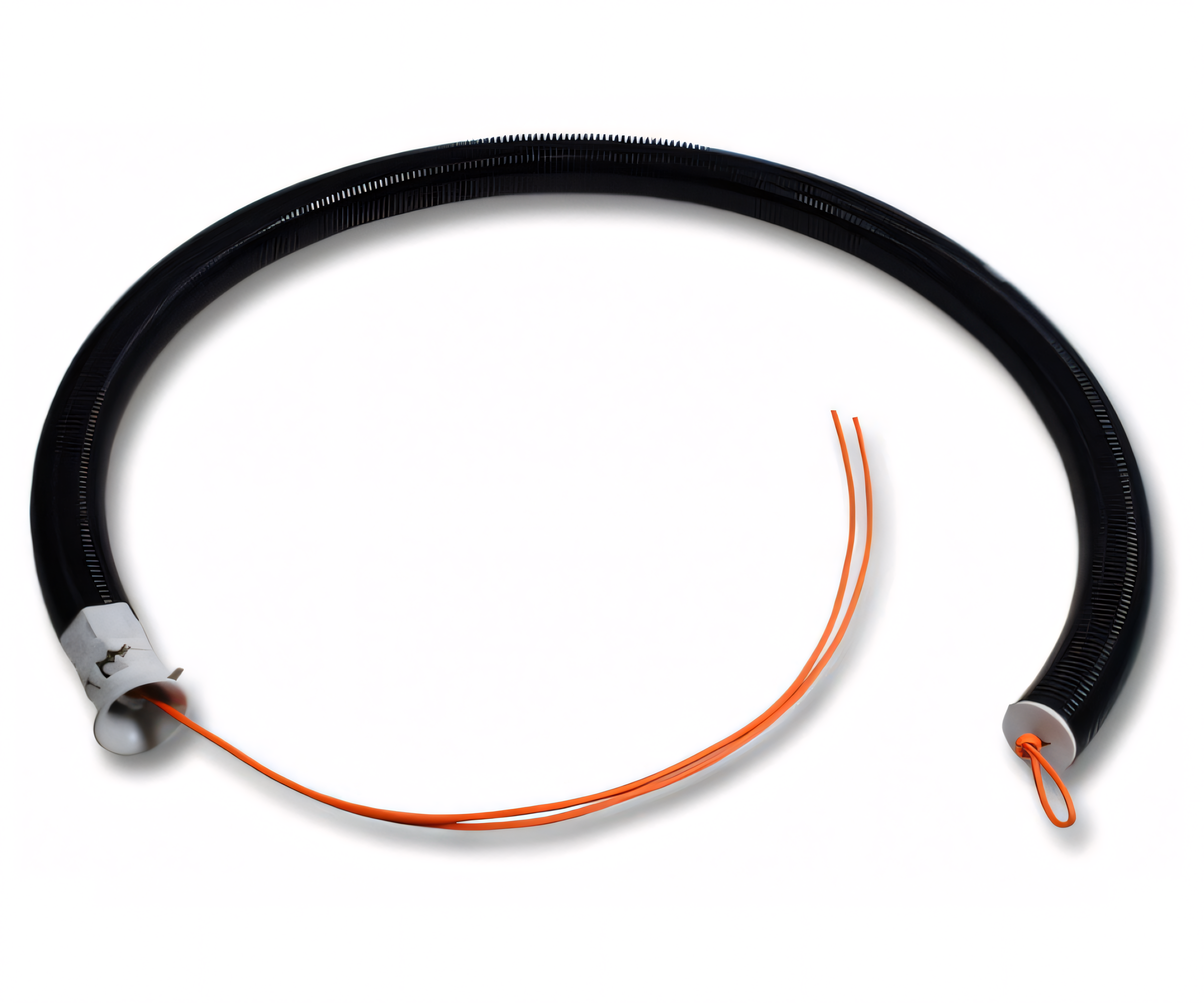
The reusable DINIC pulling aid is specifically designed as a mechanical tool for laying pre-terminated outdoor fibre-optic cables in empty conduits and cable protection conduits.
It is suitable for cable outer diameters of 6 to 15 mm and has an outer diameter of approximately 40 mm.
The pulling aid is particularly useful for:
The required conduit diameter should not be selected based solely on the cable diameter. With pre-terminated cables, particular attention must be paid to the space required for the protected connector area and the pull-through aid being used.
The DINIC pull-in aid has an external diameter of approx. 40 mm. An existing conduit must therefore, including bends, sleeves and transitions, provide sufficient clear cross-section for the actual pull-in process.
Fibre-optic cables must not be kinked, bent too sharply or pulled through with excessive force. The specific technical data for the relevant cable must therefore be taken into account prior to installation.
For the 50-metre version L4-50U-LCLC50A, for example, MAG specifies an outer diameter of approx. 7 mm and a bending radius of approx. 140 mm. :contentReference[oaicite:2]{index=2}
The DINIC OM4 Outdoor series is available in practical lengths for building and campus connections. The selection should always be based on the full cable route.
When measuring, take into account:
‘Outdoor’ does not automatically mean ‘approved for direct burial’. When laying cables directly in the ground, additional factors such as soil conditions, moisture, compressive loads, mechanical protection and project-specific requirements come into play.
For typical building connections via pre-installed cable protection conduits or empty conduits, universal outdoor cables are a practical solution. If a cable is to be laid directly in the ground without a protective conduit, the specific suitability of the intended cable design should be explicitly checked.
The DINIC OM4 outdoor cables in this series are pre-terminated with individual LC connectors. The connectors can, for example, be routed to LC couplers in the patch panel and then connected to the switch or transceiver using short patch cables.
Alternatively, provided that the installation, strain relief and active interface allow for this, the connection can be routed directly to suitable optical components.
Where buildings and switch infrastructure already utilise OM3/OM4 multimode technology.
Where the cable route is known prior to installation and a suitable pre-terminated length can be selected.
Where patch panels, connectors or optical components with LC interfaces are used.
Where, in addition to an active duplex connection, two additional fibres are to remain available for future expansion.
Where a robust, metal-free outdoor installation is required for technical cable routes and building connections.
Where a pre-assembled solution is required to reduce the effort involved in on-site installation and commissioning.
Fibre-optic cables enable high data rates and cover greater distances; they are immune to electromagnetic interference and do not establish an electrically conductive data link between the buildings via the fibre itself.
This depends on the distance, the existing network infrastructure and the transceivers used. OM4 may be a suitable choice for an existing OM3/OM4 multimode infrastructure. For very long distances or long-term single-mode planning, OS2 should be considered.
Four fibres enable, for example, a duplex network connection with two additional reserve fibres, or two separate duplex connections within the same cable.
Not in the sense of separate route redundancy. All four fibres are contained within the same cable. For true route redundancy, separate cable routes should be provided.
4G refers to four gradient fibres. In this DINIC configuration, these are four OM4 multimode fibres.
The pull-through aid facilitates the controlled pulling of pre-terminated outdoor fibre-optic cables into empty conduits and cable protection pipes. It protects and guides the pre-terminated section of the cable, helping to prevent direct tensile stress on the LC connectors.
The pull-in aid is designed for cables with an outer diameter of 6 to 15 mm. Its own outer diameter is approximately 40 mm, which must be taken into account when selecting the size of the conduit.
Yes, suitable conduit and cable protection pipes are typical installation routes. The pipe cross-section, bends, bending radius, tensile load and any potential constrictions must be checked before pulling the cable through.
The pre-assembled connectors should not be used as a point of tension. When pulling the cable through, the cable ends should be protected and tensile forces should be applied in a controlled manner to the appropriate sections of the cable.
With suitable 10GBASE-SR multimode transceivers, OM4 typically supports distances of up to around 400 m. The actual permissible distance also depends on the number of connection points and the optical attenuation budget.
OM3 and OM4 are both 50/125 µm multimode fibres and can, in principle, be spliced together within a multimode link. In a mixed installation, power planning should be based on the weakest section of the link.
The designation ‘outdoor’ alone does not constitute a blanket approval for all direct burial applications. For unprotected burial, the relevant cable and installation requirements must be assessed on a project-by-project basis.
The LC connectors are already fitted. This means that, provided the installation conditions are suitable, the time-consuming and equipment-intensive process of connector assembly or on-site splicing can be reduced or avoided.
Pre-terminated 4-fibre LC/LC cables for professional campus, building and infrastructure connections – complemented by suitable pulling tools and technical selection guides.
Fibre-optic cables between buildings – choosing and laying outdoor fibre-optic cables correctly
Why use fibre-optic cable rather than copper between buildings?
No conductive data link
Resistant to electromagnetic interference
High bandwidth
Typical applications
Four steps to the right building connection
the fibre type
Check whether the existing infrastructure uses OM3/OM4 multimode or OS2 single-mode fibre.
the transceivers
Switches, media converters or other active components must be compatible with the selected fibre and the desired data rate.
the connector type
Pre-terminated LC connectors are available for the DINIC OM4 outdoor cables in this series.
the route
Measure the entire route through technical rooms, shafts, conduit and building entries, not just the as-the-crow-flies distance.
Why four LC connectors?
View OM4 outdoor fibre-optic cables »
Why use pre-terminated outdoor fibre-optic cable?
No on-site LC assembly
Quick commissioning
Predictable installation effort
OM4 or OS2 between two buildings?
Initial situation
OM4 multimode
OS2 single-mode
Existing OM3/OM4 network
often the obvious solution
Assess the feasibility of replacing the optical components
Short to medium distances
Well suited with appropriate multimode transceivers
Also possible if single-mode is planned
Very long distances
Take note of the range limit of the Ethernet standard used
often the more suitable solution
Existing multimode SFPs
Check for OM4-compatible transceivers
Single-mode typically requires different optical modules
Newly planned long-term backbone
Check project requirements
Single-mode may make strategic sense
What is the range of OM4 between buildings?
What does U-DQ(ZN)BH mean?
Abbreviation
Meaning
Practical benefits
U
Universal cable
Cable construction suitable for indoor, outdoor or transitional applications.
D
Bundled core
The optical fibres are protected within a cable sheath.
Q
Longitudinally watertight construction
Provides protection against the longitudinal spread of moisture within the cable.
ZN
Non-metallic strain relief
Mechanical stabilisation without metallic strain relief elements.
B
Non-metallic protective structure
In this DINIC design, E-glass yarn is used as an additional rodent barrier.
H
Halogen-free sheath
Halogen-free cable design for professional infrastructure installations.
Rodent protection with E-glass yarn – when is this useful?
Laying outdoor fibre-optic cables in conduit
What is the fibre-optic pulling aid used for?
View fibre-optic pull-in aid »
How large does the conduit need to be?
Observe the bending radius and tensile load
Observe the minimum bending radius of the relevant cable during installation.
on the connectors
Tensile stress must not be transferred to the pre-assembled LC connectors in an uncontrolled manner.
the cable route beforehand
Check for bends, sleeves, existing cables and narrow sections before pulling the cable through.
temperature limits
Take into account the permissible transport, installation and operating temperatures for the relevant cable.
50, 100, 150 or 200 m – which length do I need?
Can outdoor fibre-optic cable be laid directly in the ground?
LC/LC – how is the cable connected?
When is this OM4 solution particularly suitable?
Existing OM4 network
Predictable route
LC infrastructure
Spare fibres required
Industry and Campus
Installation without splicing
Frequently Asked Questions: Fibre-optic links between buildings
Why should two buildings be connected with fibre-optic cable?
Which fibre-optic cable is suitable for building-to-building connections?
Why does the DINIC outdoor cable have four fibres?
Do four fibres constitute a redundant connection?
What does 4G mean in the context of a fibre-optic cable?
What is the fibre-optic cable pull-in aid used for?
Which cables fit into the DINIC pull-in aid?
Can I pull the cable through a conduit?
Can I pull on the LC connector?
Is the OM4 outdoor cable suitable for 10 Gigabit?
Can I connect OM4 and OM3 together?
Can the outdoor cable be laid directly in the ground?
What is the advantage of a pre-terminated fibre-optic cable?
Connecting buildings with DINIC OM4 outdoor fibre-optic cable

B2B shop Retail, Trade & Industry
 German / Deutsch
  English
  French / Français
  Spanish / Español
  Dutch / Nederlands
  Italian / Italiano
  Polish / Polski
  Norwegian / Norsk
  Danish / Dansk
  Finnish / Suomi
  Swedish / Svenska
  Czech / Česky
  Greek / Ελληνικά
  Slovak / Slovenčina
  Slovenian / Slovenščina
  Estonian / Eesti
  Latvian / Latviešu
  Lithuanian / Lietuvių
  Hungarian / Magyar
  Romanian / Română
  Bulgarian / Български
  Portuguese / Português
The short answer: For an existing OM3/OM4 multimode infrastructure, a pre-terminated OM4 outdoor fibre-optic cable with LC/LC connectors can be a very practical building-to-building solution. The DINIC version features four fibres, a U-DQ(ZN)BH construction and E-glass yarn as an additional rodent barrier. For very long distances, however, or a single-mode infrastructure planned for the long term, OS2 should also be considered.
1 Determine
2 Check
3 Determine
4 Measure
Example: pre-terminated DINIC OM4 outdoor fibre-optic cable with four individual LC connectors at the cable end.
Four fibres do not automatically constitute a redundant connection: if all four fibres are contained within the same outdoor cable and that cable is damaged, all fibres may be affected simultaneously. For true route redundancy, separate cables should be routed along routes that are as different as possible.
OM3, OM4 or OS2 – which fibre do I need? A detailed comparison of multimode and single-mode fibres, transmission distances, data rates and typical applications. LC, SC or ST – which fibre optic connector is suitable? Connector types, simplex and duplex, as well as UPC and APC, explained in simple terms.
Don’t just look at ‘Gbit/s’: for higher data rates, the specific optical standard must always be checked. For example, classic 40GBASE-SR4 typically uses MPO/MTP parallel optics. An existing LC/LC cable is therefore not automatically suitable for every 40 or 100 Gbit/s transceiver.
Important: Rodent protection does not mean ‘rodent-proof under all circumstances’. For particularly vulnerable installation routes, additional cable protection conduits or other mechanical protective measures may be advisable.
Reusable DINIC pull-in aid for pre-terminated outdoor fibre-optic cables with a cable diameter of 6–15 mm.
Practical tip: The entire empty conduit route should be checked before placing an order. It is not only the nominal conduit diameter that is crucial, but also whether tight bends, existing cables, conduit transitions or debris reduce the clear cross-section.
1 No tight bends
2 Do not pull
3 Check
4 Observe
Do not simply measure the distance between the façades. A straight-line distance of, for example, 70 m can quickly result in a significantly longer actual cable route due to the route through buildings, vertical runs and manoeuvring reserve.
LC refers only to the connector type. It does not indicate whether a cable is multimode or single-mode. This outdoor series uses OM4 multimode 50/125 µm. Suitable transceivers must also be designed for the multimode technology used.