




-
You do not have any products in your shopping cart yet.
Power cable – Rest of the world
In this category, MAG GmbH’s B2B customers will find a selection of connection cables for specific countries and special plug systems – suitable for export, rollouts, servicing and spare parts stock.
Depending on the destination country, pre-assembled power cables with suitable country-specific plugs and common appliance plugs such as IEC 60320 C13 are available. To ensure a project-safe selection, the plug type, voltage, frequency, certification and cable design for the target market should be checked.
Due to the plug design, the 3-pin Italian mains cable may also be suitable for use in Chile and Libya in practice.
Please check on a case-by-case basis whether the relevant CEI specification and the operating conditions in the target market are sufficient.
Alternative links: Power cables Italy (IT) | International power cables | International power adapters
In these markets, plug type G, also known as BS 1363, is used. This plug system originates from the UK and is widely used in the low-voltage sector.
A typical feature is the fuse integrated into the plug, which, depending on the model, is e.g. 3A, 5A, 10A or 13A.
Alternative links: Power cables for England (UK) | International power cables | International power adapters
In Syria and Turkey, the CEE 7/7 safety plug (Type E+F) is frequently used in practice.
In the CEE 7/7 system, the Type E and Type F earthing systems have been combined in a single plug, so that earthing can be achieved either via the contact surfaces or the earth pin.
Alternative links: National power cables (CEE 7/7) | International power cables | International power adapters
In the Philippines, plug types A, B and, to some extent, C are most commonly encountered in practice. The typical voltage is 220–230 V / 60 Hz. For B2B projects, however, a purely mechanical fit is not sufficient – standards, market approval and device certification are also crucial.
Further links: Everything about Philippine power cables | Power adapters for the USA / Japan | International power adapters
Please note regarding Taiwan: The cable looks similar to the US plug, but a different certification (BSMI) applies. Furthermore, the conductor cross-section is typically not specified in AWG. To ensure a project-safe selection, the relevant country requirements and device specifications should always be checked.
Alternative links: US power cables | International power cables | International power adapters | Taiwan power cable Type B to C13 (BSMI)
Power cables – Rest of the world for export, projects and international procurement
Advantages and typical applications of international power cables
Your benefits at a glance
Typical applications
Country-specific information and alternative categories
 Chile and Libya
 Ireland, Singapore and Malaysia
 Syria and Turkey
 Note: Philippine power cables
 Note: Taiwan power cables (BSMI approval)

1 to 1 (from a total of 1)
Which plug for which country?
In international projects, the question often arises as to which mains plug must be used in the respective country. In some countries – for example, Austria, Belgium, the Netherlands and, in many cases, France – connections are generally used that correspond to or are compatible with the CEE 7/7 system used in Germany.
In Italy (IT) and Switzerland (CH), the following applies: 2-pin power cables may, depending on the application, be comparable in some cases to the standard designs used in Germany; however, 3-pin variants generally feature different plug systems. Furthermore, many countries worldwide rely on their own standards, for example Denmark (DK), England (UK), the USA, Japan (JPN), China (CHN), Australia (AUS), Israel (ISR), South Africa (RSA) or India (IND).
In many cases comparable to Germany
- CEE 7/7 is common in several European markets.
- Typical examples: Austria, Belgium, the Netherlands.
- In France, too, compatible solutions are relevant depending on the device and application.
Note country-specific features
- Italy and Switzerland differ in particular with regard to 3-pin mains cables.
- Many international markets require their own plug systems and, in some cases, their own approvals.
- The destination country, device plug, standard and cable design are decisive factors in the selection.
Conclusion
Mains plugs and connection standards are not uniform internationally – not even within Europe. For a smooth installation, it is therefore always advisable to select based on the destination country, device plug, approval and cable design.
If no directly suitable standard product is available, mag-kabel.de can assist with selecting suitable alternatives and project-specific custom solutions.
Alternative links: International power cables | National power cables (CEE 7/7) | International power adapters | UK power cables | US power cables | Swiss power cables (CH) | Italian power cables (IT)
Project enquiry / Consultation
For export projects, rollouts or country-specific requirements, the MAG GmbH team will assist you in selecting suitable power cables and alternatives.
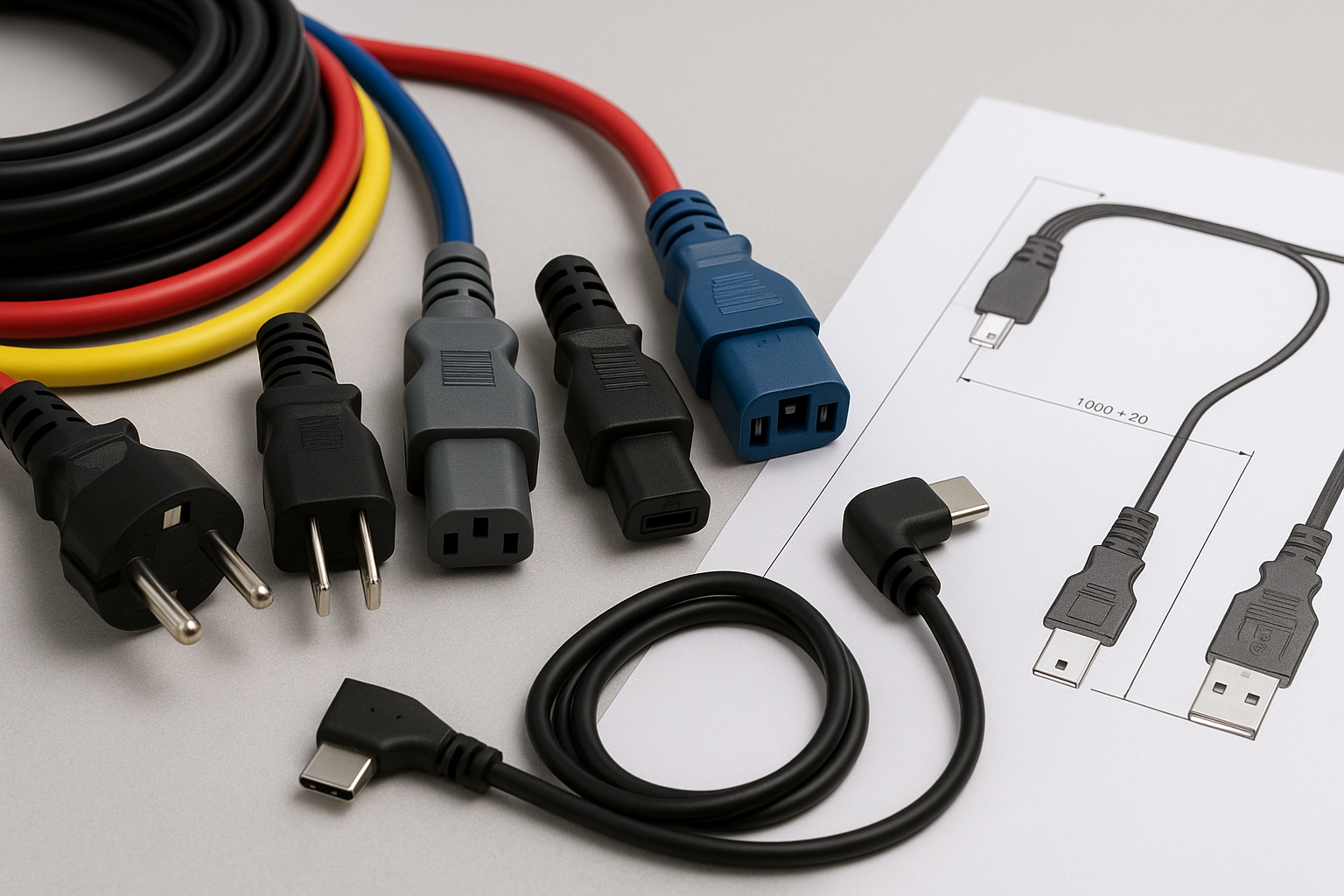
Custom-made products for individual requirements
Do you require a different length, colour or plug configuration? mag-kabel.de also offers suitable solutions for professional use, including customised assemblies and project-specific designs.
More about custom-made products