




















-
You do not have any products in your shopping cart yet.
Fibre optic cable
In the fibre optic cable category, you will find pre-assembled fibre optic solutions for reliable, low-loss data transmission in professional environments - from patch panels and technical cabinets to building and campus cabling. MAG GmbH offers a practice-orientated range for indoor and outdoor applications under the DINIC brand.
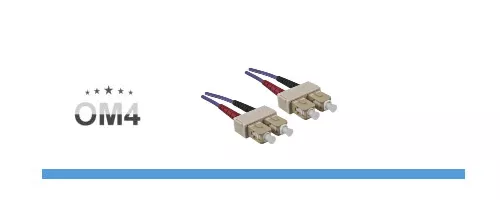
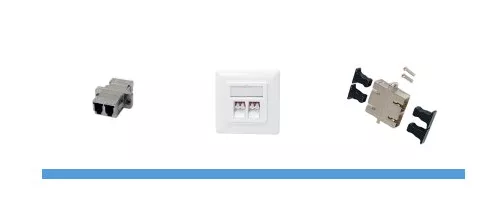
The range includes OM4 multimode patch cables(LC/LC, LC/SC, SC/SC), OS1 singlemode patch cables(LC/LC, SC/SC), router connection cables (e.g. LC/APC to SC/APC) as well as outdoor/breakout fibre optic cables and suitable fibre optic accessories such as adapters/couplers (e.g. LC/APC, SC/APC) for quick conversions and clean patch installations.
Select DINIC FO suitable for fibre (OM4/OS1/OS2), connector type (LC/SC, APC/PC), simplex/duplex, length as well as indoor/outdoor and desired packaging (e.g. polybag/box).
Advantages and typical applications of DINIC fibre optic cables
Your advantages at a glance
Typical fibre optic applications
.webp "LC to LC OM4 Cable")


.webp "LWL remaining stock")
Things to know about fibre optic fibres and polishing (OM/OS, PC/UPC/APC)
Brief overview of multimode and singlemode fibres as well as the common mating faces - as an orientation for planning and selection in the network and installation environment.
1) Fibre types: OM1-OM4 (multimode) & OS1 (singlemode)
In multimode fibre optic cables, the classes differ primarily in terms of core diameter and power reserves. Ranges depend on data rate, active hardware and attenuation budget.
Typical ranges (guide values)
OM1 (62.5/125 µm)
- 1 Gbit/s: up to approx. 275 m
- 10 Gbit/s: up to approx. 33 m
OM2 (50/125 µm)
- 1 Gbit/s: up to approx. 550 m
- 10 Gbit/s: up to approx. 84 m
OM3 (50/125 µm)
- 1 Gbit/s: up to approx. 1000 m
- 10 Gbit/s: up to approx. 300 m
OM4 (50/125 µm)
- 10 Gbit/s: up to approx. 500 m
- 40 Gbit/s: up to approx. 125 m
Recommendation for practice
OM2 or OM3 are generally used in the IT sector. OM4 is downwards compatible with OM2/OM3 and offers additional reserves - OM4 is therefore often favoured as a future-proof choice.
Singlemode
OS1 (9/125 µm) is used exclusively in singlemode operation. Depending on the system and attenuation budget, ranges of up to approx. 40 km are possible.
2) Mating faces & polish: PC, SPC, UPC, APC
Different polishing variants are common for the coupling of two fibre optic cables. The standard (unless otherwise specified) for our cables is PC (Physical Contact).
Singlemode: typical return loss
PC (Physical Contact)approx. 35 dB
SPC (Super Physical Contact)approx. 40 dB
UPC (Ultra Physical Contact)approx. 50-55 dB
APC (Angled Physical Contact)approx. 60-65 dB
APC briefly explained
With APC, the front surface is additionally bevelled by approx. 8-9°. This reduces reflections particularly effectively and ensures the best return loss.
Multimode
PC is usually standard in the multimode environment. "UPC" is occasionally used inaccurately here - it often only refers to a slightly improved PC version. Return loss values significantly above 35 dB are difficult to achieve in practice with multimode, which is why this value is often not specified.
Note: All range specifications are approximate values and may vary depending on the transceiver, connectors, patch panel, installation path and attenuation budget.