




















-
You do not have any products in your shopping cart yet.
Everything you need to know about Swiss power cables with SEV approval
Swiss power cables for commercial procurement: This overview shows when a Swiss-compliant design is required in companies, retail, system house projects, institutions or for resale. In the B2B environment in particular, it is not only the mechanical fit that counts, but above all specifications, predictability, customer requirements and standards such as SEV.
If Swiss specifications are expressly required in tenders, internal standards or customer requirements, the appropriate CH variant should be used to avoid queries, complaints and deviations in procurement.
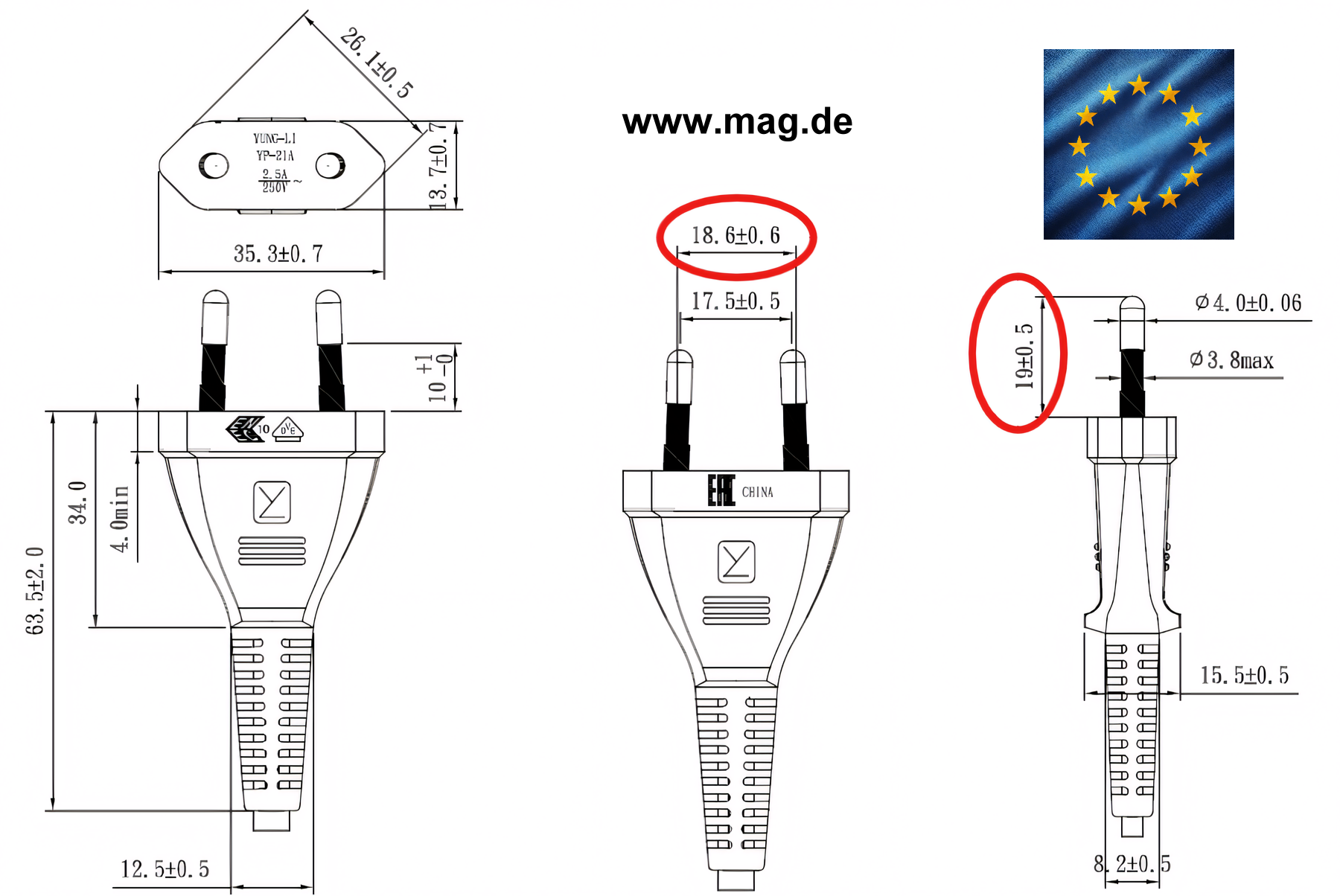
The 2-pin Type C plug, which is widely used in many European countries, is also often considered the standard in commercial environments. These plugs are almost identical to the 2-pin plugs used in Switzerland, but differ in small details that are relevant to specifications.
Important note: EU Type C vs. CH 2-pin
EU Type C plugs and Swiss 2-pin plugs are almost identical, but differ in small details that are relevant to specifications. One key feature is the slight difference in the dimensions of the pins, which is less than 1 mm – this is small, but can be enough to prevent compliance with Swiss-specific requirements. For simple applications, an EU cable may work in practice, but in a B2B environment, the required specification (e.g. "CH/SEV") is what counts.
Tip: If "Switzerland", "CH" or "SEV" is required in tenders, project lists or customer specifications, the appropriate CH version should be procured.
For certain applications, cables from other countries (some with ENEC marking) may be technically usable. The ENEC marking confirms compliance with European safety standards – but does not automatically replace a Switzerland-specific requirement. If specifications, tenders or customer requirements expressly stipulate "Switzerland/SEV", the appropriate CH version should be used.
For commercial and industrial applications, it often makes sense to keep Switzerland-specific versions separate and procure them specifically. This avoids deviations from customer specifications, unnecessary queries in sales and complaints in project business.
A clear separation between EU and CH versions increases security and predictability in purchasing, warehousing and resale, and supports consistent quality in application.
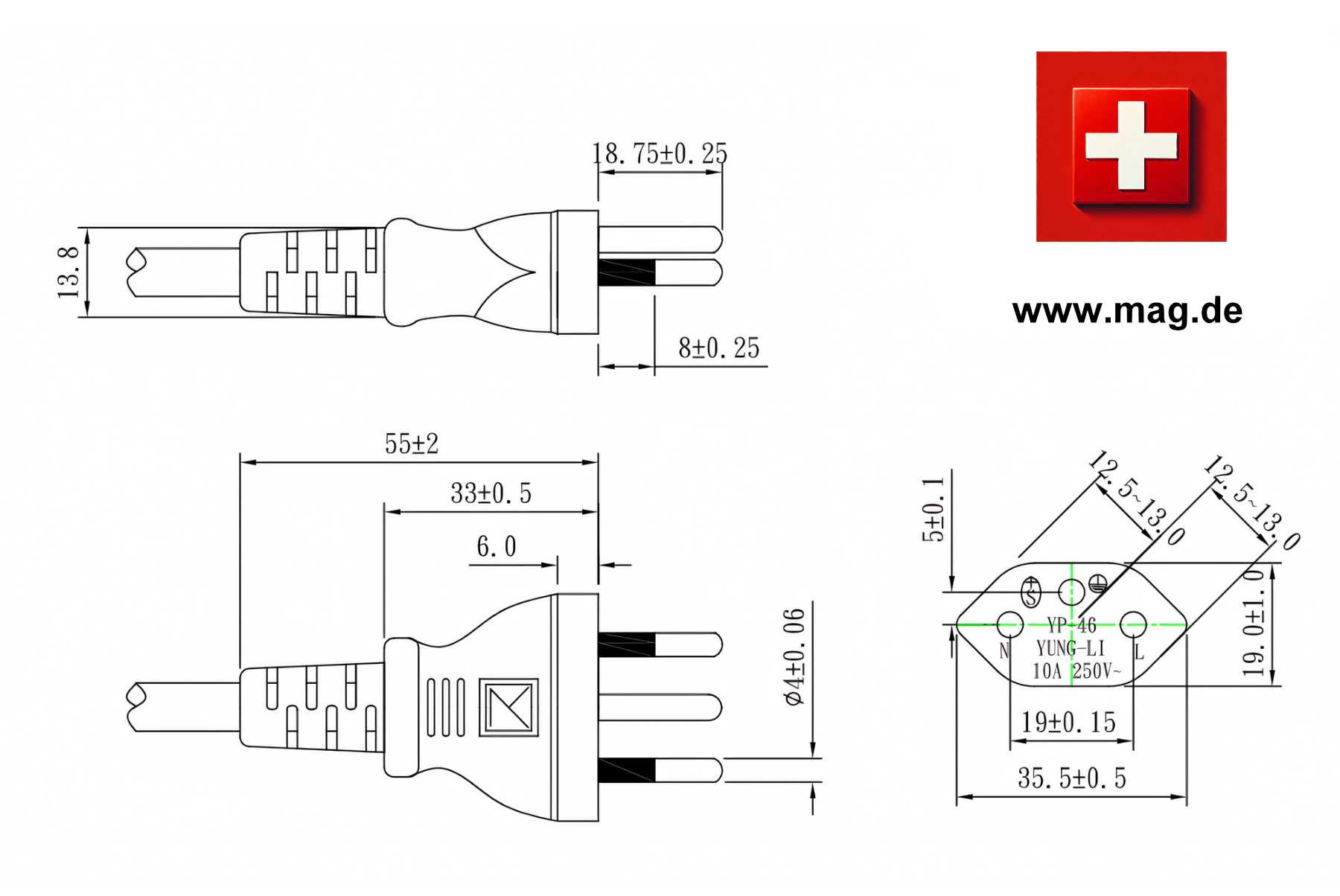
The 3-pin plugs, often referred to as type J, are the earthed version and offer additional safety for devices that require a protective earth conductor. They have three contacts: two for power and one for earthing. Typical applications in commercial environments include computers, monitors, power strips, AV technology and other devices that require a protective earth conductor.
Depending on the application and requirements, a suitable Swiss reference or a corresponding test mark may be required for the Swiss market. When in doubt, the Switzerland-specific product variant is the right choice when it comes to procurement for companies, institutions, trade or resale.
Our Swiss power cables are equipped with type 12 and type 13 plugs and are designed for a maximum current of 10 amps. They are suitable for typical applications in offices, technical and general commercial environments – depending on the device, power and device connection.
C19 plugs are designed for higher-power devices that require up to 16 amps. In Switzerland, these applications typically require type 23 sockets, which are designed for higher amperage and are more commonly found in data centres, technical rooms or industrial environments.
Note on the product range: We do not currently stock Swiss power cables with C19 and Type 23 plugs in our standard range. As an alternative, you will find the category for Swiss power cables here: Power cables Switzerland (CH).
A plug for a type 23 socket differs visually and structurally from type 12 and type 13 due to its design for 16 A. This design ensures that a type 23 plug does not fit into a standard 10 A socket (e.g. type 13).
While Type 12 and Type 13 are used in standard applications, Type 23 is designed for higher currents and is more commonly found in professional technical and industrial environments.
For a safe and clear selection, here are the most important categories for Swiss power cables and suitable 2-pin variants for applications without specific CH specifications.
The right category for CH/LI-compliant procurement, standardised project requirements and applications with clear Swiss specifications.
Suitable for applications without explicit CH specifications – depending on the device concept, area of application and power requirements.
Contents
Quick selection guide for commercial customers
Area of application
Recommended design
Note for procurement
Companies, trade, resale
CH design
Particularly useful for clear customer specifications, tenders or standardised goods procurement.
Devices without protective earth conductor
2-pole version
Ensure that the specifications and country of use are suitable.
Devices with protective earth conductor
Type J
Earthed version for typical commercial device applications.
More powerful 16A applications
Type 23 / suitable 16A infrastructure
Not to be confused with standard 10A versions.
2-pin type C plugs in Switzerland and Europe
SEV and ENEC approvals
.png)
Why separate 2-pole cables make sense for trade and industry
3-pin plugs
SEV approval
3-pin with C19 device plug (16A)
Important: Installations with type 12 or type 13 are usually designed for 10 A. A 16 A application (e.g. C19) requires a designated 16 A socket (type 23) and a suitably dimensioned supply cable.
Visual difference between plugs for type 12, type 13 and type 23 sockets
Suitable product categories
Suitable categories for commercial procurement
Power cables Switzerland (CH)
2-pole power cables
Note for buyers and resellers: If your customers, projects or internal standards require a Swiss version, the clear distinction between EU and CH variants is an important factor in reducing complaints, ensuring clear specifications and reliable procurement.